Get Full Government Meeting Transcripts, Videos, & Alerts Forever!
Get email alerts on the Prison Facility Study topic
No spam. Unsubscribe anytime.
Committee orders study on Marana prison site as option for transitional reentry
Summary
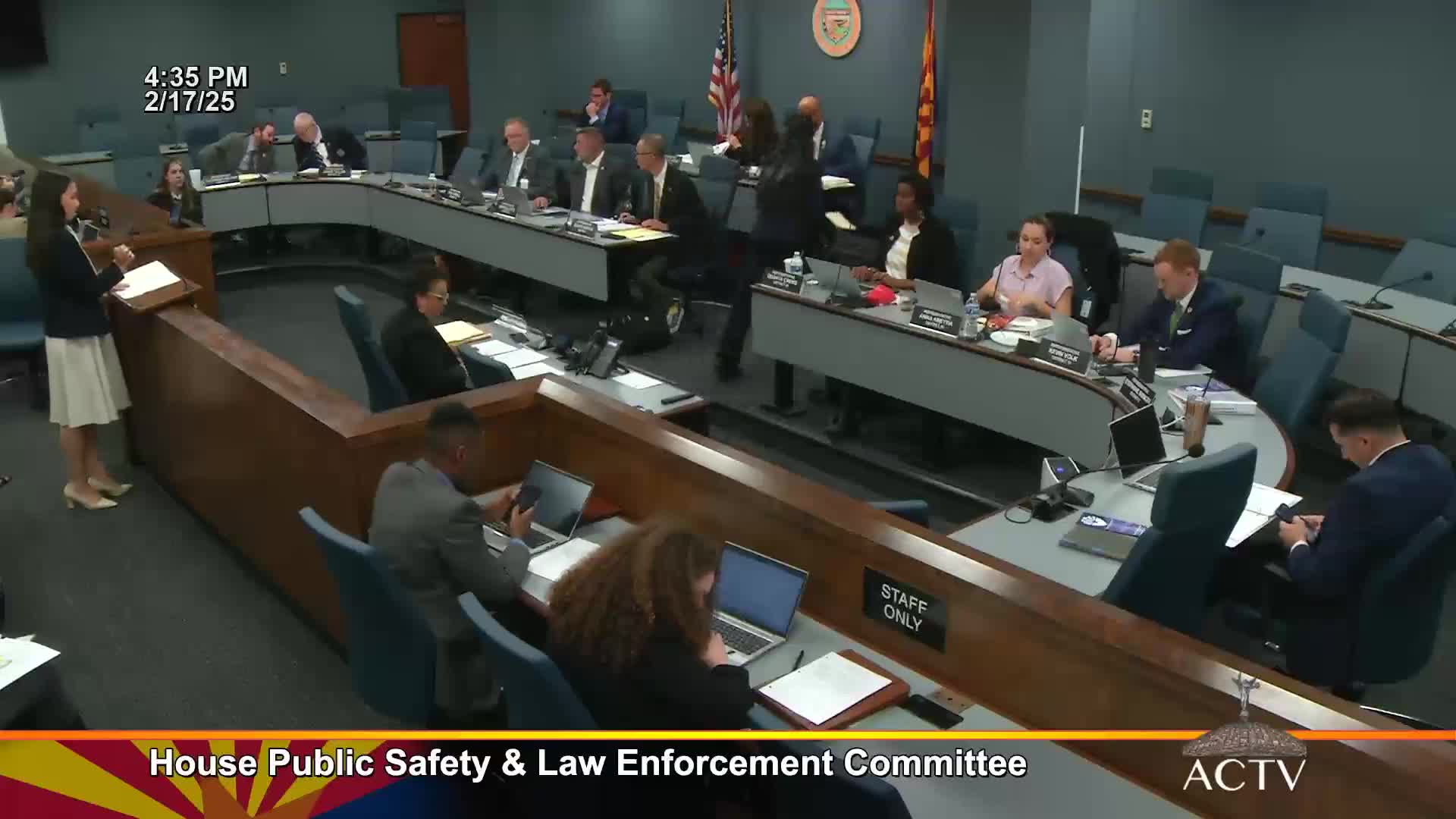
House Committee approved HB 2430 requiring the Department of Corrections to study converting the Marana prison site into a transitional reentry facility and report back by June 1, 2026.
The House Public Safety Committee voted to send House Bill 2430 forward with a due‑pass recommendation after hearing sponsor Representative David Livingston describe it as a request for a departmental study, not a directive to adopt a particular use.
Under the bill, the Arizona Department of Corrections would analyze whether the Marana prison site could be converted into a transitional facility for inmates in the final 60 days before scheduled release and what resources would be required. The department would submit findings to the governor and legislature by June 1, 2026.
Sponsor Representative David Livingston told the committee the property is a state asset currently unused and that a department study could identify options that save taxpayer money — including selling the site, repurposing it for reentry services, or consolidating beds. “The director has full say,” Livingston said; “the goal is not to make more beds but to find options that save the state money.”
Witnesses supporting the bill included Brian Kane (CEO, Social Purpose Corrections), who said a nonprofit corrections model showed potential cost savings and reduced recidivism in similar scenarios, and several county and municipal officials who said a study would clarify whether Marana could be used for transitional programming, rehabilitation, or eventual sale.
Committee members asked whether the study would incur additional cost. Livingston said no outside consultants were required and that the department could perform work with existing staff, though later members noted the department would incur internal staff time and marginal cost. Representative Gillette and others emphasized the practical need to decide whether to put the unused building to work or dispose of it.
The committee returned HB 2430 with a due‑pass recommendation; the chair announced the committee vote as 11 ayes, 2 nays and 2 absent.
What’s next: The Department of Corrections, if the bill becomes law, must report options by June 1, 2026. The committee and multiple members indicated they expect follow‑up on funding, program design and whether beds elsewhere would be closed if Marana is repurposed.