Get Full Government Meeting Transcripts, Videos, & Alerts Forever!
Get email alerts on the Witness Confidentiality topic
No spam. Unsubscribe anytime.
Committee advances bill shielding anonymous tips from routine disclosure after constitutional debate
Summary
The Arizona House Public Safety Committee advanced House Bill 2388 on a party‑line split after adopting a strike‑everything amendment, with supporters saying the measure preserves anonymous tipster protections and opponents saying it risks violating constitutional disclosure obligations.
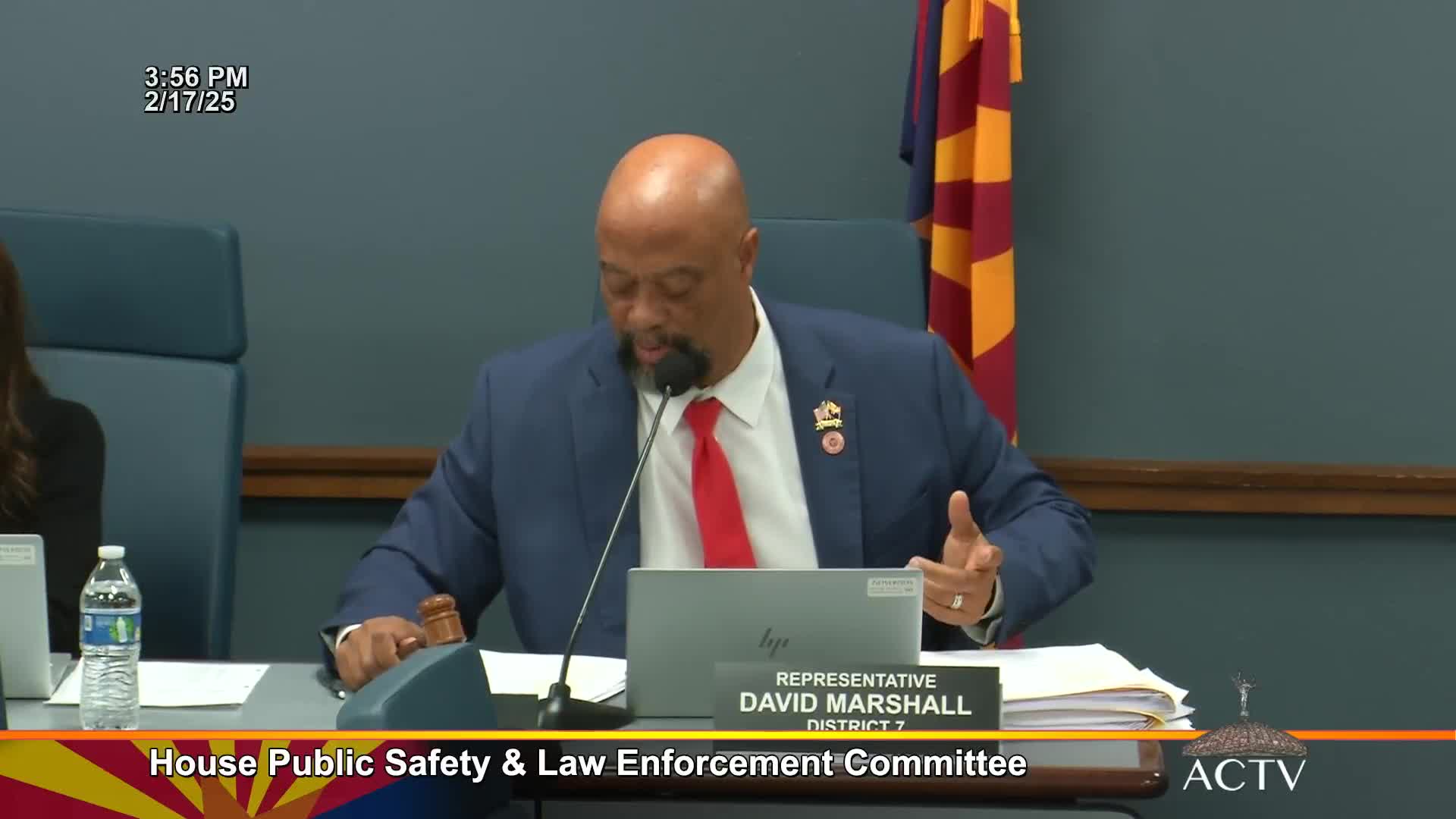
The Arizona House Committee on Public Safety and Law Enforcement voted to advance House Bill 2388 after adopting the Marshalls “strike‑everything” amendment, sending the measure to the full House with a due‑pass recommendation.
Supporters including counsel Cole Libera of Rose Law Group, and volunteers from Silent Witness, told the committee HB 2388 adds a layer of protection allowing anonymous tip lines to remain confidential unless a court finds good cause to disclose. “This is a passion project of mine,” Cole Libera said, describing Silent Witness as “a community policing organization” that routes anonymous tips to law enforcement and sometimes pays rewards. George Quinniff, a past president of Silent Witness, said the program’s anonymous tips have led to thousands of arrests and that tipsters often want to remain unidentified: “Most of our tipsters want to remain anonymous,” he said.
Former Representative Jennifer Longden, speaking as a private citizen and on behalf of families who seek closure in unsolved violent crimes, urged support, saying anonymous tips have helped bring “closure and peace to innumerable families.”
Opponents, led by Marilyn Rodriguez of Creosote Partners appearing for the Arizona Attorneys for Criminal Justice (AACJ), argued the strike‑everything language creates constitutional problems. Rodriguez told the committee the bill “violates the Arizona Constitution” and conflicts with the state’s and federal prosecutors’ Brady obligations to disclose evidence material to guilt or punishment, and that the bill improperly shifts the burden to defendants to show “good cause.” She cited Crane v. Kentucky and other U.S. Supreme Court precedents in arguing the measure could deny defendants a meaningful opportunity to present a complete defense.
During questions, committee members pressed both sides on how the proposed confidentiality standard would operate in practice — whether prosecutors would still be able to meet discovery obligations, and how defense counsel would learn of material that might be exculpatory. Supporters said language was modeled on statutes in other states and had been reviewed with the Arizona court system; opponents said the language upends settled disclosure rules and might encourage constitutional violations unless courts craft protective orders on a case‑by‑case basis.
After debate, the committee adopted the Marshalls strike‑everything amendment dated 01/30/2025 and voted to return HB 2388 with a due‑pass recommendation. The committee’s announced tally for the action was 11 ayes, 2 nays and 2 recorded as present at the vote.
The bill’s proponents said the measure aims to protect people who provide anonymous tips through programs such as Silent Witness, Crime Stoppers and related hotlines; opponents urged more work on amendments to preserve constitutional disclosure duties to criminal defendants.
What’s next: the bill will be scheduled for floor consideration in the House; sponsors and opponents indicated willingness to negotiate additional amendments to address the constitutional concerns raised by AACJ.