Get Full Government Meeting Transcripts, Videos, & Alerts Forever!
Get email alerts on the Vocabulary Education topic
No spam. Unsubscribe anytime.
MSD of Steuben County webinar emphasizes vocabulary strategies for early readers
Summary
Jonathan Winslow and EL teacher Josie Gilbert led the fifth 'Raising Strong Readers' webinar, outlining vocabulary tiers, classroom practices and home strategies to boost comprehension for elementary and multilingual learners.
Jonathan Winslow, director of elementary education for MSD of Steuben County Schools, and Josie Gilbert, English-language (EL) teacher at Carlin Park Elementary, led the district's fifth Raising Strong Readers webinar focused on building student vocabulary and supporting comprehension.
Vocabulary is central to reading comprehension, Winslow told attendees, defining vocabulary as “all of the words a person knows and understands.” He and Gilbert emphasized that vocabulary includes both expressive words (what a student can say or write) and receptive words (what a student can understand when listening or reading), and that receptive vocabulary often outpaces expressive use.
The presenters described a three-tier framework for vocabulary instruction. Tier 1 includes everyday spoken words (for example: sad, eat, baby); Tier 2 includes high-frequency academic words that appear frequently in text (for example: elderly, foundation); and Tier 3 includes highly specialized, content-specific words (for example: molecule, aorta). Winslow said teachers prioritize Tier 2 words for instruction because students encounter them across subjects and texts.
Why it matters: research cited in the presentation found that children whose parents read to them regularly hear substantially more words by age 5; one study cited estimated nearly 1,500,000 more words by age 5 for children read to five times a week. Winslow said typical learners should gain roughly 2,000 to 5,000 new words per year — about six to eight new words daily — and that many English learners or students behind grade level will need additional exposure to catch up. He also noted that mastery can require many encounters with a word: “sometimes it can take students up to 40 times interacting with a word before they're able to fully understand its meaning.”
Instructional strategies presented - Build word consciousness: create curiosity and engagement around words so students pause on unfamiliar words rather than skipping them. Winslow said this helps with comprehension because students will think about meaning rather than only decoding. - Morphemic analysis (morphology): teach prefixes, suffixes and roots so students can break words into parts of meaning. Winslow described this as a routine used in the district’s upper-elementary grades. - Contextual analysis: teach students to use surrounding text and context clues to infer word meaning.
Classroom and district practice Winslow described district practices across K–5 classrooms: teachers select Tier 2 vocabulary tied to thematic units and provide repeated practice, sometimes requiring dozens of encounters for durable learning. He said grades 3–5 and some grade 2 classrooms include a focused morphology/Advanced Word Study unit to teach word parts and Greek/Latin roots.
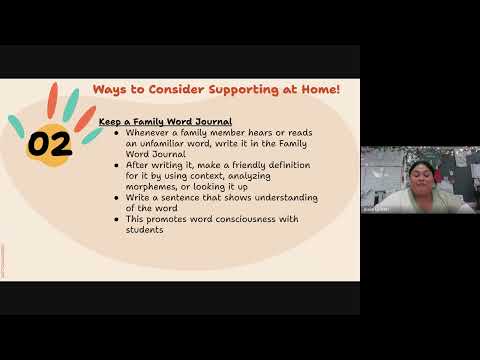
Home strategies from the webinar Josie Gilbert, EL teacher at Carlin Park Elementary, recommended short, regular conversations and read-alouds. “Just a few minutes a day can make such a big difference with your students,” Gilbert said, advising parents to turn everyday activities into language opportunities (grocery shopping, cooking, neighborhood walks) and to use simple games such as charades, Pictionary and “I spy.” She suggested keeping a family journal to record new words and model turning spoken words into writing.
Resources mentioned The presenters pointed families to district- and public-facing resources: Core5 by Lexia (available at Carlin Park, Henry Park and Ryan Park), the Florida Center for Reading Research activity library, and live animal cams on the San Diego Zoo website as prompts for vocabulary-rich conversation.
Logistics and next session Winslow said the webinar was the fifth in an eight-part series. The district will hold the next Raising Strong Readers session on March 18 from 5:30 to 6:15 p.m., focusing on reasoning and mental models related to comprehension. Attendees were invited to follow up by email for slides and links shared during the session.
Ending Speakers closed with a reminder that regular conversation and read-alouds are foundational to vocabulary growth and invited attendees to contact district staff with questions or to access the slide decks and resources shared during the webinar.