Get Full Government Meeting Transcripts, Videos, & Alerts Forever!
Get email alerts on the Immigration Enforcement And Funding topic
No spam. Unsubscribe anytime.
Committee reports resolution to restrict earmarks to jurisdictions that refuse federal immigration enforcement
Summary
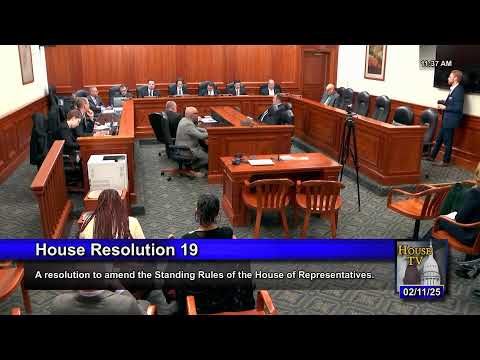
The House Government Operations Committee reported House Resolution 19 as substituted after debate and extensive public testimony. The resolution would bar legislatively directed spending to municipalities and universities that adopt policies refusing cooperation with federal immigration enforcement unless they certify compliance.
The Michigan House Committee on Government Operations on Wednesday reported House Resolution 19 (as substituted) following testimony from Representative Mike Harris, public comment from multiple advocacy groups, and several failed amendment votes.
Representative Mike Harris, speaking for the resolution introduced by Speaker Hall, said HR 19 "reinforces the importance of rule of law in our state's municipalities and universities" and described recent local policies he said "directly undermine federal immigration law and create inconsistencies in enforcement that can lead to serious public safety concerns." Harris cited East Lansing's 2023 noncooperation declaration and said Kalamazoo Township was considering similar measures.
Harris told the committee HR 19 would amend House standing rule 52 to require that municipalities or universities seeking legislatively directed spending certify by official letter or resolution that they will not "subvert immigration enforcement" and will comply with federal law. "Simply put, taxpayer dollars should not be funneled into local governments that willfully defy federal law," he said, and framed the measure as a path to uniformity and accountability.
Public testimony opposing the resolution was extensive. Liz Balck of the ACLU of Michigan, who said she practiced immigration law for 12 years, argued immigration law is civil and federally controlled and warned HR 19 is vague and could produce an unfunded mandate. "What we're worried about is that entities would be sending in letters... without any other instructions," she said, adding the resolution "could, again, result in a lot of confusion within localities."
Monique Stanton, president and CEO of the Michigan League for Public Policy, said HR 19 "is a solution in search of a problem," and warned it would "disrupt local control" and force municipalities to spend existing dollars to comply with federal immigration enforcement duties. Eleanor Jordan of the Michigan Immigrant Rights Center said to her knowledge "there's no currently any Michigan municipalities that are violating federal law with regard to immigration enforcement" and that the resolution could "penalize communities doing lawful work to protect constitutional rights."
Other opponents included Julie Powers of Immigration Law and Justice Michigan, Nicole Keyway Biber (Anishinabek Caucus), Viviana (MiPoder), and Marita Key (naturalized U.S. citizen speaker). Speakers cited concerns that the resolution would erode trust with immigrant communities, divert local law enforcement from community policing, risk racial profiling, and impose costs on underfunded local governments.
Committee members offered and voted on several amendments. Representative Mike McFaul moved an amendment to clarify the rule "would not impede any constitutional or statutory revenue sharing for a municipality;" that amendment failed on a 3‑to‑2 vote (2 yays, 3 nays). Representative John Fitzgerald offered amendments to exempt critical public safety equipment and to ensure only unlawful policies would bar eligibility; both Fitzgerald amendments also failed on 3‑to‑2 votes.
Representative Harris described HR 19 as a targeted measure applying to municipalities and universities with respect to access to legislatively directed funds and said the resolution "does not seek to indiscriminately punish municipalities, but instead establishes a clear path for compliance." He and the sponsor emphasized HR 19 is a resolution amending House rules, not a statute.
On the final motion to report HR 19 as substituted, the clerk recorded three yeas and two passes; the chair announced "3 ayes, 0 nays, 2 pass. The motion prevails." House Resolution 19 was reported with recommendation as substituted and will proceed to further House consideration.
The committee hearing included written testimony submitted by groups including the ACLU of Michigan, Michigan League for Public Policy, Michigan Immigrant Rights Center, Immigration Law and Justice Michigan, MiPoder, and others.