Get Full Government Meeting Transcripts, Videos, & Alerts Forever!
Get email alerts on the State Budget topic
No spam. Unsubscribe anytime.
Committee hears Senate Bill 171 to route a portion of surplus revenues into coal severance trust
Summary
Senate Bill 171 would add a step in Montana's budget-stabilization flow so that, after other reserves are filled, up to 10% of remaining excess revenue could be deposited to the coal severance trust; sponsors said the bill is prospective and the fiscal note shows no near-term revenue impact.
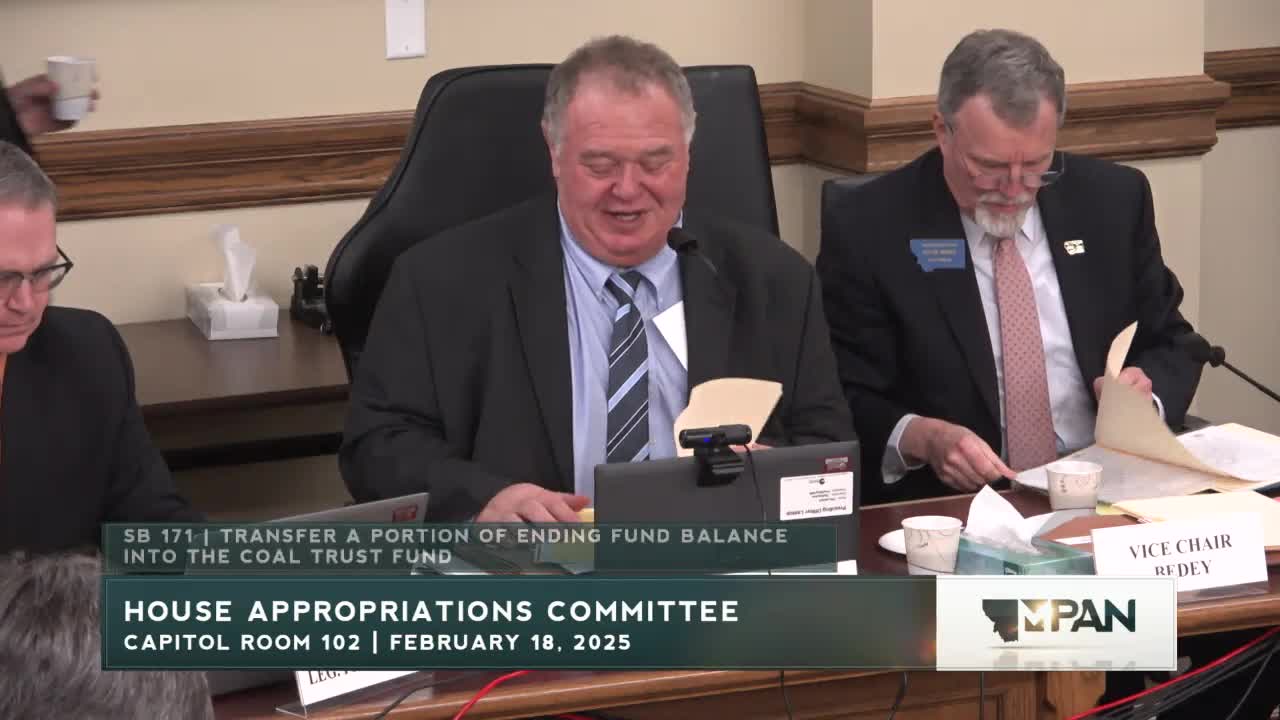
Senate Bill 171, a proposal to direct a share of excess state revenue into Montana’s coal severance trust, received a hearing before the Appropriations Committee on March 15. The bill’s sponsor, Sen. Dave Fern, introduced the measure and described a tiered flow for surplus revenue that would funnel a portion into the coal trust once other reserves and priorities are satisfied.
The bill “is a very short bill,” Sen. Dave Fern said, explaining the mechanics: after filling the budget stabilization reserve and then capital-related reserves, a remaining split would allocate 75% toward a pension account, 15% to the general fund and 10% to the coal severance trust when the prior buckets are full. “If we’re lucky enough to be in a situation…10% can go deposit into the coal trust,” Fern told the committee.
The nut graph: supporters said the change is intended to grow the coal trust corpus over time so interest earnings can support education, conservation and local projects tied to severance revenues; opponents and questioners sought clarity on the bill’s numerical effects and near-term fiscal impact.
Committee members pressed for concrete dollar estimates and the bill’s near-term effect. Representative Gillette asked how to read the fiscal note and whether the bill would move existing surplus dollars; Fern responded that the proposal is prospective and depends on future surplus “mountains” above the official revenue estimate. He noted the fiscal office’s revenue forecast does not project excess for the immediate years, and therefore the fiscal note shows no impact for the next biennium: “Based upon our forecast…there’s no fiscal impact to the state,” Fern said, characterizing surplus as effectively a future possibility rather than a present transfer.
Members also questioned how the bill interacts with an already-created pension bucket. Fern and other participants clarified the pension bucket exists but seed funding intended in an earlier session was not appropriated; this bill would not immediately seed that pension account but would change the order in which excess revenue is allocated should surpluses materialize.
Several members asked about the coal trust’s investment limitations and returns. Representative Schellinger queried whether the prohibition on equities was constitutional; the chair replied that it is effectively prohibited from equities under current constitutional constraints, making the trust’s return lower than equity-based funds. Fern noted Montana’s coal trust corpus is modest compared with some other states and that constrained investment options reduce long-term returns: he cited the trust corpus at about $1,300,000,000 and contrasted that with larger sovereign funds in other states.
Committee members also reviewed how the coal trust’s subaccounts operate. Fern summarized that portions of trust earnings already flow to specific programs—including school facilities and conservation district funds—and that the bill would add an additional inflow into the corpus rather than redirect existing subaccount earnings.
No committee vote was taken at the hearing. The committee concluded the informational hearing and left the bill pending further action; the fiscal office’s forecast and any future excess revenues will determine whether the bill would produce deposits to the coal trust.
The committee adjourned with plans to continue hearings on other long-range resource bills later in the week.