Get Full Government Meeting Transcripts, Videos, & Alerts Forever!
Get email alerts on the Zoning Code Update topic
No spam. Unsubscribe anytime.
Lebanon planning panel reviews zoning-code rewrite, block-length standards and SP process
Summary
At a Planning Commission meeting, staff and commissioners discussed the proposed zoning-code rewrite, debated existing block-length standards and agreed to schedule further review of the Special Plan (SP) process and a possible design-review committee before making formal recommendations to City Council.
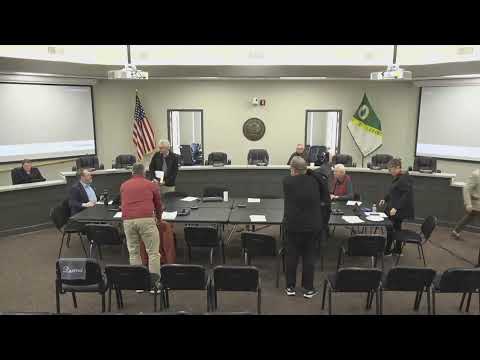
The Lebanon Planning Commission discussed a proposed rewrite of the city’s zoning code and requested more focused review of the Special Plan (SP) section and a proposed design-review committee at its meeting on Oct. 12.
Planning staff emphasized that some dimensional standards in the draft are long-standing: “It’s 800 feet. So 800 feet is the minimum,” a planning staff member said, describing the commission’s current minimum block-length standard and contrasting it with block-length guidance used in other cities.
Why it matters: block length and SP rules shape where development can go, how walkable neighborhoods are and how narrowly a site’s allowable uses can be defined. Commissioners said they want time to review the 200-page draft in more detail, to make recommendations to City Council and to consider carving specific items out for separate votes rather than delaying the entire code package.
Most discussion focused on three topics: the municipality’s block-length standard; how the SP process is being used; and whether to create a separate design-review committee. Planning staff and commissioners traced the local block-length standard to older code language, noting that some cities recommend block lengths closer to 300–600 feet and that the local code includes references to 800 feet and historically to 1,200 feet. A staff member said larger block perimeters — roughly a mile — are generally the upper practical limit for circulation in certain contexts, and cited walkability and sightlines as reasons the metric matters.
Commissioners flagged how applicants use SP approvals. One commissioner noted that SPs often list multiple uses — “6, 8, 10 uses” was cited — which can leave future uses broad. Commissioners asked whether the city should cap SP acreage or otherwise limit when an SP is the appropriate tool. Staff said internal discussions have considered thresholds for when an SP should be required, especially where road building or major infrastructure would be needed. Staff also noted that moving a building location by more than 25 percent currently requires a City Council amendment, which helps explain why applicants sometimes pursue SPs to accommodate larger changes.
On the proposed design-review committee, reactions were mixed. Several commissioners said they did not see an immediate need for another commission but asked for a formal process to let the Planning Commission weigh in on new bodies or major code changes before those items are forwarded to City Council.
No formal votes were taken. Instead, the commission agreed to continue discussion: commissioners asked staff to schedule at least one meeting focused on the SP section, and agreed that staff may break the overall code package into pieces the commission can vote on separately if that will speed adoption without sacrificing detailed review. A staff member said the project team is willing to meet with commissioners and to provide more graphic-oriented drafts and targeted briefings on topics such as commercial and mixed-use districts.
Commissioners asked for practical follow-up: a prioritized list of sections that commissioners consider urgent, a focused session on SPs and continuing opportunity to identify specific language that needs tightening. Staff repeatedly said the code rewrite has been in development for roughly two years and that while they want to expedite adoption, the commission should take the time needed because it will “live with this.”
The commission closed the discussion by agreeing to fold continued review into upcoming preliminary meetings and to place the SP section on the near-term agenda for deeper review. There was no formal referral to City Council during this session; staff will return with additional materials and scheduling options.