Get Full Government Meeting Transcripts, Videos, & Alerts Forever!
Get email alerts on the Energy Planning topic
No spam. Unsubscribe anytime.
Committee hears bill asking utilities to submit renewable-energy planning reports
Summary
Sen. Andrea Olsen’s bill would ask Montana utilities to provide a plan describing options, timelines and barriers for increasing renewable generation. Proponents cited the state constitutional duty to a clean environment and potential cost benefits; opponents questioned cost claims and federal funding assumptions.
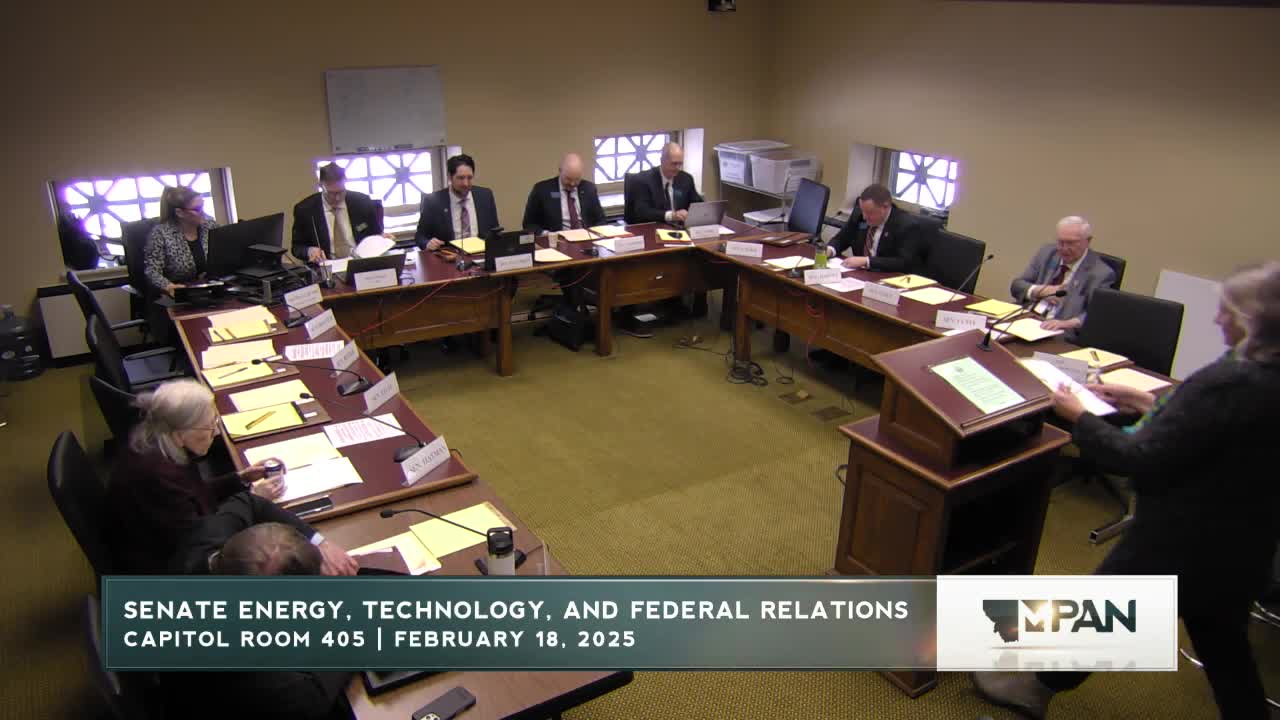
Senator Andrea Olsen introduced Senate Bill 294 to the Senate Energy, Technology and Federal Relations Committee, asking utilities to provide a transparent plan that outlines options, timelines and challenges for increasing the share of renewable energy in their portfolios.
The bill, Olsen said, is “a request essentially that we start asking NorthWestern Energy, our utility companies for information about what how they're planning to meet some goals.” The sponsor characterized the measure as “the bare bones minimum to start” a structured engagement between the Legislature and utilities.
The bill’s proponents told the committee the plan would improve transparency and help Montana meet constitutional obligations. Natalie Wright of the Montana Conservation Voters Education Fund said SB 294 “is a key step to ensuring Montana upholds its constitutional mandate to a clean and healthful environment.” Derek Goldman, Montana policy associate for the Northwest Energy Coalition, urged the panel to consider affordability, citing a global renewables report: “new capacity of renewables added since the year February has reduced the electricity sector's fuel bill overall in 2022 by $520,000,000,000.” Shannon James of the Montana Environmental Information Center said the bill “simply ensures that our public utilities have a clear, transparent roadmap for meeting their carbon pollution reduction goals.” McKenna Sellers of the Montana Renewable Energy Association noted the bill is not a mandate but a transparency tool because “the plan requires outlining options, timelines, and challenges.”
Tribal representatives also voiced support. Patrick Yawake identified himself as representing the Blackfeet, Chippewa Cree (Rocky Boy), and Fort Belknap communities and said those communities “appreciate the bill…in an effort to hold the state accountable to the obligations of [the Montana] State Constitution.”
Witnesses opposing the bill asked the committee to scrutinize cost claims and federal-policy assumptions. Carbon County resident Lisonbee Bennett disputed testimony that Montana has among the highest energy costs, saying she reviewed federal Energy Information Administration data and found different rankings. She also warned that some analyses favoring renewables are funded by parties that benefit from federal incentives. Sheridan Hoyer of the Montana Chamber of Commerce said the chamber supports renewable sources but urged “an all of the above energy approach” to maintain reliability as demand grows.
Committee members asked procedural and factual questions; Senator Heyman asked whether the trend of some states “pulling out of” wind or solar projects was broad or isolated. Witnesses replied they had not seen a nationwide rollback and emphasized that pairing renewables with storage is the common response to intermittency concerns.
The sponsor closed by returning to policy obligations: “this is a plan to ask us to explore the options, the timelines, and the challenges, and to do it in a way that is transparent communication between the power company and us,” Olsen said, and asked the committee to pass SB 294.
No formal committee vote on SB 294 was recorded in the transcript; the hearing was closed and the bill moved on to the committee record.