Get Full Government Meeting Transcripts, Videos, & Alerts Forever!
Get email alerts on the Medicaid Provider Rates topic
No spam. Unsubscribe anytime.
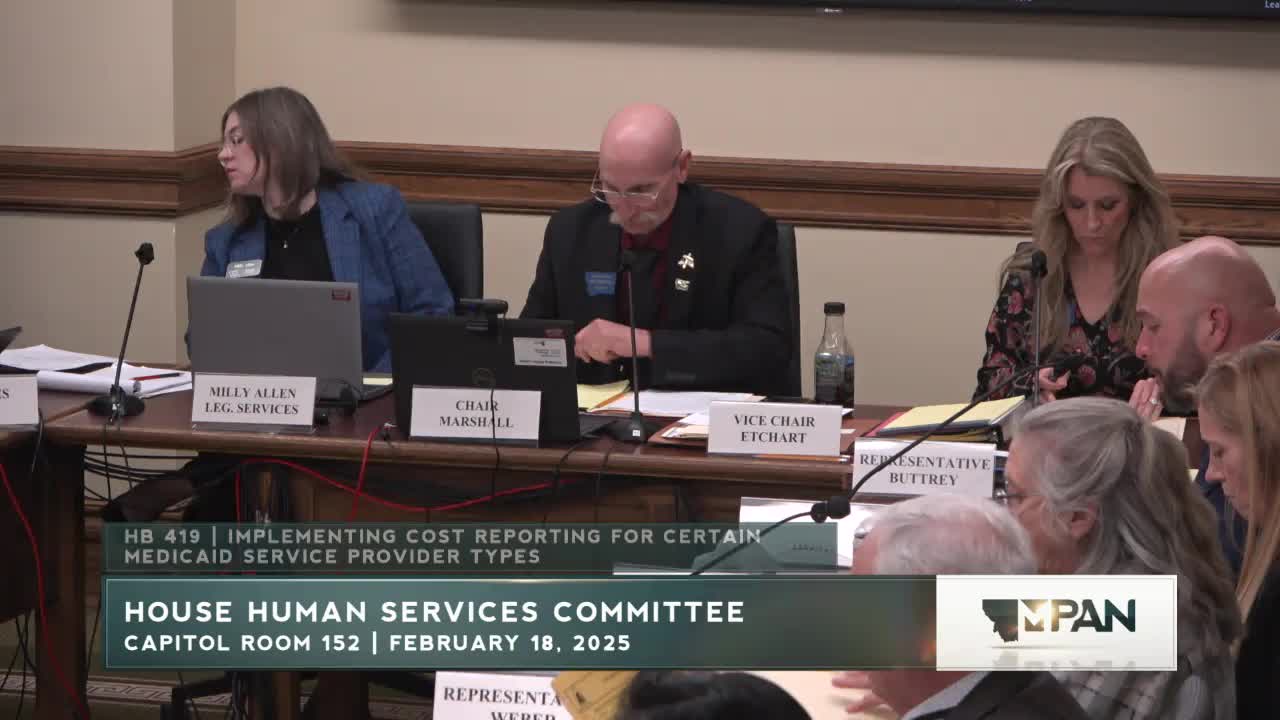
Committee hears bill to require regular cost reporting to assess Medicaid provider rates
Summary
The House Health and Human Services Committee heard testimony in support of House Bill 419, which would require standardized cost reports for certain Medicaid-dependent providers, set a first report due Sept. 1, 2026, and include a one-time appropriation of $1.2 million to implement the process.
Representative David Beatty, sponsor of House Bill 419, told the House Health and Human Services Committee that the bill would create a formal process for reporting revenues and costs for specified Medicaid services so rate adequacy can be assessed at least once every four years. “House bill 4 19 provides a formal process for reporting the revenues and costs incurred for certain Medicaid services so that the adequacy of provider rates can be assessed at least once every 4 years,” Beatty said.
The bill would exclude hospital services paid with cost-based reimbursements and services paid through resource-based relative value scales, such as physician specialty visits, Beatty said. He told the committee the first report would be due Sept. 1, 2026, and that implementation requires a one-time appropriation of $1,200,000, half from the state general fund and half as a federal special revenue match.
Nut graf: Supporters — including disability-service providers, hospitals and behavioral-health advocates — told the committee standardized cost reporting is necessary to maintain adequate Medicaid reimbursements, improve workforce recruitment and retention, and to provide the legislature and the Department of Public Health and Human Services (DPHHS) data for budget requests.
Proponents described workforce impacts under current rates. Cassie Wick of Ability Montana said prior to recent rate increases caregivers in a self-directed program earned $12.75 per hour and that low wages “made it nearly impossible to recruit and retain dedicated individuals.” After last session’s increases, she said wages rose to $18.25 plus benefits and the program’s stability improved. Jackie Jantz, project management specialist at DPHHS, listed services the bill aims to cover outside existing reimbursement models, including private duty nursing, multiple types of group homes, waiver services, psychiatric residential treatment facilities, and inpatient residential substance use disorder treatment.
Multiple provider groups and advocacy organizations voiced support, including Consumer Care Direct Network, the Montana Hospital Association, Shodair Children’s Hospital, the Montana Primary Care Association, SEIU 775, the ARC Western Montana, and the Montana Association of Community Disability Services. Gene Hermanson, Medicaid chief financial manager at DPHHS, identified himself as available for fiscal questions.
Several witnesses urged the committee to ensure cost reporting would not be used to reduce funding or freeze rates. “Fair and accurate cost assessments are essential to ensure that Montana's vulnerable populations have access to quality care and support services,” Cassie Wick told the committee.
The hearing record closed after sponsors and proponents finished; no opponents testified. Representative Beatty closed by saying the bill supersedes a more limited existing reporting statute and urged a do-pass recommendation.
Ending: Committee members did not take a floor vote on HB 419 during the hearing. The bill’s first required report date and its appropriation amount are specified in the sponsor’s testimony and the bill text as presented to the committee.