Get Full Government Meeting Transcripts, Videos, & Alerts Forever!
Get email alerts on the Voter Registration topic
No spam. Unsubscribe anytime.
Hearing on bill to allow voluntary party preference on Montana voter registrations draws mixed testimony
Summary
Senate Bill 129 would let electors add a political-party preference to their voter registration. Sponsor Senator Trevis described it as voluntary freedom-of-association policy; tribal representatives and other witnesses warned it could burden election offices and compromise voter privacy.
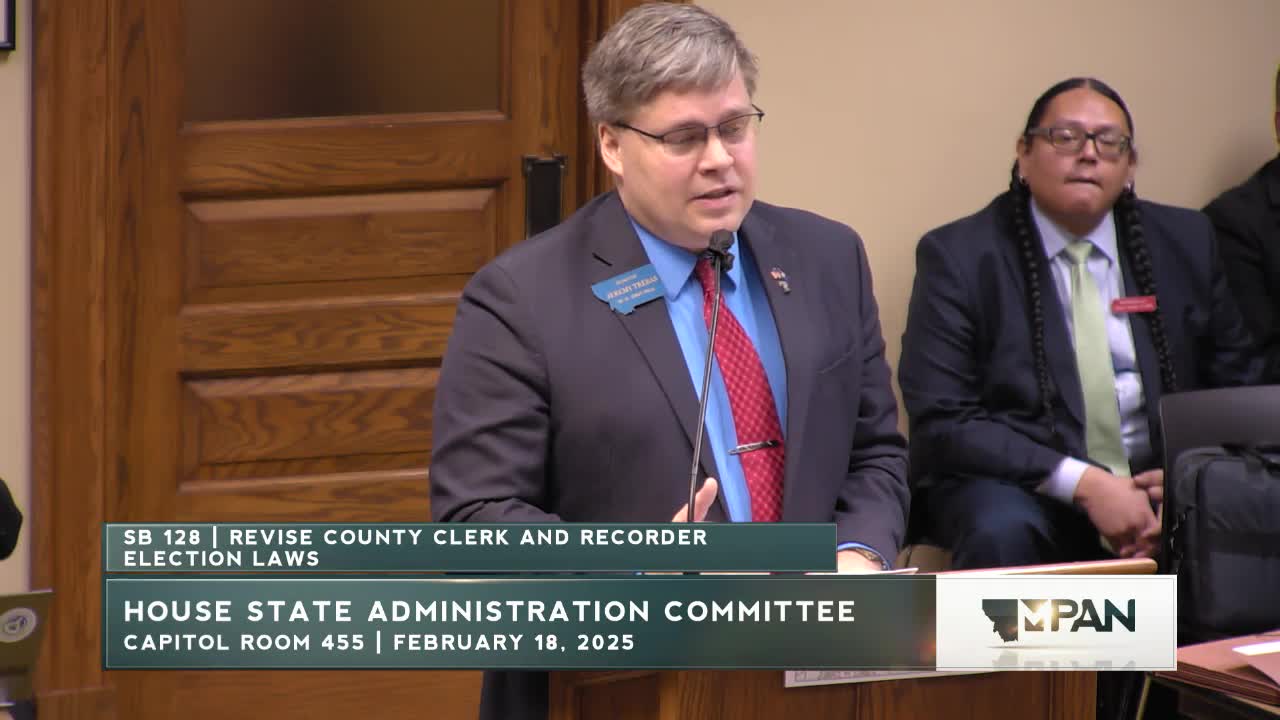
Senator Ryan Trevis, sponsor and Senator for Senate District 10, told the committee that Senate Bill 129 would allow an individual to add a political party preference to a voter-registration record and that the party list on forms would track Montana ballot-access rules.
“An individual may choose a political party affiliation when completing the standard application form,” Trevis said. He described the change as voluntary and said the bill’s effective date was set to Jan. 1, 2026 to allow transition time.
Opponents and public commenters raised concerns. Patrick Yawake, speaking for the Blackfeet Tribe, Fort Belknap Indian Community and the Chippewa Cree Tribe of Rocky Boy, said SB 129 would impose an added burden on voters and county election officials and risk imposing partisan labels where many Montanans prefer privacy. “Montana electors want simplicity with the process of voting,” Yawake said, urging the committee to table the bill.
Evan Barrett, a longtime party operative who testified as a private citizen, urged caution and argued voluntary party-registration would mainly help party organizations and could chill privacy-minded voters.
Austin James, appearing for Montana Secretary of State Christy Jacobson, offered practical context on implementation in the state voter-record database and cautioned the committee that “independent” is not a currently qualified political party under Montana ballot-access statutes, so the committee should be aware of how fields are defined in state systems.
Committee members asked how the bill would affect existing primary ballots and whether previously registered voters would need to re-register. Trevis said existing voters would not be required to re-register, and that adding party preference would be optional for new or current registrants. The sponsor also said the bill does not change how people would cast ballots and that primary ballot distribution would remain governed by existing ballot-access rules.
The hearing included no recorded committee vote. Senator Trevis closed the hearing and the committee moved on to other items.