Get Full Government Meeting Transcripts, Videos, & Alerts Forever!
Get email alerts on the Local Foods Retail Incentive topic
No spam. Unsubscribe anytime.
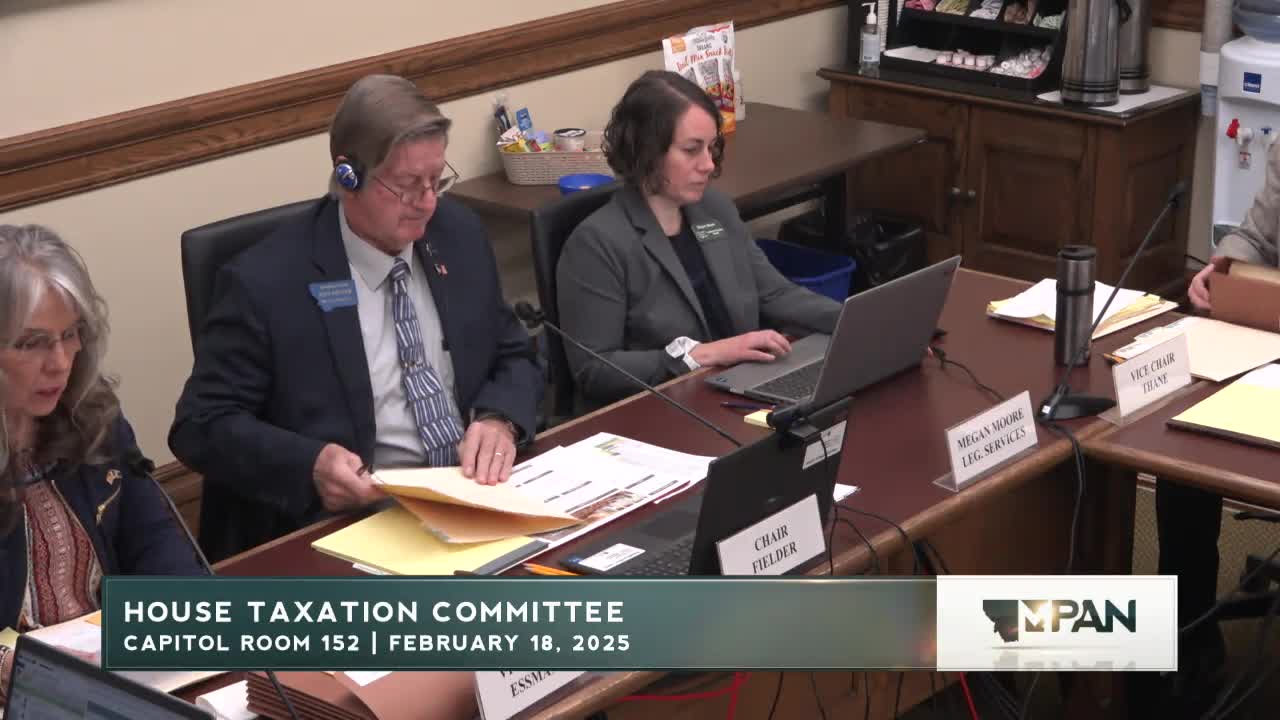
House committee hears bill to give retailers a tax subtraction for Montana-produced foods
Summary
Montana lawmakers heard testimony on House Bill 440, which would let retailers subtract 50% of net income from sales of qualifying Montana-produced foods to encourage grocery shelf space for local products; proponents called it a voluntary, market-access measure while the Department of Revenue flagged administrative and Commerce Clause questions.
Representative Jane Weber, sponsor of House Bill 440, told the House Taxation Committee that the bill would create a voluntary tax incentive to help Montana farmers and ranchers get products onto grocery store shelves. “In Big Sky Country, you know, we want to have wholesome food from our local farmers and ranchers on our family table,” Representative Jane Weber said, introducing the Montana Food First proposal.
The bill would allow a grocer to subtract 50% of net income derived from the sale of Montana-produced food at the point of sale, Weber said, and includes a statutory definition of “Montana produced food” with exclusions for ready-to-eat on-site prepared items such as sandwiches and soups. “The program is totally voluntary for the grocer,” Weber said during her opening remarks.
Proponents — including Montana Farmers Union, Grow Montana, Northern Plains Resource Council and several Montana producers — told the committee the measure addresses a practical market-access barrier. Jasmine Krotkov of Montana Farmers Union said national distributors use incentives, discounts and slotting allowances that effectively block shelf space for small Montana producers: “Local Montana producers create products that are just as good if not way better than the nationally produced and distributed foods…They deserve to get the same incentives that the national products get and that's just what this bill does.”
Grow Montana’s Kali Wicks described local sales and jobs supported by local food and urged a “do pass.” Proponents gave multiple examples of producers who struggled to place goods at chain stores because distributors contract prime shelf space to national brands and offer promotional allowances to out-of-state suppliers. Producer testimony raised concrete market barriers such as slotting fees, sampling programs paid by manufacturers, and distributor pressure to carry regional corporate items.
Department of Revenue staff and other informational witnesses answered technical questions about the fiscal note and administrative needs. Finn McMichael of the Department of Revenue’s Tax Policy and Research Unit said the agency prepared a fiscal estimate and was available to answer questions. Keith Broussard, bureau chief in the department’s Natural Resource and Corporation Tax Bureau, and other DOR staff said the department anticipates administrative work to audit claims; the fiscal note currently estimates 2.0 FTE for administration and audit, though Weber said the estimate depends on how many grocers participate.
Committee members questioned the bill’s interaction with interstate commerce rules and implementation complexity. Representative Minor asked for clarification of a legal note; Weber and witnesses referenced the Commerce Clause and case law applying a four-part test (Complete Auto Transit, Inc. v. Brady) when states adopt tax measures that touch interstate commerce. Weber said the bill is voluntary and intended to provide a retail option for grocers who want to prioritize Montana producers.
The hearing included detailed regulatory and operational questions: how the subtraction would be claimed on income reports, how “point of sale” net income would be verified, and what documentation retailers would need. DOR staff said additional guidance and potential audit procedures would be required if the program moved forward.
The sponsor and proponents emphasized the bill’s purpose as an economic-development and resiliency tool — to give Montana producers greater visibility and traction in retail channels — and requested a committee “do pass.” The committee closed the hearing on House Bill 440 and moved to the next agenda item.