Get Full Government Meeting Transcripts, Videos, & Alerts Forever!
Get email alerts on the Child Family Services Budget topic
No spam. Unsubscribe anytime.
Legislators and Department Officials Debate Ground-up vs. Incremental Budgeting for Child and Family Services
Summary
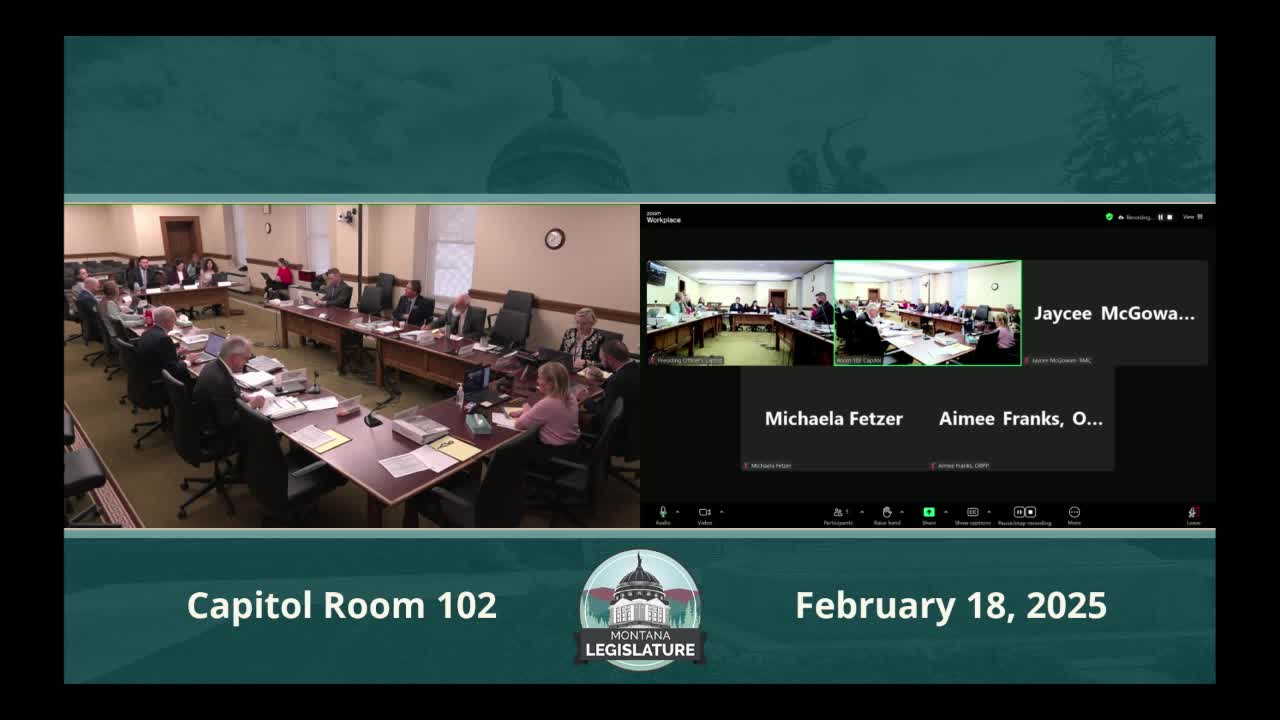
Legislators on the 2025 Legislature MT appropriations review questioned Department of Public Health and Human Services staff on Oct. 12 about why the Child and Family Services Division’s (CFSD) biennial budget is presented as incremental adjustments instead of a ground-up, zero-based budget.
Legislators on the 2025 Legislature MT appropriations review questioned Department of Public Health and Human Services staff on Oct. 12 about why the Child and Family Services Division’s (CFSD) biennial budget is presented as incremental adjustments instead of a ground-up, zero-based budget.
Madam Chair Gillette opened the discussion by saying the committee had expected a “full budget review, at least the numbers part of it,” and asking staff to explain how the department builds its baseline figures. "From the department's perspective, we concluded our presentation on the child and family services division budget yesterday. We are here to answer your questions and have a discussion with you on CFSD budget related matters," the department director said.
The department’s budget staff explained they rely on an incremental approach informed by historical expenditures. "What we do is we look at a year's worth of actual experience," Ms. Aiken said, describing the process that uses fiscal 2024 completed expenditures as the base for the 2026–27 budget projections. Aiken added that some areas—such as personal services—are driven by prescribed personal-services snapshots, while other lines (leases, motor pool, travel) are reviewed account by account.
Lawmakers repeatedly said they had expected a more detailed, bottom-up accounting that would show per-office startup costs and per-FTE breakdowns. "How many FTEs do you need? What's your lease space? How much does the cleaning company cost?" Chair Gillette asked. Committee members pressed for a format that would make it possible to see, for a given region, the personnel count, rent, vehicles and communications costs that would be required if the state stood up a new regional office.
Department staff pointed to yesterday’s regional slides as the closest available view. On that slide set, the Miles City regional office was shown at just under $1.2 million in total operating costs for the period presented, with personal services, motor pool, communications and rent among the largest components. Legislative Fiscal Division staff noted a spreadsheet total for the same set of items that was "a bit over $4,000,000," which the committee said indicated the need for clearer rollups.
Officials described specific constraints that limit a zero-based presentation. Motor-pool costs are tied to statewide rates and recent changes in fuel and vehicle leasing; staff said the motor-pool line reflects these Department of Administration rate adjustments rather than a department-controlled estimate. Lease costs for many offices are set by the Department of Administration for facilities on the state Capital Complex and therefore use fixed rates that the agency passes through. Travel was described as roughly half in-state—routine travel across a worker’s region—and half out-of-state for monthly visits to children placed outside Montana; air fares and overnight lodging raise those costs when placements are out of state.
Several members said the existing iBARS account structure limits how granular the department can report. "iBARS stops at that third level," a department official said, explaining that while staff can pull detailed expense account codes in their internal systems, the budget system’s chart of accounts includes hundreds of sub-accounts and does not present a single, simple per-FTE startup estimate.
Representative Mercer circulated a 2016 Protect Montana Kids Commission report to provide comparative context and highlighted changes in demand and caseload since 2015. "In fiscal '24, there were 28,812 calls received, but in 2015 there were 35,812," Mercer said, adding that investigations dropped from 8,908 in 2015 to 6,544 in the most recent year and that foster-care placement counts were lower than the 2015 figure of 3,179. Mercer used those figures to press for staffing comparisons across jurisdictions and to ask whether staffing levels should be adjusted in response to caseload changes.
Department staff said they do caseload projections for benefits-driven areas of the budget (for example, some Medicaid-related programs and placement projections) and that those projections inform the personal-services and benefits numbers for CFSD. For operating lines such as travel, communications and motor pool, the department said it uses recent actuals and contract/lease information to estimate future needs.
Committee members thanked staff for the presentations but asked for a different format going forward: one that explicitly pairs the number of FTEs in each regional office with the per-FTE components (salary, benefits, communications, vehicle allocation and a rent share) so legislators can see both the current cost picture and what it would take to stand up a comparable office from scratch. The department agreed to consider formatting changes to show region-level staffing and per-FTE cost breakdowns more clearly in future materials.
No formal votes or committee directives were recorded in this segment of the transcript. The discussion closed with recognition from committee members that the process had increased their understanding of CFSD funding drivers and with a request that the department and Legislative Fiscal Division work on a clearer, more actionable presentation format for subsequent budget work.