Get Full Government Meeting Transcripts, Videos, & Alerts Forever!
Get email alerts on the Road Safety Drug Testing topic
No spam. Unsubscribe anytime.
Bill would authorize saliva (oral‑fluid) screening at roadside; law enforcement calls it a screening tool, not evidentiary
Summary
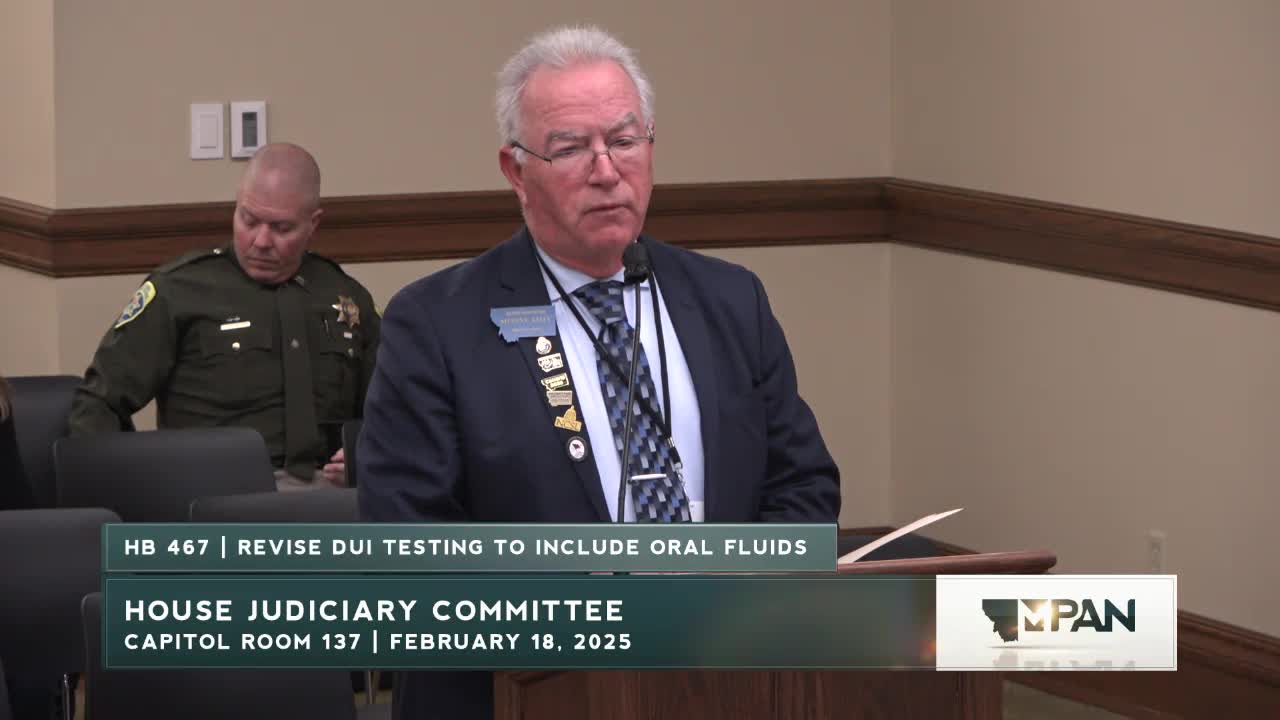
Representative Steve Kelly introduced House Bill 4 67 to allow oral‑fluid (saliva) screening tests as a preliminary tool for officers investigating impairment; supporters said the devices give officers an additional data point for probable cause while critics raised concerns about accuracy and environmental/ingestion effects.
Representative Steve Kelly introduced House Bill 4 67, a narrowly framed measure to allow saliva (oral‑fluid) screening devices for preliminary testing in DUI/drug investigations. Kelly said the change responds to requests from local law enforcement and would restore statutory language that previously existed in Montana law.
Captain Doug Samuelson testified as an informational witness that oral‑fluid devices have been used in limited pilot periods and currently are most common as screening devices for recent drug use (measuring multiple drug classes with a swab and quick cartridge). He described the devices as analogous to a preliminary breath test: a positive oral‑fluid screen would be a field screening result that could support probable cause and lead officers to seek evidentiary blood testing and other investigative steps. Samuelson said the technology is evolving, that many products on the market are drug‑screening devices (not evidentiary alcohol machines), and that a positive oral‑fluid screen indicates recent use and should prompt follow‑up testing.
Committee members pressed on accuracy. Several legislators and witnesses raised studies and practical concerns: one member asked about potential interference from recent food or drink, caffeine or nicotine, and the risk of false positives or false negatives; another asked whether a positive oral‑fluid result alone could justify arrest. Samuelson and other witnesses said the devices are a single data point and would not replace evidentiary testing; they compared the tool to preliminary breath testing for alcohol, which is widely used but not itself admissible as proof of a crime.
The sponsor said the bill is limited to screening uses and that evidentiary testing would remain the standard for prosecution. No committee vote was recorded at the hearing.