Get Full Government Meeting Transcripts, Videos, & Alerts Forever!
Get email alerts on the K 12 Education Parental Rights topic
No spam. Unsubscribe anytime.
Bill would require parental opt‑in for school ‘identity instruction,’ clarifies notification window
Summary
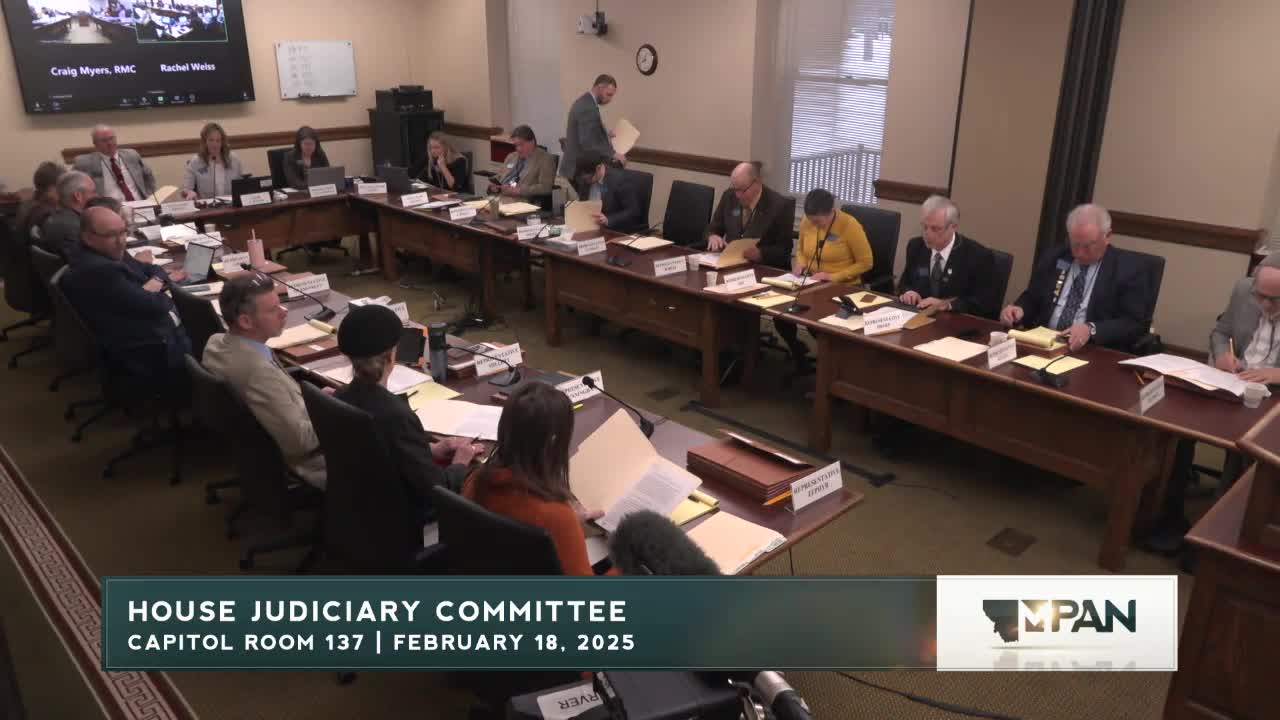
Representative Jay Hinkle opened the House Judiciary hearing on House Bill 4 71, saying the bill would clarify notification rules from 2021 and require parents to affirmatively opt in before students are taught material on gender identity, gender expression or sexual orientation.
Representative Jay Hinkle opened the House Judiciary hearing on House Bill 4 71, saying the bill would clarify notification rules created by 2021’s Senate Bill 99 and establish a new category called “identity instruction” that would require parents to affirmatively opt in before students see material on gender identity, gender expression or sexual orientation.
Supporters framed HB 4 71 as a transparency and parental‑rights measure. Katie Bloodgood of the Office of Public Instruction said the bill “prioritizes transparency in education and strengthens the fundamental rights of parents.” Derek Aestreicher of the Montana Family Foundation told the committee he supported an opt‑in approach and cited a January 2021 federal directive as further justification. Dylan Klapmeier, education policy advisor to Governor Greg Gianforte, said the governor supports HB 4 71 and described the bill as drawing a line between unexpected or fleeting references and curriculum that has the goal or purpose of addressing identity topics.
The bill would: (1) define “identity instruction” as materials or teaching addressing gender identity, gender expression, or sexual orientation; (2) require explicit parental permission (opt‑in) for identity instruction; and (3) set the required parent notification window for human sexuality instruction at between two and ten days before first introduction of materials, eliminating the redundancy some teachers reported under earlier law.
Opponents warned of policy and implementation problems. Macaul Flynn, executive director of the Board of Public Education, said the board opposes the opt‑in provision because content standards adopted by the board are intended to be required, not optional, and an opt‑in regime could create a precedent making other standards appear optional. Rob Watson said school districts and teachers would face “logistical chaos” if they had to track opt‑ins alongside opt‑outs in the same unit of instruction. Kim Popham of the Montana Federation of Public Employees, a former high‑school biology teacher, said Montana is already facing a teacher shortage and that adding paperwork and litigation risk could drive people away from the profession.
Committee members asked implementation questions: witnesses said current law (the 2021 statute implementing Senate Bill 99) requires an annual notice and a 48‑hour notice before instruction; proponents said HB 4 71 would harmonize those requirements into the proposed 2–10‑day window and allow districts to collect opt‑in permission at the start of the year to reduce burden. The Board of Public Education described its role as setting minimum content standards and said local trustees adopt curriculum consistent with those standards; complaints about potential teacher burden and mixed classrooms were discussed at length.
No formal committee action or vote was recorded at the hearing.