Get Full Government Meeting Transcripts, Videos, & Alerts Forever!
Get email alerts on the Education Standards Ethnic Studies topic
No spam. Unsubscribe anytime.
House committee re-refers bill to pause social-studies standards, repeal ethnic-studies mandate
Summary
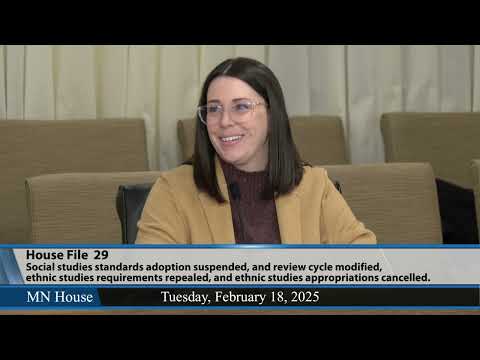
The House Education Policy Committee on Feb. 18 re‑referred House File 29, a bill that would delay the implementation of Minnesota's 2021 social-studies standards, repeal a statutory requirement to embed an ethnic-studies strand into required academic standards and cancel related appropriations.
The House Education Policy Committee on Feb. 18 re‑referred House File 29, a bill that would delay the implementation of Minnesota's 2021 social-studies standards, repeal a statutory requirement to embed an ethnic-studies strand into required academic standards and cancel related appropriations.
Representative Presha, the bill's sponsor, told the committee that academic achievement in Minnesota has fallen and that mandates such as the ethnic-studies requirement divert classroom time from foundational skills. "Students in Minnesota deserve the fundamental right to a quality education measured with academic success," Representative Presha said, and argued the state should "remove the distractions" so teachers can focus on reading, math and science fundamentals.
Supporters and opponents of the 2021 standards gave sharply different accounts of the standards and how they were developed. Catherine Kersten, senior policy fellow at the Center of the American Experiment, told committee members she supports HF 29 and described the ethic-studies framework as ideologically driven and intrusive. "Minnesota policymakers have entrenched liberated ethnic studies ideology in every grade and academic subject," Kersten said. By contrast, Crystal Johnson, a social-studies teacher who served on the standards committee, said the standards reflect a multi‑stakeholder process and urged members to "trust your teachers." Mark Westfall, president of the Minnesota Council for the Social Studies, said the standards broaden cross‑cultural understanding and are supported by professional educators.
Students and school officials also weighed in. Multiple current and former students testified that ethnic studies classes helped them find representation and develop civic skills; a student who identified herself as part of the class of 2025 said, "Ethnic studies must stay." Saint Paul Public Schools testified in favor of the ethnic-studies provisions, saying students "feel safer when their culture is seen." The Minnesota Department of Education, represented in testimony by a department official, urged caution on repeal and said reverting to prior standards would disrupt work districts had already done to align curriculum and would add costs.
Committee members asked for budget details. Nonpartisan staff told members the bill would modify three appropriations connected to ethnic-studies work: rescinding competitive grants to schools and reducing funding for a department specialist. Staff estimated a reduction of roughly $700,000 in competitive grant funding and $150,000 per year for an ethnic-studies specialist position at MDE.
The committee chair moved that HF 29 be re‑referred to the Education Finance Committee. A roll-call vote recorded seven members in favor and six opposed; the motion prevailed. The roll call recorded yes votes from Chair Bennett, Vice Chair Mueller, Representative DePel, Representative Fogelman, Representative Gordon, Representative Lawrence and Representative Roach; no votes from Representatives Lee Jordan, Biermann, Falconer, Green, Hill and Keeler.
The referral sends HF 29 to education finance, where budgetary implications and the specific appropriations changes will be examined further.