Get Full Government Meeting Transcripts, Videos, & Alerts Forever!
Get email alerts on the Governor Tax Proposal 2025 topic
No spam. Unsubscribe anytime.
Governor's tax package would cut state sales-tax rate slightly, expand taxable services; R&D credit partially refundable
Summary
The Department of Revenue presented Governor Tim Walz and Lt. Gov. Peggy Flanagan’s tax provisions to the House Tax Committee, centering on a small state sales-tax cut paired with an expansion of the sales-tax base to many services and a partially refundable research-and-development credit.
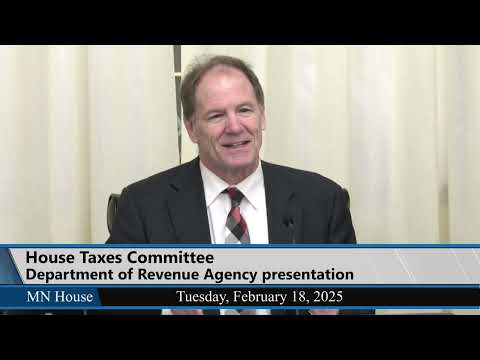
Paul Marquardt, commissioner of the Minnesota Department of Revenue, presented the tax provisions of Governor Tim Walz and Lieutenant Governor Peggy Flanagan’s budget to the House Tax Committee. The centerpiece is a small state sales-tax rate cut tied to an expansion of the sales-tax base to include many services now untaxed.
Marquardt described the proposal as a rate cut from 6.5% to 6.425% for the state portion, paired with taxing additional services that would broaden the base. He said the change would be effective for sales after Sept. 30 if enacted. The commissioner said the governor’s proposal “cuts the rate and expands the base,” and called it “a long overdue improvement to the sales tax code.”
Key provisions presented by the commissioner:
- Sales-tax change: Reduce the state sales-tax rate and expand the tax to many consumer-facing services, including certain professional services such as legal, banking and accounting, and some brokerage and investment-advisory charges. Business-to-business transactions and services used as inputs in production would remain exempt, Marquardt said. He added carve-outs to protect some items: services tied to filing the child tax credit or the working family credit, certain pensions, and loan-origination and overdraft fees would be exempt under the proposal.
- Revenue effect: Marquardt told the committee the rate cut alone would be a roughly $95,000,000 reduction in the first full year, the base expansion would raise roughly $210,000,000, producing a net increase of about $115,000,000 to the general fund in the initial year of full effect. He said the governor’s broader budget addresses a larger structural deficit and that these tax items are part of a wider plan.
- Research-and-development credit: The governor would make the R&D credit 25% refundable and add reporting elements recommended by an Office of the Legislative Auditor (OLA) review. The administration estimates the change would cost about $20,000,000 annually and aid hundreds of corporations and pass-through entities.
- Other items: The package would transition the renter’s refund to a renter’s credit, adjust personal-property exemptions for some low-income housing tenants, revise corporate-audit capacity for complex pass-through entities, and propose elimination of an initial local government cannabis aid allocation (the department said a small amount had already been distributed to counties).
Committee reaction and follow-up requests
Lawmakers pressed the administration on several fronts.
- Local tax and distribution questions: Members asked whether newly taxable services would also be subject to local option sales taxes. Marquardt said the state rate change does not alter local tax rates, but that taxing additional services would mean local-option taxes apply to those services where local taxes already exist.
- Impact on low-income and vulnerable residents: Committee members repeatedly raised concerns about bank-service and check-cashing fees being taxable and the potential impact on low-income households who pay such fees or lack bank accounts. Marquardt said the proposal includes carve-outs for certain fees and stressed the budget’s broader protections for seniors and property-tax relief enacted in 2023; he also said the administration would consider concerns in further committee work.
- Software-as-a-service and online tax-preparation: Members asked whether software-as-a-service (SaaS) products such as online tax-preparation tools would be newly taxable. Marquardt said prepackaged software is already taxable and that software delivered as a service today would likely be taxable under the expansion.
- R&D credit scrutiny: Several members cited an OLA review questioning the design and effectiveness of the R&D credit, and asked why refundability was being restored in part. Lawmakers said the credit historically benefits larger firms and asked for data showing it drives incremental activity in Minnesota. Marquardt said the administration received feedback from business leaders and aims to retain Minnesota’s competitiveness in innovation.
What happens next: Marquardt said the committee will hold deeper hearings on the governor’s tax proposals and provide committee members a detailed list of the specific services and carve-outs affected by the expansion. Committee members requested nonpartisan estimates of local tax impacts, the distributional effect on households, and additional detail on how carve-outs will be defined in statutory language.
Votes at a glance: The committee approved a motion to adopt the Feb. 13 minutes at the start of the hearing; Representative Freiburg moved the motion and the transcript records the approval by voice vote.