Get Full Government Meeting Transcripts, Videos, & Alerts Forever!
Get email alerts on the Immigration Policy topic
No spam. Unsubscribe anytime.
Madera council asks staff to draft ‘welcoming city’ resolution amid immigration enforcement fears
Summary
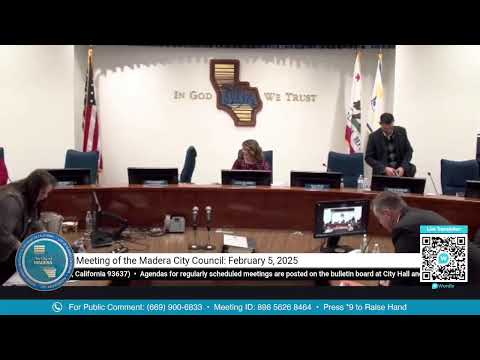
At its Feb. 5 meeting the Madera City Council directed staff to return with a narrowly worded resolution affirming support for immigrant residents — short of declaring a ‘sanctuary city’ — after staff briefed the council on recent federal actions, state law limits and possible financial and legal risks.
MADERA, Calif. — The Madera City Council on Wednesday directed city staff to draft a resolution affirming the city as a welcoming, refuge-oriented community while avoiding the specific label “sanctuary city,” after a lengthy public discussion and staff briefing about federal immigration enforcement and local limits on cooperation with U.S. Immigration and Customs Enforcement (ICE).
City Manager Rodriguez presented the informational report, saying the item was agendized at the council’s request and noting the situation is “very politically charged” and rapidly changing. Rodriguez said state law (Senate Bill 54) and a city resolution passed in January 2018 already limit local cooperation with federal immigration enforcement. “We do not report people to ICE. We do not collaborate with ICE. So if ICE has their information, I can assure them it's not coming from the from our police department,” Rodriguez said.
The presentation framed community fear as the immediate issue: Rodriguez told the council she had seen reporting that absenteeism in some schools spiked to roughly 30% following recent federal actions and said residents had phoned city offices expressing worry. Staff also listed potential fiscal consequences if the federal executive branch were to withhold funding from jurisdictions it deems noncooperative, but said the legal picture was unclear and evolving.
Why it matters
Council members, community groups and dozens of residents said they wanted council action to reassure people who work and attend school in Madera. Legal counsel warned the council about potential legal exposure if the city adopted a policy that would direct employees to take actions that interfere with federal enforcement, but indicated narrowly worded symbolic measures are less risky.
What the council decided
After more than an hour of staff briefing, councilmember remarks and public comment, the council settled on a direction (not a final vote) for staff to return with a resolution reaffirming support for immigrant residents, restating protections available under state law and reaffirming the city’s 2018 DACA resolution where appropriate. City staff said they will draft language that stops short of the explicit term “sanctuary city,” include options such as modular references to DACA, and propose a public-information posting about legal rights and local resources within the legal guardrails.
Key details from the meeting
- Legal framework: City staff summarized that California’s SB 54 (2017) restricts state and local law enforcement from using local resources to assist ICE except in cases of serious or violent crime. The city’s 2018 DACA resolution remains in effect, city staff said.
- Legal risk: City Attorney Shannon told the council there is no legal mechanism for a city to bar ICE from entering any part of the city; federal agents may operate on federal authority. Counsel added that directing staff to obstruct federal enforcement could, in theory, expose both implementers and policymakers to criminal or civil liability depending on the conduct: “it could expose both the people carrying out the policy and the people who are given direction to the policy to theoretical criminal prosecution.”
- Financial risk: Rodriguez said the city receives federal funds for programs such as CDBG (about $1 million annually) and HOME allocations (roughly $372,000 announced recently) and noted other recent awards — a $1.6 million federal grant for a highway interchange study and a $5.7 million award from the California Transportation Commission — that could be affected under hypothetical federal enforcement actions. Staff said they could not confirm whether those awards would be withdrawn and that the legal status is unsettled.
- Community impact: Councilmembers and public commenters described fear among students and workers. Councilwoman Evans recounted an incident at the courthouse and said, “I went to the courthouse myself... I was approached and I was asked what nationality I was.” Several residents urged the council to act quickly to reassure families and encourage reporting of crimes.
- Public-opinion and precedent: Dozens of residents and civic groups urged a strong statement of support. Speakers recommended a range of options from a formal sanctuary-city declaration to a narrowly worded “welcoming city” resolution and “know your rights” outreach. Staff and counsel recommended a narrowly tailored resolution in part to avoid immediate legal or funding risk.
What staff will do next
City staff said they will draft a resolution that reaffirms the 2018 DACA resolution, affirms the city’s welcoming/refuge stance and proposes public-information language about residents’ rights that can be posted online and in public locations. Staff asked for and received council consensus to prepare that draft and to retain flexibility to adapt language as federal guidance changes.
Ending
The council did not take a binding vote on a policy at the Feb. 5 meeting; instead, members signaled consensus to return with a narrowly framed resolution and related outreach materials. A staff report with draft language will return to the council for consideration at a future meeting.