Get Full Government Meeting Transcripts, Videos, & Alerts Forever!
Get email alerts on the Renewable Energy topic
No spam. Unsubscribe anytime.
Livermore approves 25-year PPA with AVA Community Energy for solar and battery systems at five city sites
Summary
The City Council unanimously approved a 25-year power purchase agreement with AVA Community Energy to install solar panels and battery storage at five municipal facilities, project to be installed with no upfront capital cost to the city and targeted to be operational by early 2026.
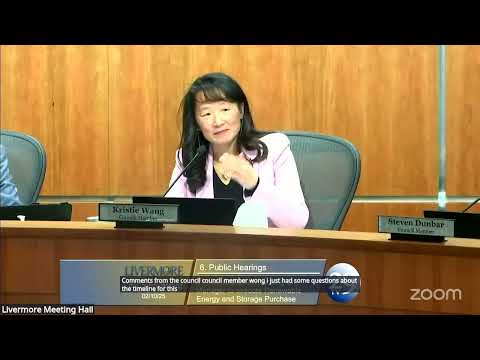
The Livermore City Council unanimously approved a 25-year power purchase agreement with AVA Community Energy on Feb. 10 to install solar panels and battery storage at five city facilities, city staff said.
City sustainability program manager Tricia Mento told the council the project covers City Hall, the Civic Center meeting hall, the maintenance service center, the police department and the water reclamation plant. Mento said the systems are intended to improve energy resilience by providing backup power during emergencies, reduce energy costs by discharging battery power when grid electricity is more expensive, and lower reliance on diesel generators. "The item before you tonight is consideration of a 25 year power purchase agreement with Ava Community Energy," Mento said.
The project will add solar carports that shade parking spaces: about 36 spaces at City Hall, 20 at the police department and four at the Civic Center meeting hall, Mento said. Under the proposed contract, private developers will install, own, operate and maintain the systems; the city will pay monthly for electricity generated and a flat storage fee, with staff saying those payments are expected to be less than current grid costs and that the project requires no upfront capital investment by the city. The staff report also said the city is able to "grandfather" the facilities under the state's prior net energy metering laws if systems are installed by about April 15, 2026, a key financial assumption for projected savings.
JP Ross, vice president of local development at AVA Community Energy, explained the agreement term and schedule: "The term of the agreement is a 25 year power purchase agreement from when the systems would be installed," and the team expects systems to be installed and operational in early 2026, with permit submissions and long-lead equipment ordering to begin within months if the council approves the project.
Public commenters were split. Trish Monroe, speaking as a representative of East Bay Community Energy, said the project "will make a step in the right direction" and urged council support. Other speakers raised questions about storage sizing and comparative electricity rates. Staff acknowledged supply-chain and tariff risks that could affect pricing and said the city manager would have authority to finalize the agreement provided the pricing and feasibility issues are resolved and the agreement remains substantially the same as the version reviewed by council.
Council members cited the ability to preserve prior net energy metering compensation, the project’s resiliency benefits for critical facilities and the lack of upfront cost as reasons to approve the project. A motion to adopt the staff recommendations passed unanimously.
The council’s action authorized staff to adopt two resolutions as recommended in the agenda packet: finding the project exempt from the California Environmental Quality Act and authorizing the city manager to execute an agreement in substantially the same form as presented, contingent on final pricing and feasibility confirmations. Installation and operations will proceed under agreements with AVA’s chosen developer/financier team, identified in the staff presentation as Greenbridge and Gridscape.
Councilmembers and staff said they expect the installation phase to be phased by site complexity, with the water reclamation plant among the earliest sites due to longer lead-time equipment needs. The city did not commit to additional sites beyond the five included in the proposal; staff said they evaluated other facilities and found limited additional economic value across the broader portfolio.
If the council-approved agreement moves forward, staff will return required executed documents and proceed with permits and equipment procurement under the terms authorized by the council.