Get Full Government Meeting Transcripts, Videos, & Alerts Forever!
Get email alerts on the Airport Conversion topic
No spam. Unsubscribe anytime.
Santa Monica council advances planning work on airport conversion after extensive public debate; adopts transit prohibition ordinance
Summary
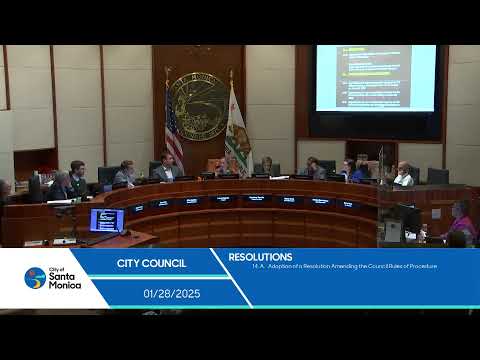
Santa Monica City Council members spent the bulk of their Jan. 28 meeting on further planning for the conversion of Santa Monica Airport, hearing a staff-led summary of nearly a year of community engagement and debating competing visions for the 192-acre site. Council members also approved a transit-related ordinance giving the city new authority to issue temporary prohibition orders to problem transit riders and adopted several routine calendar items and appointments.
Santa Monica City Council members spent the bulk of their Jan. 28 meeting on further planning for the conversion of Santa Monica Airport, hearing a staff-led summary of nearly a year of community engagement and debating competing visions for the 192-acre site. Council members also approved a transit-related ordinance giving the city new authority to issue temporary prohibition orders to problem transit riders and adopted several routine calendar items and appointments.
City planners and consultants told the council that phase 2 outreach for the airport conversion project drew thousands of online engagements and hundreds of in-person contacts, producing five draft “guiding principles” — "start with nature," "inspire wonder," "balance economics," "amplify versatility" and "celebrate place." Sasaki, the city’s design consultant, and city staff said those principles will frame phase 3 work: three contrasting scenario studies that will show different mixes of park, cultural, recreational and revenue-generating uses, plus preliminary financial strategies and time frames for implementation.
The presentation and the public comment that followed made clear the depth of disagreement in the community. Hundreds of speakers filled the council chambers and dozens addressed the airport item; dozens of written comments were submitted. Supporters of an "LC-compliant Great Park" urged the council to use the airport land as public open space and recreation fields, and said a large park would provide long-term environmental and quality-of-life benefits. Advocacy groups, youth speakers and longtime neighborhood organizations emphasized the city’s shortage of parkland and called for preserving and activating open space.
Other speakers, including workers, hotel and hospitality employees and organizations that represent artists and arts tenants, urged that the planning study examine options that include significant amounts of affordable housing or mixed uses to serve local workers and reduce long commutes. Several speakers urged that proposals also examine financing options — including public-private partnerships, naming rights, special financing districts and phased development — so that long-term maintenance and operations would be sustainable without placing the full burden on city general funds.
City staff and the consultant team said the phase 3 work will try to show the tradeoffs and costs of different mixes of uses and to identify delivery strategies that could reasonably be implemented. Staff repeatedly told the council the project will not presuppose an outcome; it will study feasible alternatives and the environmental review needed to advance whichever preferred scenario the council ultimately approves.
Separately, the council adopted an ordinance (item 10a) implementing provisions of Senate Bill 1417 that allow the Santa Monica Department of Transportation to issue short-term prohibition orders to people cited or arrested repeatedly on Big Blue Bus property. Lisa He (Department of Transportation) reviewed the new administrative process, which includes training requirements for staff, an advisory committee to provide oversight, an appeal process for people subject to orders and limited exemptions for essential travel (medical, work or legal appointments). The ordinance passed on first reading and was adopted by roll-call vote, 7-0.
The council also approved an ordinance updating rules for use of the city seal and other city symbols (item 10b) and handled a number of routine items, including appointments to commissions and committees.
Votes at a glance - Ordinance (10a) to allow DOT prohibition orders for disruptive transit riders: adopted (roll call) 7–0. (See staff presentation by Lisa He; ordinance text and training/appeal requirements were discussed.) - Ordinance (10b) amending city code on use of the city seal and other symbols: approved by voice vote. - Consent calendar: approved 7–0. - Public-comment time limits: Council approved shortening general non-agenda public comment to one minute earlier in the meeting (voice vote) and later adopted a one-minute limit for a set of agenda public-comment periods by roll call (6–1). The council also agreed to give students longer time in selected slots. - Council rules/procedure amendments: the council approved an update of its rules (including direction to study ranked-choice procedures and timed remarks) with specific parts held for staff implementation; the final amended rules were adopted by vote (roll call recorded 7–0 for the package after moderation where staff will return with implementation details for ranked-choice and timing mechanisms).
Why it matters The airport conversion is among the largest public‑land decisions in the city’s recent history: the site spans nearly 200 acres and is the only contiguous parcel large enough to become a single, large urban park. How the council frames the next phase of analysis — and whether it studies scenarios that include below-market housing, major cultural venues or largely park-only outcomes — will strongly shape what planning, environmental review and ballot questions (if any) follow. The transit ordinance changes city practice and give DOT an administrative tool to address repeat disruptive behavior on buses while preserving limited appeal and essential-travel exceptions.
What happens next Staff and Sasaki will return with phase 3 materials over the coming months: three contrasting, site-level scenario studies, feasibility and early cost estimates, and an expanded community-engagement schedule. The council directed staff to explore fiscal strategies and public-private partnership models during that work. The DOT prohibition ordinance now proceeds to implementation steps the ordinance prescribes (training, advisory committee and public notice). Several commission and committee appointments made at the meeting will be filled as advertised, and the council's revised rules will be phased in after staff returns with implementation details for ranked-choice voting and timing changes.
Ending note Council and staff repeatedly told the chamber that substantial public engagement will continue through phase 3; the next public milestone will include published scenario diagrams and further community workshops so residents can compare concrete options rather than summaries. The council's stated schedule aims to keep the project moving while preserving opportunities for more targeted outreach and financial analysis.