Get Full Government Meeting Transcripts, Videos, & Alerts Forever!
Get email alerts on the State Housing Legislation topic
No spam. Unsubscribe anytime.
City staff brief commission on roughly 30 new 2024 state housing laws and likely code updates
Summary
Planning staff summarized about 30 state laws from the 2024 California legislative session that affect housing elements, RHNA, builders' remedy, ADUs, CEQA exemptions, fees, renter protections and transit‑based parking rules; staff said many changes require further guidance and local code amendments.
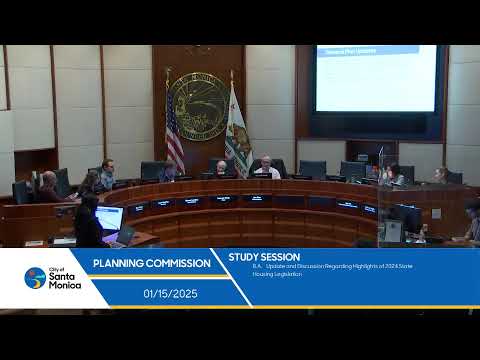
"I'm here tonight to present the an legislative update on the 20 24 California legislative session," Rachel, planning staff, told commissioners during the Jan. 15 study session. Rachel said staff identified roughly "30 bills that just addresses housing and homelessness alone," covering RHNA and housing elements, the Housing Accountability Act, density bonus and ADU law changes, CEQA exemptions, fee timing, and renter protections. "Unless otherwise noted, all of these bills went into effect 01/01/2025," Rachel said, adding that staff are still reviewing the full implications and awaiting guidance from the California Department of Housing and Community Development (HCD) on several items.
Staff highlighted several items and likely local impacts: AB 3093 (noted in the presentation as "AB 30 93") changes housing element reporting and adds new income categories for the next RHNA cycle, including an "acutely low income" group; SB 7 and related bills modify RHNA procedures at the regional level; AB 1893 revises the Housing Accountability Act's definition of a "housing project" and amends builders' remedy provisions; SB 11211 (presented as SB 12 11) increases the allowable number of detached ADUs on multifamily lots (up to eight, subject to limits) and other ADU changes will require code updates; AB 2553 (presented as AB 25 53) expands the definition of a "major transit stop," enlarging transit priority areas and affecting when parking requirements apply; and multiple bills defer collection of some development fees until final inspection or certificate of occupancy.
Rachel cautioned that many of the bills are procedural or cleanup but that some will require local code amendments, implementation plans, or HCD guidance. On SB 1123/AB 3116 and similar measures, staff said they will "copy and paste literally from state law" into local code where required, but other items—such as a July 1, 2025 effective law expanding eligibility for administrative subdivision approval—are "a little hairy" and staff are seeking HCD guidance.
Commissioners asked about practical implications: one commissioner noted the expanded transit priority areas could change parking requirements on parts of Lincoln Boulevard, prompting staff to point out that the city has already reduced parking requirements for most housing projects but that commercial projects may still be affected. Commissioners also questioned whether the new definitions and timelines would force staff to "drop what you're doing" and reprioritize work; staff said some adjustments will be needed but that ongoing projects (for example the Local Coastal Program work) are not required to stop.
Staff closed by reiterating that the summary is preliminary, that HCD guidance and further staff analysis will refine the city's response, and that council direction and code amendments will follow as needed. The presentation did not produce a formal vote; staff said they will return with specific code change proposals for commission and council consideration.