Get Full Government Meeting Transcripts, Videos, & Alerts Forever!
Get email alerts on the Black Belt Drive Through topic
No spam. Unsubscribe anytime.
Planning board accepts Black Belt LLC drive‑through application, continues public hearing after extensive resident concerns
Summary
The board accepted the Black Belt LLC site‑plan application for a proposed drive‑through restaurant at the Marcy Hill Road/Route 12 intersection as complete, heard extensive public comment on traffic, wetlands and circulation, and continued the public hearing to request additional studies and plan revisions.
The Swansea Planning Board accepted as complete the site‑plan application submitted by Black Belt LLC for a proposed drive‑through restaurant at the southern corner of Marcy Hill Road and Route 12 (tax map 220 lot 5), then opened the public hearing and took extended public comment before continuing the hearing to the board’s next scheduled meeting.
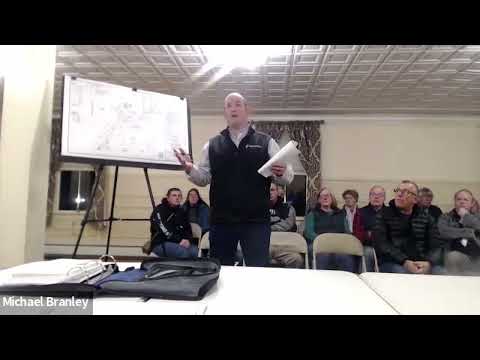
Mark Bodrey (Civil New England), presenting for Black Belt LLC, described the property as 15.3 acres with a conceptual 1.8‑acre parcel identified for the proposed 3,380‑square‑foot building and drive‑through circulation. He said the owners, Steven and Lonnie Giordano, purchased the land from the town and currently have no tenant lined up; the site plan is intended to enable marketing to prospective tenants. Bodrey said the conceptual floor plans show a potential occupant load of about 30 people and that a conservative parking calculation would require roughly 10 parking spaces; the plan as revised exceeded the zoning requirement.
Bodrey also said the plan includes an on‑site well and a subsurface septic system located roughly 75–80 feet from mapped wetlands, which he said exceeds New Hampshire DES minimum set‑backs in comparable circumstances. He described a stormwater design with a wet pond and orifice outlet intended to reduce peak flows to the wetlands. He told the board the project would not use underground fuel storage—only an above‑ground propane tank was proposed—and that the applicant does not yet have a tenant lined up.
Planning staff and board members noted two parallel regulatory pathways that will affect the project: (1) the town requires a special exception for a drive‑through in the business district, and (2) New Hampshire DES and the town’s conservation commission will review wetlands and alteration of terrain permitting. Bodrey said the plan as submitted reflected comments received from the town and DOT District 4, and that the team had adjusted driveway locations based on DOT and town feedback.
Public comment was extensive. Dozens of residents raised concerns about traffic safety on Marcy Hill Road and Route 12—particularly at the flat spot at the bottom of Marcy Hill where sight lines worsen and vehicles often approach at high speed—peak‑hour backups, school buses, snow and ice, and potential queuing from the drive‑through spilling onto Marcy Hill or Route 12. Residents also raised wetlands and historic fill issues from prior decades; planning staff noted town files and older agency letters showing past involvement by DES and the U.S. Army Corps of Engineers related to fill on the property dating to the 1980s.
Board members and staff required the applicant to address several items before another hearing: updated site plans reflecting the revised circulation patterns (including the DOT‑reviewed Route 12 driveway option), a traffic study focusing on Marcy Hill and the Route 12 intersection at relevant times of day, a snow‑storage plan, a drainage/treatment detail showing how winter road treatments and plowed snow will be managed, an updated lighting and landscape plan, a specific location for trash containment and a perimeter trash fence, and confirmation of wetlands/permitting strategy (including any DES or Army Corps permits). The board also noted that a pending town zoning amendment that would restrict crossing wetlands might affect the project and that building permits could be withheld if the zoning change is adopted before final permits are issued.
Given the public comment and outstanding technical items, the board continued the public hearing to its next meeting on February 27 and instructed the applicant to return with the requested studies and revisions. The board voted to continue the hearing by voice vote; no roll‑call tally appears in the transcript.