Get Full Government Meeting Transcripts, Videos, & Alerts Forever!
Get email alerts on the Meeting Procedure topic
No spam. Unsubscribe anytime.
Delray Beach commission holds Robert's Rules training to clarify meeting procedures
Summary
Commissioners attended a workshop led by professional parliamentarian Tim Wynne on Feb. 18 to review Robert's Rules of Order, local rules for agenda changes, points of order, appeals, motions and voting procedures, including a city rule that silence is counted as an aye.
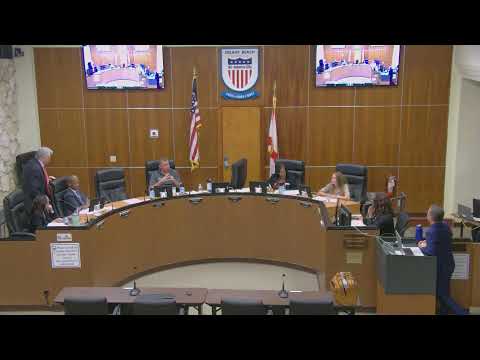
Delray Beach City Commission commissioners set aside their regular agenda on Feb. 18, 2025, for a 90-minute training session led by Tim Wynne, a professional parliamentarian, who reviewed Robert's Rules of Order and how they interact with the commission's local rules.
The session was scheduled from 3:30 p.m. to no later than 5:00 p.m. and was introduced by the mayor after a roll call that established a quorum. Mayor Carney thanked colleagues for attending and praised the workshop's tone, saying the commission had “made some good progress towards [a] positive, respectful atmosphere up here.”
The training covered the hierarchy of governing documents, the difference between debate and informal discussion in small boards, how to properly amend and adopt agendas, rules for points of order and appeals, and practical vote-taking procedures. Wynne summarized the purpose of parliamentary law as “to facilitate the smooth and orderly transaction of business in a meeting.” He emphasized that the highest-ranking authorities are procedural rules and state statutes, followed by a local charter, local rules of procedure, the parliamentary authority (commonly Robert's Rules of Order) and standing rules.
Wynne told commissioners that as a five-member body they generally fall under Robert's Rules' small-board provisions, which allow more informal discussion when no motion is pending, but he cautioned that ‘‘once a member makes a motion, then there’s really no distinction between a large assembly and a small board’’ and formal debate rules apply. He also explained that a pre-circulated agenda is amendable when it is being considered for adoption, and once adopted it can be changed only by a two-thirds vote, a majority of the entire membership, or unanimous consent, unless local rules provide otherwise.
On points of order and appeals, Wynne explained that a point of order is used ‘‘to point out a violation of the rules’’ and can be raised by any member without recognition if the violation is timely. The chair must rule on a point of order; members may appeal that ruling. Under Robert's Rules an appeal vests the question in the assembly for final decision and is overturned by a majority voting in the negative. Wynne noted that the commission’s own local rules require that appeals to the commission be decided without debate and by a majority vote.
The presenter reviewed motion procedure (a motion, a second, and the chair stating the question), the distinction between a motion in form and substance, and the importance of clarity in the wording of motions. He said seconds are not required under Robert’s Rules for small boards or for committee-recommended motions, but acknowledged that the commission’s local rules effectively require seconds.
On voting, Wynne explained that under Robert’s Rules abstentions ‘‘do not affect the vote at all.’’ He also flagged a Delray Beach-specific rule discussed during the training: the commission’s local rules state that a commissioner’s silence will be counted as an aye vote. The presenter and commissioners discussed the implications of that rule and reiterated the value of consistency in applying rules to avoid legal risk.
Wynne also described unanimous consent as a time-saving device, explained the use of parliamentary inquiries as a softer alternative to points of order, and advised commissioners to speak to the merits of a pending motion and to avoid personal attacks or impugning motives during debate.
The session closed with procedural questions from commissioners about public notice requirements, when items require formal notice versus being placed on an agenda, and the difference between public notice and notice to members. The chair concluded by calling for a short recess before the next meeting.
The workshop was instructional: it reviewed recognized sources and local deviations, clarified procedures commissioners can use (points of order, appeals, parliamentary inquiries), and highlighted several Delray Beach-specific practices that affect how votes and agenda changes are handled.