Get Full Government Meeting Transcripts, Videos, & Alerts Forever!
Get email alerts on the Climate Action topic
No spam. Unsubscribe anytime.
Green board asks city to make climate action plan goals central: equity, trees, microplastics and data collection
Summary
The Green Implementation Advancement Board reviewed its 2024 priorities and urged the commission to use a Climate Action Plan (CAP) framework to guide energy, tree canopy, waste and transportation work; the board also highlighted public survey support and recommended further data collection and outreach.
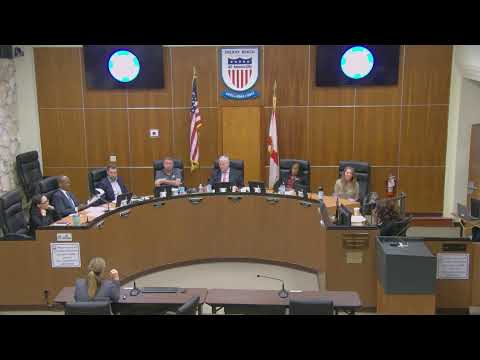
The Green Implementation Advancement Board presented its annual report on Feb. 18, urging the Delray Beach City Commission to use a city-specific climate action plan (CAP) as a framework for energy efficiency, green infrastructure, waste-reduction and transportation priorities.
Evan Orianna, chair of the Green Board, said the CAP recommendations first presented in 2023 and updated in 2024 should drive next steps. Orianna told the commission the board’s survey of residents generated several hundred responses and that “more than 80% of the respondents supported taking action.” Ken Edwards, the city’s sustainability officer, joined Orianna in outlining work already underway and near-term priorities.
Why it matters: The CAP would guide city policy on greenhouse-gas reductions, green building standards, tree canopy targets and stormwater resilience. Board members framed equity and public education as central goals of any plan.
Key points from the board’s year-in-review: - Energy and built environment: the board reaffirmed support for the city’s green building ordinance adopted in prior years and called for improved data collection to measure energy performance and the ordinance’s effects. - Green infrastructure and trees: the board highlighted an active tree-planting program and a recent tree drop-off effort to increase plantings and improve canopy in low-canopy neighborhoods. The board urged a certified city arborist or cross-department arborist role to support tree protection and maintenance. - Waste and microplastics: the board recommended environmentally preferred purchasing (EP3) and a focus on single-use plastics reduction; members noted state preemption limits some local restrictions but encouraged voluntary downtown business engagement. - Transportation and water: the board recommended advancing pedestrian and bicycle master-plan priorities, worker shuttle coordination with the Tri-Rail station and strengthening stormwater infrastructure for more frequent extreme rainfall events.
Commissioners thanked the board and asked about staffing resources. Commissioner Casal noted the state preemption on polystyrene but suggested the city consider a grant program to seed outplanting and reef restoration funding (later discussed in the reef restoration presentation). Commissioner Markert asked whether the city has a certified arborist on staff; staff said that the city has tree-care personnel but recommended considering a certified arborist for cross-department work.
Next steps: The board recommended identifying measurable CAP goals, strengthening outreach for equity and educational work, and pursuing state and private grant opportunities for tree-planting and waste-reduction pilots. The board also proposed continued monitoring and evaluation of the green building ordinance and improved data collection.
Ending: The commission received the report and thanked the board for the work; no formal vote was requested tonight but staff and the commission will continue coordination on CAP implementation and prioritized projects.