Get Full Government Meeting Transcripts, Videos, & Alerts Forever!
Get email alerts on the Civil Protections topic
No spam. Unsubscribe anytime.
Committee hears bills to protect jurors, adults at risk and prohibit nonconsensual deepfake explicit images
Summary
The Senate Judiciary committee took public testimony on bills to criminalize threats to jurors and their families (SB 5), strengthen protections for "adults at risk" including asset freezes for alleged financial exploitation (SB 15), and prohibit nonconsensual sexually explicit deepfake images and theft of intimate images (SB 33).
The Senate Committee on Judiciary and Public Safety held a public hearing on three bills addressing jury intimidation, protections for adults at risk, and the creation and distribution of nonconsensual sexually explicit deepfake images.
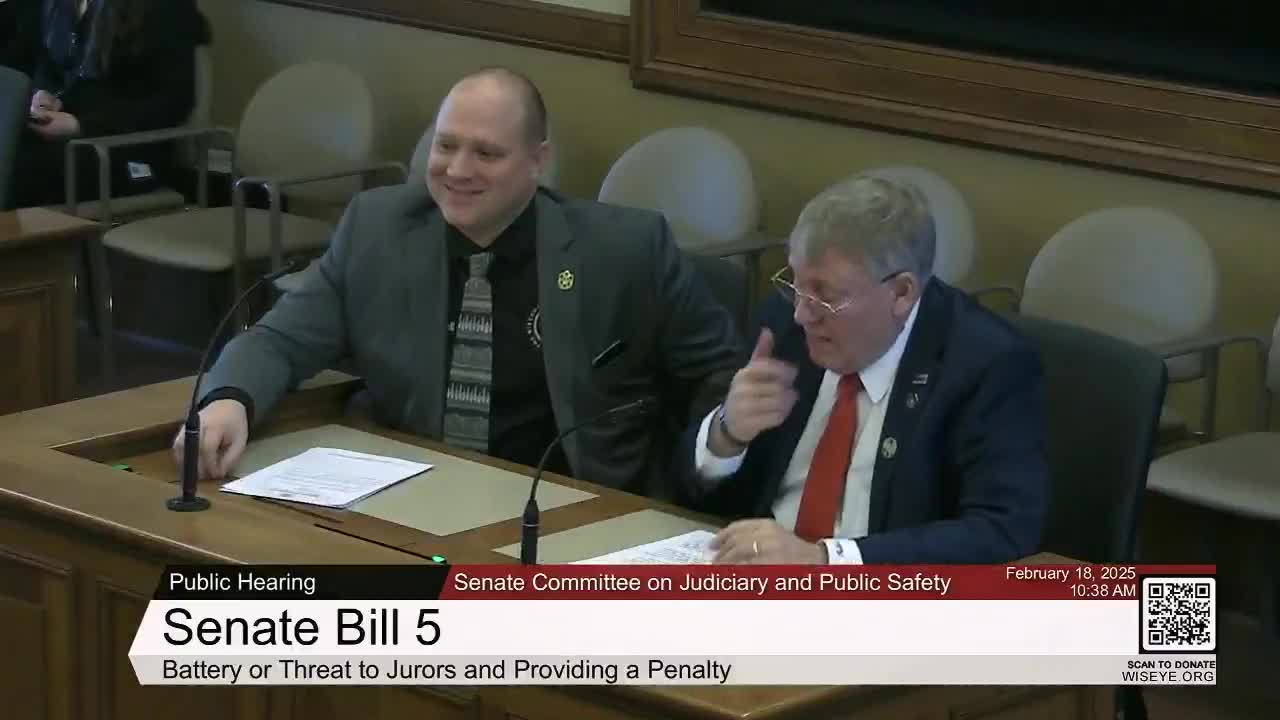
Senate Bill 5 (juror threats): The sponsor described SB 5 as a measure to treat threats against jurors — and threats against a juror’s family — with the same felony-level penalties that currently apply to physical battery against jurors. The sponsor said the bill would allow judges to bar a person convicted of a crime from contacting a juror, similar to existing authority to bar contact with victims or witnesses. The sponsor and Representative Sartwell, who coauthored the measure, said jurors and their families should be protected from threats that could improperly influence verdicts. During committee questioning, members discussed a drafting fix from the prior session that had unintentionally reduced penalties; the current draft restores the intended felony level.
Senate Bill 15 (adults at risk): The committee heard from the bill sponsor about aligning protections for "adults at risk" — defined in statute as an adult whose physical or mental condition substantially impairs their ability to care for themselves and who is experiencing or at risk of abuse, neglect, self-neglect, or financial exploitation — with statutes that currently protect people age 60 and older. The measure would allow prosecutors to seek asset freezes when a defendant is charged with financial exploitation of an adult at risk, permit certain hearings by telephone or live audiovisual means, increase penalties for sexual misconduct when the victim is an adult at risk, and allow sentence enhancements where appropriate. The sponsor said the Wisconsin Board for People with Developmental Disabilities and the Alzheimer's Association support the measure; a board representative registered in favor.
Senate Bill 33 (deepfake explicit images): The committee heard from the Senate author that advances in artificial intelligence are facilitating the creation and dissemination of nonconsensual sexually explicit images (so-called "deepfakes"). SB 33 would make it a felony to create, store, reproduce, or disseminate sexually explicit deepfake images without the depicted person's consent and a misdemeanor to reproduce intimate images that were taken voluntarily but not intended for wide sharing. The sponsor told the committee the proposal is a redraft of a 2023 bill that previously passed the Senate and would also criminalize hacking or stealing intimate images from a device.
Committee reaction and context: Committee members questioned drafting details, the interplay with existing statutes, and operational issues such as how adult-at-risk status would be determined in practice and how restrictions on contact or asset freezes would be implemented. Several members described the bills as aimed at protecting vulnerable people and the integrity of the justice system; others raised concerns about proof standards and potential prosecutorial discretion in applying aggravators.
No committee votes on these bills were recorded during the hearing portion on the transcript; the items were discussed and the committee carried over its roll call from the executive session. Each bill’s authors asked for the committee’s support and the record shows bipartisan references to refining technical language ahead of possible votes.