Get Full Government Meeting Transcripts, Videos, & Alerts Forever!
Get email alerts on the Criminal Justice topic
No spam. Unsubscribe anytime.
Committee splits on bill to limit judge-initiated complaints against officers in officer-involved deaths; advances with no recommendation
Summary
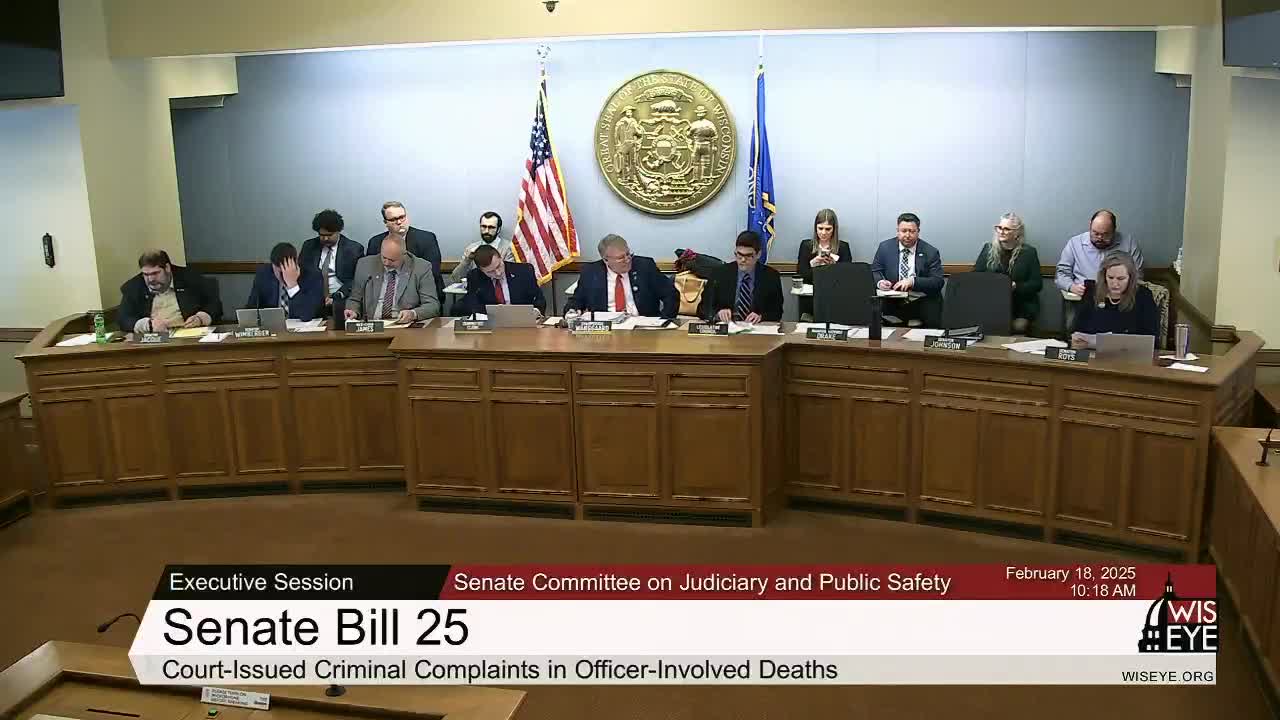
The Senate Judiciary committee advanced Senate Bill 25 on a 4–4 tie, recording no committee recommendation for a bill that would bar judges from permitting complaints against law-enforcement officers in officer-involved death cases absent new or unused evidence.
The Senate Committee on Judiciary and Public Safety forwarded Senate Bill 25 with no recommendation after a 4–4 tie. The bill would limit a judge’s authority to permit the filing of a complaint against a law-enforcement officer involved in a death unless the judge finds new or unused evidence that warrants further review.
Why it matters: The proposal drew sharply divided views at the committee hearing. Opponents said the measure denies families and victims an avenue for independent judicial review that exists for other suspects; supporters said the measure protects officers from indefinite, duplicative investigations after full inquiries have already concluded.
What the bill does: Committee counsel summarized current law as generally vesting charging discretion with district attorneys but preserving a process for a judge to independently determine whether charges should be brought when a district attorney declines. SB 25 would bar a judge from permitting the filing of a complaint against a law-enforcement officer in an officer-involved-death case unless there is new or unused evidence presented at the hearing.
Committee debate: Senator Rice argued the bill would “lose an avenue for justice” for families whose loved ones died in encounters with officers and said it grants “a special privilege” to officers that other defendants do not receive. Rice cited memoranda from the state bar and the ACLU that raised concerns about unequal treatment and described practices in which officers can make additional statements after reviewing video evidence.
Senator James, identifying himself as a former law-enforcement officer, contended that the process for interviewing officers is not mischaracterized in testimony and said the bill still allows a judge to act when new or unused evidence is presented. He and other supporters described cases in which officers underwent repeated investigations and said the bill would prevent perpetual re-investigation once adequate evidence had been examined.
Senator Drake and others said the proposal risks sending the wrong message to victims and their families and would inappropriately restrict their access to judicial review in serious officer-involved death cases.
Committee action: The committee recorded a tied vote (4–4) and advanced SB 25 without a committee recommendation. The transcript shows an earlier passage entry in the hearing that the measure "passes" during an on-the-record vote, but the executive-session summary documents the outcome as a 4–4 tie and advancing with no recommendation.
Next steps: Because the committee produced no recommendation, SB 25 may next be considered by the full Senate under the chamber’s procedural rules; the committee record left its roll call open during the session and carried it over to the end of the hearing.
The record shows sustained, substantive debate over the balance between protecting officers from repeated probes after full investigations and preserving access to judicial review for families and victims in officer-involved deaths.