Get Full Government Meeting Transcripts, Videos, & Alerts Forever!
Get email alerts on the East Bank Development topic
No spam. Unsubscribe anytime.
East Bank authority organizes; Metro outlines $33M in infrastructure, bike‑ped plans and timelines
Summary
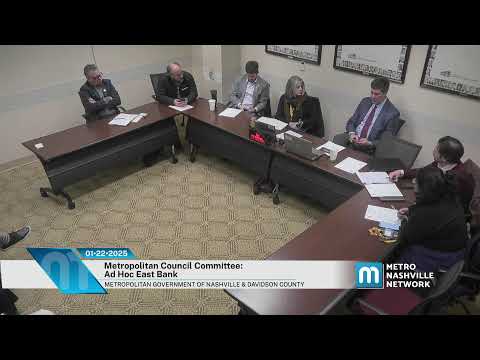
Ms. Reynolds, who led the presentation to the East Bank Committee on Wednesday, said the East Bank Development Authority has taken initial steps to organize and that the administration is working toward a package of transfers and agreements to make the authority operational.
Ms. Reynolds, who led the presentation to the East Bank Committee on Wednesday, said the East Bank Development Authority has taken initial steps to organize and that the administration is working toward a package of transfers and agreements to make the authority operational.
“At the time y'all passed the legislation last August, the authority really needed 5 things to really come into existence,” Ms. Reynolds said, listing a board, a CEO, assets, employees and operating funds. She told the committee the authority’s board has been appointed, the mayor’s office is conducting the CEO search, and the board “would meet once a month.”
The update to the committee summarized several concurrent items that will shape the next phases of East Bank development: (1) a capital spending plan adopted in December that includes about $33 million for East Bank infrastructure and planning; (2) planned intergovernmental agreement (IGA) language that the administration hopes the authority and Metro Council will approve this spring; (3) ongoing design work on pedestrian and bicycle circulation; and (4) the developer Fallon’s initial site sequencing and a rough construction timeline.
Why it matters: the East Bank redevelopment spans many blocks and will require large, multi‑year infrastructure investments, traffic and transit changes, and coordinated construction sequencing. Committee members pressed staff for timelines and opportunities for public input because decisions about the boulevard cross section, bicycle access and right‑of‑way acquisitions will shape how dense and walkable the new neighborhood becomes.
Key details from the presentation and discussion
- Capital spending and right‑of‑way: Ms. Reynolds said the package the council approved in December contains roughly $33,000,000 “and change” for NDOT‑related infrastructure and connectivity on the East Bank, with about $14,600,000 of that identified for right‑of‑way acquisition. She cautioned that the $700,000,000 figure often cited for East Bank projects in prior capital plans is a snapshot and that Metro’s eventual share could differ: “the total amount of infrastructure from 1 end of the East Bank to the other, will certainly be higher, than what's in the capital improvements budget now,” she said.
- Authority formation and IGA timing: Ms. Reynolds said the administration plans to use an intergovernmental agreement to transfer operating funds, certain assets and employees into the authority and that staff hope the authority will take up the IGA in April and the Metro Council will consider it in May, with the goal of the authority being fully operational for the fiscal year that begins July 1.
- Board organization and governance steps: The board met for the first time on the day of the committee meeting and took organizational steps including scheduling monthly meetings and pursuing bylaws and separate legal representation so the authority can negotiate with private partners without a conflict of interest.
- CEO search: Ms. Reynolds said the mayor’s office hopes to complete a CEO hire by February, or March at the latest, so the hire can review the IGA before it is finalized.
- Fallon development sequencing and timing: Staff said Fallon will begin work closest to the football stadium where infrastructure constraints are fewest. Fallon told staff it expects to break ground on the first two buildings—likely a hotel on Parcel C and an affordable housing building on Parcel G—“in the second half of ’26.” Staff noted that other parcels and building timetables depend on market conditions and incentives in the development agreement.
- Pedestrian and bicycle circulation and East Bank Boulevard: Staff showed a developer‑generated circulation diagram and said it depicts a vision with multiple pedestrian and bicycle choices rather than a single route. Anna Bridal (Metro Planning) and Ben York (INDATA, East Bank program team) both explained that design details are still being developed. Bridal said the darker green on the diagram shows planned grade‑separated, protected bikeways, and that cross‑section details (curbs, planters, trees, elevation) remain to be decided.
- NEPA/public meeting: Ms. Reynolds said NDOT will lead the NEPA process required to secure federal funding for East Bank Boulevard, and staff are targeting a public meeting for late February or March to show cross‑section options. She emphasized the trade‑off to be shown at that meeting: a cross section wide enough to accommodate buses, cars and protected bike lanes will feel very wide; a narrower cross section will require providing protected bike facilities on adjacent streets so the boulevard can still serve transit needs.
- Pedestrian bridge and riverside ramps: Staff presented several conceptual ramp options to connect the pedestrian bridge down to the riverfront. They noted CSX railroad tracks near the river constrain some options; ramps or structures that would cross active tracks cannot be built unilaterally until track ownership or operations change.
- Parking and financing: Staff said a parking structure will be part of early planning for Parcel C (Parcel C is roughly seven acres) but that final decisions and financing are unresolved. Staff discussed a potential approach using GO bonds with reimbursement from a 50% sales‑tax capture of the 100+ acre area around the stadium, and noted the East Bank team has engaged a parking consultant to refine counts and timing.
- TPAC and MOU reference: Staff reminded the committee that a nonbinding memorandum of understanding (MOU) approved last year referenced a non‑dismount option to get cyclists from the bridge to river level. Staff said that concept was originally anticipated to be on TPAC’s parcel but may not be feasible there; the MOU obliges discussion but the location and financing remain unresolved.
What was decided and what remains: The new authority’s board agreed to pursue bylaws and separate legal counsel and scheduled monthly meetings (next authority meeting: Feb. 19 at Nissan Stadium), but no final transfer of assets, formal IGA or financing mechanism was adopted at the committee meeting. Staff repeatedly framed many items as conceptual or in draft form and said public engagement and NEPA processes will take place before final cross‑section and design decisions.
Selected direct quotes (all from the meeting transcript):
- “At the time y'all passed the legislation last August, the authority really needed 5 things to really come into existence,” — Ms. Reynolds, presentation lead.
- “I guess they also decided today that, they would meet once a month.” — Ms. Reynolds.
- “The darker green are the planned dedicated grade separated protected bike lanes.” — Anna Bridal, Metro Planning.
- “Yeah. So we had a TDOT coordination meeting today.” — Ben York, INDATA, East Bank program team.
What to watch next: staff said they expect an IGA to be shared with the authority in the coming months, with possible authority action in April and Metro Council consideration in May; NEPA/public‑meeting notice for East Bank Boulevard is expected within weeks of the meeting and would require roughly a 30‑day public notice once scheduled. Fallon’s first buildings could break ground in the second half of 2026, and the stadium construction work remains on track for a 2027 opening, according to staff and an on‑site consultant referenced at the meeting.
Ending: Committee members asked for continued coordination and early notice so they can provide input as authority bylaws, the IGA and public‑facing NEPA materials are developed. Staff said they will share dates and invited committee members to provide examples of bike/ped infrastructure they prefer.