Get Full Government Meeting Transcripts, Videos, & Alerts Forever!
Get email alerts on the Local Food Systems Urban Ag topic
No spam. Unsubscribe anytime.
Delegate Kent Roberson seeks to expand urban agriculture property‑tax credit to include value‑added products, beekeeping and composting
Summary
Delegate Kent Roberson told the committee HB 907 would broaden eligibility for county discretionary urban‑farm property‑tax credits so more small and beginning urban farms can qualify; farmers, nonprofit groups and the Maryland Department of Agriculture supported the change.
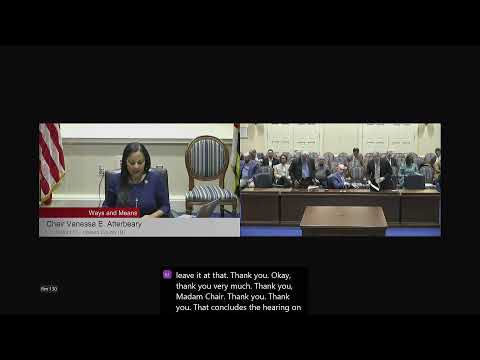
Delegate Kent Roberson presented House Bill 907 on Feb. 18 to expand the statutory language that allows counties to offer an urban agricultural property‑tax credit. He told the Ways and Means Committee the change clarifies and broadens eligible uses to include production of value‑added agricultural products, beekeeping, raising livestock, composting, and pollinator habitat creation and maintenance.
Nut graf: Supporters, including small and beginning urban farmers, county agricultural development representatives and the Maryland Department of Agriculture, said the current statutory definition and size limits exclude many real‑world urban farms and that the change would help small operations access tax relief designed to support production close to communities.
Northern Baltimore farmer Nick Healy described his 1‑acre Community Toss Farm and said intensive, regenerative production on small parcels can yield tens of thousands of pounds of food and support 26‑week subscription programs and farmers markets. Testimony from the Southern Maryland Agricultural Development Commission and Prince George’s County food equity organizations emphasized urban farms’ roles in food access, education and youth programs; the Prince George’s Food Equity Council’s acting director asked that recipients be required to sell or donate at least $1,000 of farm goods to ensure community benefit.
Maryland Department of Agriculture staff told the committee current statutory definitions (e.g., 1/8 up to 5 acres, priority funding area restrictions) exclude many urban farms from eligibility; MDA said expanding the definition would let jurisdictions implement county legislation consistent with local conditions. The Maryland Municipal League testified in opposition, arguing the bill alters an optional local credit and expands definition beyond crop production to include value‑added enterprises that MML said should be considered separately.
Ending: The sponsor asked for a favorable report; opponents urged caution about changing an optional county tool and suggested separate credits for different uses. No committee vote was recorded at the hearing.
Sources: Committee hearing transcript, Feb. 18, 2025 (presentation by Delegate Kent Roberson; testimony from urban farmers, SMADC, Prince George’s Food Equity Council and MDA).