
Douglas County adopts tiny‑house rules required by Nevada law, sets zoning and building limits
Get AI-powered insights, summaries, and transcripts
Sign Up Free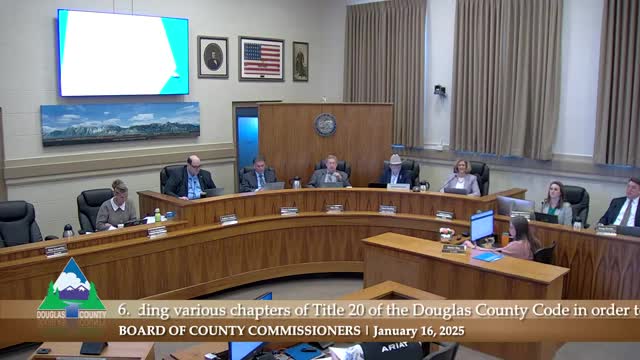
Summary
The commission unanimously adopted an ordinance implementing NRS 278.253 to allow tiny houses (<=400 sq ft) as accessory dwelling units and, in some districts, as single‑family residences. Commissioners stressed building‑code, foundation and public‑safety requirements; public speakers raised wildfire and emergency staffing concerns.
Douglas County commissioners unanimously adopted a zoning ordinance Jan. 16 to implement Nevada law (NRS 278.253) permitting tiny houses in county code. The ordinance (20‑24‑16‑45) clarifies where and how tiny houses may be located and regulated in the county.
Planning staff explained the countys rules mirror the 2018 International Residential Code definition of a tiny house (a dwelling of 400 square feet or less, excluding lofts), and distinguish two common uses: tiny houses as accessory dwelling units and tiny houses used as a primary single‑family residence. Under the adopted text, tiny houses used as single‑family dwellings are allowed only in manufactured‑home overlay zoning districts; tiny houses used as accessory dwelling units are allowed on half‑acre lots where the county already permits ADUs.
The ordinance requires tiny houses to meet building‑code standards (2018 IRC and Appendix Q where adopted) and utilities must be hard‑plumbed and hard‑wired (no RVs or travel trailers allowed as permanent tiny houses). Staff told commissioners that permanent foundations or stem‑wall foundations will be required in new tiny‑house parks and that existing manufactured‑home parks that do not require permanent foundations may allow a tiny house if it meets park rules.
Commissioners asked whether sprinkler or secondary access requirements would apply to tiny‑house parks; staff said those park design details would be addressed if and when a park proposal was brought forward. Commissioners and neighbors also discussed wildfire risk and emergency access. Several members of the public urged the county not to approve new residential density without corresponding emergency staffing: Jim Jackson and others said single‑family additions in remote communities should not exceed local fire‑protection capacity.
Commissioner Gardner moved for adoption of the ordinance; the motion was seconded by Commissioner Tarkanian. The motion passed unanimously.
Key provisions adopted: - Tiny house defined as 400 sq ft or less (2018 IRC); lofts excluded. - Tiny houses may be permitted as ADUs on half‑acre parcels, and as primary single‑family dwellings in manufactured‑home overlay districts per Title 20 changes. - Utilities must be hard‑plumbed/hard‑wired; mobile homes, RVs and trailers are not permitted as tiny houses under the ordinance. - Staff will continue researching tiny‑house parks and recommend standards for permanent foundations, access, utilities and fire protection should a park proposal be brought to the county.