Get Full Government Meeting Transcripts, Videos, & Alerts Forever!
Get email alerts on the Education Peer Mediation topic
No spam. Unsubscribe anytime.
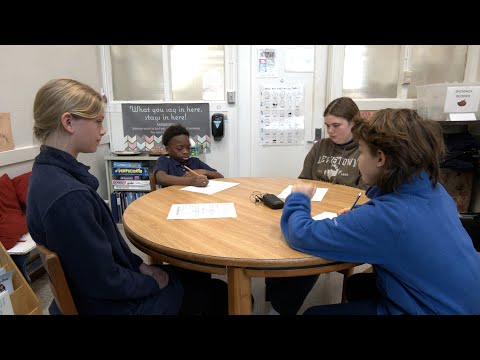
Charles Ellis students trained as peer mediators to resolve conflicts
Summary
Students at Charles Ellis Montessori Academy receive 12 hours of training from the Mediation Center of the Coastal Empire to serve as peer mediators, using nonpunitive mediation contracts and teacher referrals to address conflicts at school and beyond.
Students at Charles Ellis Montessori Academy have been trained to serve as peer mediators, a program school officials say helps peers resolve conflicts without referring them to administrators.
Eleonora Smith, a peer mediator at Charles Ellis, said the role gives students a chance to settle disputes with classmates. “I really was glad I didn't have to, like, go to the principal or vice principal with that and, like, I could just, like, solve it on my own terms,” Smith said. “Makes me feel really good that I can help someone that I've helped someone to resolve their conflict.”
The training is provided by the Mediation Center of the Coastal Empire and includes 12 hours of instruction in mediation skills, conflict resolution and managing anxiety and anger, according to the segment produced for the Savannah-Chatham County Public School System (SCCPSS). Those skills are intended to help students at school and in their lives at home, the recording said.
Under the program, students agreed on a set of rules for mediators: they “will not judge, take sides, or try to punish” participants, and mediators and disputing students work together to reach an agreement and often produce a written mediation contract. Teachers may refer student conflicts to mediators or refer the students directly to peer mediators, the recording said.
Supporters say the program promotes self-awareness and gives students an intermediate option between informal peer talks and administrator intervention. One student described mediation as easier because mediators are “kind of your own age,” reducing the concern that speaking up will lead to disciplinary action by school leaders.
The piece concluded with a sign-off naming SCCPSS; no formal votes, policy adoptions or funding details were presented in the transcript of the segment.