Get Full Government Meeting Transcripts, Videos, & Alerts Forever!
Get email alerts on the Good Cause Eviction topic
No spam. Unsubscribe anytime.
Good‑cause eviction bill returns to committee after year of revisions
Summary
Delegate Janelle Wilkins reintroduced a county‑enabling good‑cause eviction bill (HB 709) to let localities require landlords to state lawful reasons for lease nonrenewal; proponents said the measure would reduce retaliatory and arbitrary displacements, while industry groups warned of litigation and impacts on development and dispute timelines.
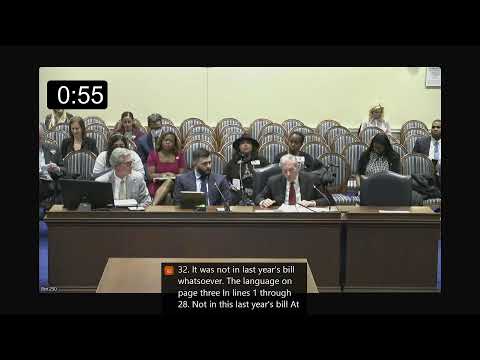
Delegate Janelle Wilkins told the House Environment and Transportation Committee on Feb. 18 that House Bill 709 would authorize counties and Baltimore City to adopt local ordinances requiring landlords to state a lawful reason for lease nonrenewal or termination.
Supporters said the measure is a targeted tool to prevent involuntary displacement — not a ban on evictions. "A renter who is paying their rent and following the rules should have a stable and secure place to live," Wilkins said, describing the measure as an enabling framework that preserves landlords’ rights to remove tenants for specific, legitimate causes.
Why advocates pressed for the statewide option Advocates and local officials argued that good‑cause frameworks reduce avoidable evictions and the downstream human and fiscal costs — from homelessness to emergency shelter and social‑service burdens. David Weed of the Legal Defense Fund summarized research and changes incorporated since the committee passed a version last year, including transparency measures and anti‑circumvention language aimed at preventing large corporate owners from claiming small‑landlord exemptions via multiple LLCs. Kenton Card, a researcher at the University of Minnesota and visiting scholar at Boston University, cited empirical studies finding that just‑cause protections reduce evictions and do not demonstrably depress new housing production in the jurisdictions studied.
Tenant testimony and enforcement concerns Several tenants and former tenants recounted disruptive nonrenewal notices that followed tenant complaints about habitability or safety problems. Rebecca Clausen, a written and in‑person witness, described a case in which a landlord did not remediate repeated code violations and then delivered a nonrenewal notice after local enforcement engaged. Supporters said good‑cause statutes would reduce retaliatory nonrenewals that currently leave families with little time to find alternative housing.
Industry objections and points of committee inquiry Representatives of landlords and industry groups opposed HB 709 or urged caution. The Maryland Multi‑Housing Association and apartment owners argued the bill’s scope had expanded since last year’s committee consideration and flagged new language they said is vague (for example, how to define “routine disorderly conduct” or “indirect ownership”). They warned of longer landlord–tenant adjudication timelines, higher compliance costs and potential chilling effects on property maintenance and development.
How the bill changed since last year Supporters pointed to specific edits in the current draft that were added after the committee advanced the measure previously: additional transparency requirements (for example, disclosure of ownership interests when filing a holdover complaint), an explicit DHCD role to produce standardized notice language, and anti‑circumvention language modeled on recent New York reforms. Proponents argued these clarifications respond to industry concerns while preserving tenant protections.
Next steps and political dynamics DHCD testified in support of the change at the committee hearing and several municipalities — including Rockville — and nonprofits urged passage. Opponents asked lawmakers to measure the local impact and urged waiting for further study, but committee members pressed both sides on enforcement logistics, exemptions for small landlords, and definitions that may need tightening. If the committee reports HB 709 favorably, it would move to the House floor and then to the Senate; local governments would decide whether to adopt local good‑cause ordinances under the bill’s enabling language.
Ending Supporters described HB 709 as a corrective tool that balances landlords’ property rights and tenants’ housing stability; opponents raised consequences for administration and market behavior. The committee must next weigh technical clarifications and exemptions before deciding whether to advance the measure.