Get Full Government Meeting Transcripts, Videos, & Alerts Forever!
Get email alerts on the Criminal Justice Reentry topic
No spam. Unsubscribe anytime.
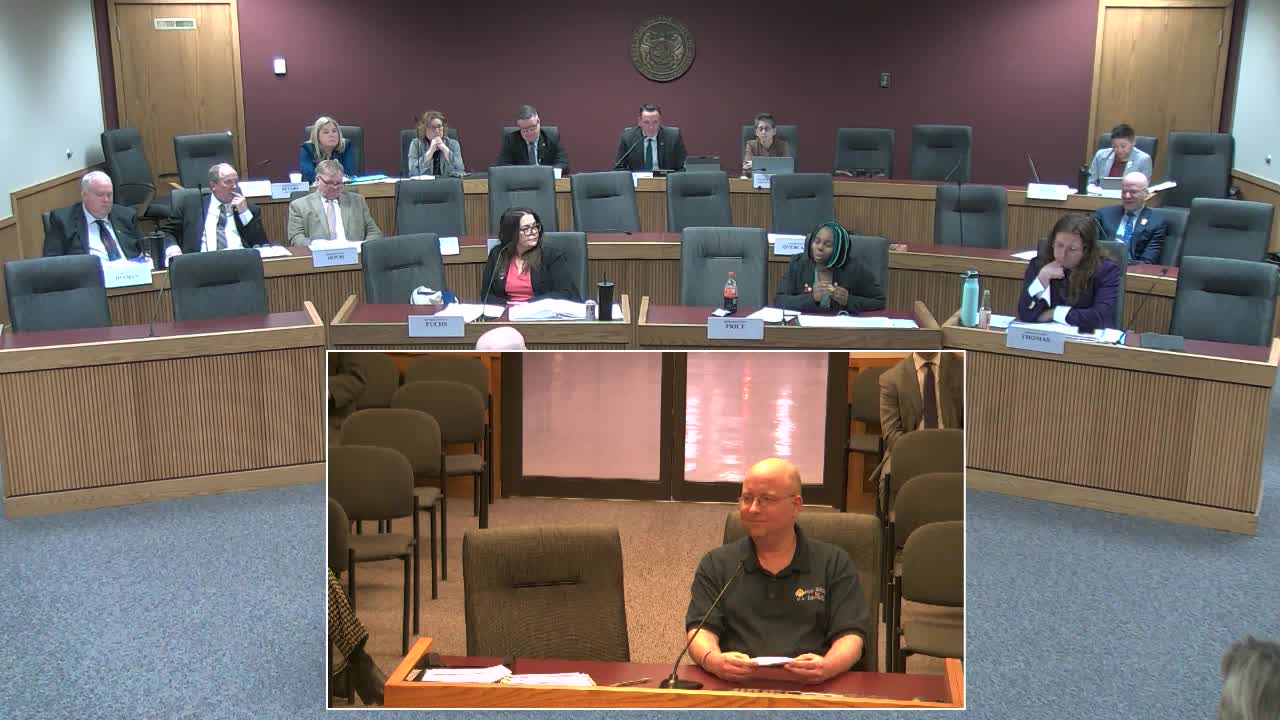
House committee hears bill to repeal Missouri 'pay‑to‑stay' law (HB 723)
Summary
Vice Chair Tara Peters introduced HB 723 to repeal the Missouri Incarceration Reimbursement Act (MIRA), which allows the state to recover up to 10% of the cost to house an offender and to seize assets that accrue to an incarcerated person; proponents said repeal would aid reentry and reduce recidivism.
Vice Chair Tara Peters presented House Bill 723, which would repeal the Missouri Incarceration Reimbursement Act (MIRA), a statute commonly described as a "pay‑to‑stay" law that allows the state to seek recovery of incarceration costs and, in some cases, seize assets that accrue to an incarcerated person while they are in custody.
"How many times do we have the opportunity to actually shrink our government?" Peters said when she introduced the bill, describing MIRA as a statutory process originating in the 1980s that allows the state to seek up to 10% of the cost of housing an offender for up to two years and to seize as much as 90% of an offender's assets to secure that reimbursement. Peters said the measure would remove the state's ability to seize those assets.
Proponents at the hearing said repeal would support reentry and reduce recidivism by allowing people leaving incarceration to retain money they need for housing, transportation and family support. Bevis Schock, a St. Louis civil attorney, described cases of people who received settlements or inheritances while incarcerated and then lost those funds to state claims; he urged the legislature to repeal MIRA rather than rely on courts to find it unconstitutional. "We're taking people's property here, a tiny number of people's property, and it's their property," Schock said.
Jeremy Lafavor, who testified for Empower Missouri, and Jeff Smith of Missouri Appleseed, a nonprofit that focuses on justice and family outcomes, said retaining modest assets helps people successfully reenter their communities and reduced recidivism. Smith said research shows two interventions that reduce reoffending are educational credentials earned in custody and maintaining close contact with loved ones; small amounts of money can help people pay for phone calls, transportation, and a place to sleep on release.
Committee members asked practical and legal questions. Representative Obis asked whether repeal would affect court‑ordered restitution owed to victims; witnesses and the sponsor said restitution orders and fines imposed at sentencing would still be handled through the judicial process and are separate from MIRA collections. Representative Hovis asked whether the law captures ill‑gotten gains from high‑level offenders; witnesses said many criminal‑proceeds remedies exist but that MIRA mainly affected modest settlements, inheritances or property that accrued while people were incarcerated.
The bill's fiscal note was discussed in the hearing. Committee testimony cited figures from the Department of Corrections and the Attorney General's office showing approximately $750,000 collected by the Department of Corrections last year and about $170,305 retained by the Attorney General's office, for a total of roughly $920,000 in collections reported on the fiscal note. Witnesses argued the modest revenue should be weighed against the broader social and fiscal costs of recidivism.
Several witnesses said the attorney general's office had indicated it did not plan to oppose repeal, and supporters urged the legislature to act so that courts are not forced to resolve constitutional challenges in piecemeal litigation. No committee vote was recorded during the hearing.
The committee heard multiple proponents — including legal advocates, a reentry nonprofit representative and former incarcerated individuals working in advocacy — and closed the hearing without a recorded committee decision. Supporters asked legislators to consider the reentry consequences of continuing MIRA and to weigh the fiscal tradeoffs against recidivism reduction and family stability.