Get Full Government Meeting Transcripts, Videos, & Alerts Forever!
Get email alerts on the School Safety topic
No spam. Unsubscribe anytime.
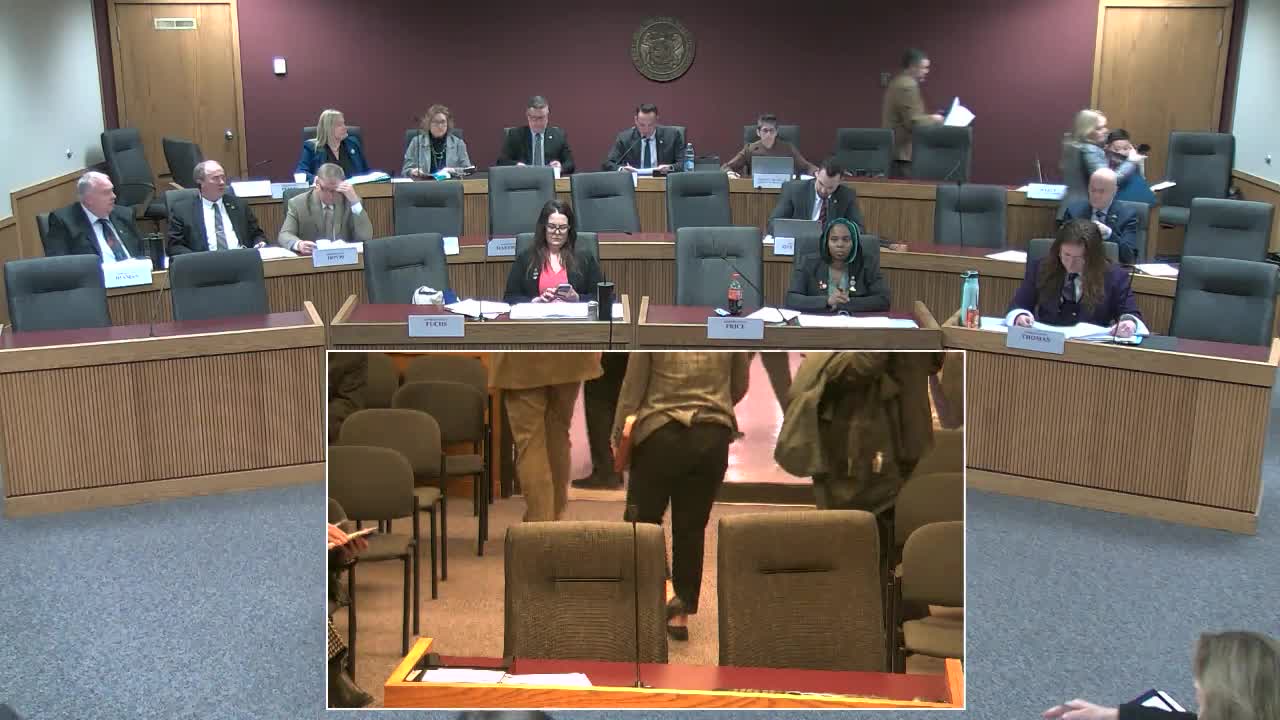
Missouri committee hears broad support for comprehensive school safety bill (HB 416)
Summary
Representative Brenda Shields presented House Bill 416 to the committee as a comprehensive approach to school safety, proposing new requirements for emergency plans, site assessments, stop‑the‑bleed kits, anti‑intruder locks, behavioral risk assessments that follow a pupil, prosecutor notification for violent charges, and training for staff.
Representative Brenda Shields presented House Bill 416 to the Missouri House committee as a comprehensive approach to school safety, saying the measure would require districts to adopt emergency operations plans, complete annual physical site assessments, equip schools with “stop the bleed” kits, install anti‑intruder classroom locks and bullet‑resistant film on entry windows for newly constructed schools, and require behavioral risk assessments and several training priorities.
"School safety is much more," Representative Brenda Shields said, listing planning, community involvement, behavioral and mental‑health supports and communication among the bill's priorities. Shields said the bill requires districts to adopt plans for all emergencies, mandating training, planning, response and follow‑up and supporting mental‑health needs.
The bill would: require emergency operations plans and annual physical security assessments; require a primary and a secondary school safety coordinator; place stop‑the‑bleed kits in high‑traffic areas and require staff training in their use; require interior classroom doors to have anti‑intruder locks that lock from inside without a key; require exterior doors and sidelights in new construction to have bullet‑resistant film; require behavioral risk assessments to follow a student who transfers schools; require prosecutors to notify schools within 24 hours if a student is charged with a violent crime outside school; require CPR and intruder‑drill training for staff; and expand use and training for the Missouri Highway Patrol’s Courage to Report and Handle With Care notifications.
The bill frames several requirements as contingent on funding. "None of these though are required unless the General Assembly specifically appropriates money to cover the costs related to equipping existing buildings," Shields told the committee, and added that all listed protections would be required for buildings constructed on or after July 1, 2029.
John McDonald, chief operating officer for the Missouri School Board Association Center for Education Safety, told the committee the bill establishes a consistent, statewide "reasonable standard of care" for school safety and argued more consistent planning and training would reduce lost learning time caused by threats and incidents. "When students feel safe, they're better learners," McDonald said, citing a recent period with multiple credible threats and research linking safety to improved educational outcomes.
Travis Coleman, a middle‑school teacher, said the bill's stop‑the‑bleed requirement and anti‑intruder locks address gaps he has seen in practice and could reduce fatalities and injuries. "If teachers aren't trained on basic first aid or even CPR, that kid's gonna pass in front of them," Coleman said, urging practical, low‑cost approaches to training.
Committee members pressed on cost and implementation. Representative Hovis and others asked whether equipment such as AEDs or bullet‑resistant upgrades would be funded; Shields said AEDs are not included in HB 416 but could be added and often are donated locally. Multiple members asked about the bill's fiscal note and whether smaller districts could afford the requirements; Shields and witnesses said the bill is intentionally structured so many mandates for existing buildings would only take effect with state appropriations, while new construction after 07/01/2029 would be required to include specified features as part of bond or construction packages.
Members also discussed training standards. The bill references FEMA incident training and allows districts to use training from the Missouri School Boards Association as an alternative if a district prefers not to use federal training. Shields described behavioral risk assessments as tools for identifying students who have demonstrated homicidal or suicidal ideation, proactive or reactive planning, or other conduct that makes the school environment unsafe; the bill would require that such assessments follow a student who transfers schools so receiving schools have information to support them.
Several committee members raised confidentiality and public‑records concerns about emergency plans. Shields said prior committee discussion considered language to keep emergency operations plans from being made widely public to avoid creating a threat vector.
No committee vote was recorded during the hearing; the committee held the bill for further consideration following testimony. Supporters urged the committee to weigh the bill’s safety benefits against fiscal constraints, emphasizing local partnerships, donated equipment and phased implementation as ways to reduce direct costs to districts.
The hearing concluded after in‑committee discussion and witness testimony; committee members said they would follow up on fiscal details and technical questions about training standards and information sharing.