Get Full Government Meeting Transcripts, Videos, & Alerts Forever!
Get email alerts on the Criminal Justice Public Safety topic
No spam. Unsubscribe anytime.
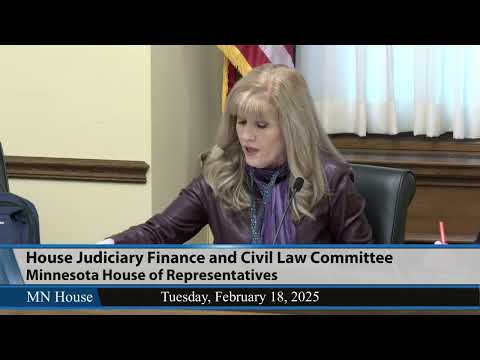
House committee re-refers GOP public-safety package after debate over tracking, transparency
Summary
The House Judiciary Finance and Civil Law Committee voted 7-6 to re-refer House File 7 — a 12-part Republican public-safety package — to the Committee on Public Safety and Policy after hours of debate over vehicle-tracking authority, public databases of dismissals and expanded liability for critical-infrastructure protests.
The House Judiciary Finance and Civil Law Committee voted 7-6 on Feb. 18 to re-refer House File 7, a 12-provision public-safety package sponsored by House Republicans, to the Committee on Public Safety and Policy for further consideration. Representative Novotny moved the measure as amended; the committee chair conducted a roll call that produced seven ayes and six nays.
House File 7, described by Representative Novotny as representing "the priorities of the House Republican caucus in the public safety area," packages provisions to increase penalties for several offenses, expand law-enforcement authority to place tracking devices on vehicles under limited circumstances, require public reporting about case dismissals and sentencing reductions, and increase penalties for assaulting peace officers and blocking critical public access.
Supporters said the bill targets a small cohort of repeat offenders and tools that can reduce dangerous vehicle pursuits. Bob Fletcher, Ramsey County sheriff, told the committee that tracking stolen vehicles helps police choose safer intervention points and avoid high-speed chases: "Unless you catch a person in a car, we're not going to get them charged," he said, adding that his office seeks owner permission and removes devices if permission cannot be obtained within the statutory window.
Opponents and several committee members raised civil-liberty, privacy and fiscal concerns. Representative Feist and Representative Mueller expressed continued worry about warrantless searches and privacy risks even after changes to the bill; Representative Liebling and others flagged potential fiscal impacts on courts and the Board of Public Defense. County Attorney John Choi, representing Ramsey County and the Minnesota County Attorneys Association, said his office already publishes many charging and sentencing data and warned that publishing reasons for dismissals risks exposing victims and oversimplifying nuanced prosecutorial decisions: "The number 1 reason why a case will be dismissed is because there's insufficient evidence," Choi said, urging caution about making dismissal reasoning public in every case.
Two author amendments were adopted before the re-referral vote. Amendment A7 removed language that would have disclosed whether a victim supported a dismissal; Representative Novotny said the change honors victim anonymity and adopted language in response to members' concerns. Amendment A6 tightened the bill's tracker language after discussion with the Ramsey County Sheriff's Office: it limits placement of trackers to stolen vehicles in public right-of-way when unoccupied, shortens the prior 24-hour allowance to 12 hours, and requires officers who attach trackers to file a report documenting why the device was used, the time and date, the attachment method, duration and an explanation of how the device affected the investigation; those reports would be placed in the criminal-investigation file.
Environmental and civil-rights testifiers opposed portions of the bill dealing with critical infrastructure and vicarious liability. Amy Bralier, a constituent and former court employee, warned that language extending liability to people associated with an arrest could be "broad and vaguely written" and expose peaceful protestors and organizations to civil suits. Evan Mulholland of the Minnesota Center for Environmental Advocacy told the committee that conspiracy and trespass laws already criminalize coordinated illegal action and said, "We don't need these provisions in this law."
Members debated the utilities of public data. Representative Ingen and others argued searchable data on sentencing and departures would help public oversight of judges and prosecutors; Representative Choi and others cautioned that raw dismissal reasons can be legally and ethically complicated and that publishing some details could harm victims or mislead the public. Representative Novotny said proponents intend a publicly searchable dashboard modeled on the Minneapolis police dashboard and said the aim is to allow the public to track trends in dismissals and sentencing.
The roll call recorded individual votes as spoken during the committee proceeding; the chair announced the final tally as "7 ayes to 6 nays," and the committee re-referred House File 7 as amended to the Committee on Public Safety and Policy.
The bill will next be considered by the public-safety committee, which Novotny and other members identified as the appropriate forum for fiscal and enforcement questions that arose during the debate.