Get Full Government Meeting Transcripts, Videos, & Alerts Forever!
Get email alerts on the Address Confidentiality Program topic
No spam. Unsubscribe anytime.
Senate committee advances address‑confidentiality bill after survivor testimony
Summary
The Senate State Affairs Committee adopted a committee substitute for Senate Bill 31 and reported the bill out of committee with individual recommendations and an attached fiscal note after testimony from a domestic‑violence survivor‑services advocate and discussion of program costs.
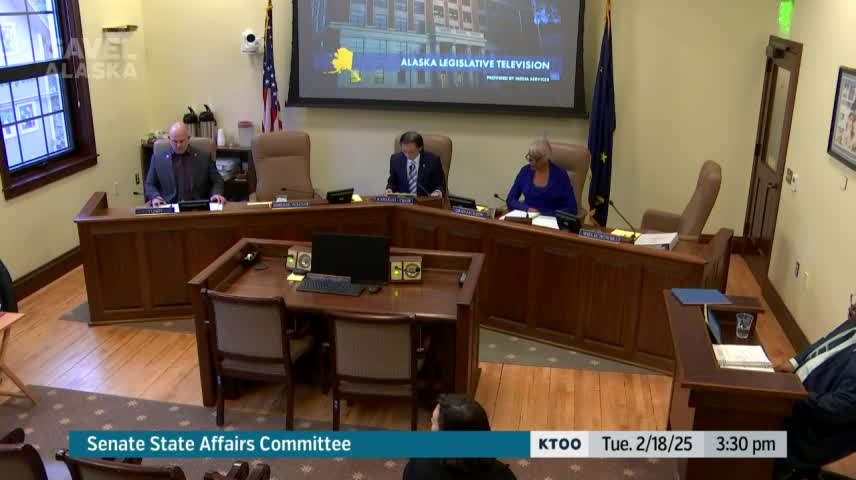
The Alaska Senate State Affairs Committee on Feb. 18 adopted a committee substitute for Senate Bill 31, an address‑confidentiality program intended to help people at high risk of domestic violence, and voted to report the bill out of committee with individual recommendations and an attached fiscal note.
Senator Jesse Kiel, sponsor of SB 31 and senator for District B, told the committee the substitute “tightens the title. It removes the broad phrase relating to the duties of the Department of Administration,” narrowing the bill to the address‑confidentiality program and its effective date so the measure would not become a vehicle for unrelated changes.
The bill matters because it is designed to reduce the risk that people who cause harm will locate survivors through public records. Laurie Morton, deputy director of the Alaska Network on Domestic Violence and Sexual Assault, told the committee the program would be “one tool and part of a larger safety plan” and that in extreme, high‑danger situations confidentiality can be life‑saving. Morton said the program will delay delivery of first‑class mail and is intended for cases where secrecy is critical. “One life lost to domestic violence is one too many,” she said.
Committee discussion focused on enrollment criteria and program cost. Morton said the network appreciates allowing the Department of Administration to set standards and to permit enrollment in some instances when a protective order is not appropriate because the order itself could increase lethality. Senator Kiel told the committee the department has been “sharpening their pencils” on the fiscal estimate following questions at the bill’s first hearing. The committee chair remarked that the nearly half‑million‑dollar estimate for a program manager and an additional staff position “seems a little bit high,” and said the finance committee will examine the fiscal note more closely.
The committee moved two formal actions: a motion to adopt the committee substitute, made by Senator Grama Jackson, which was discussed and then allowed to proceed; and a motion by Vice Chair Bjorkman that “CS for Senate Bill 31 be reported out of committee with individual recommendations and attached fiscal note.” Both actions were approved by voice vote with no recorded roll call after the chair called for objections and none were raised.
The bill will go next to the Senate Finance Committee for consideration of the fiscal note and any budgetary changes. The Department of Administration has been working on a revised, tighter fiscal estimate, Senator Kiel said, and the committee recorded the report out with attached fiscal material for that follow‑up review.