Get Full Government Meeting Transcripts, Videos, & Alerts Forever!
Get email alerts on the Bike Pedestrian Safety topic
No spam. Unsubscribe anytime.
Alaska DOT details steps to reduce pedestrian and bicycle deaths, singles out Anchorage for action
Summary
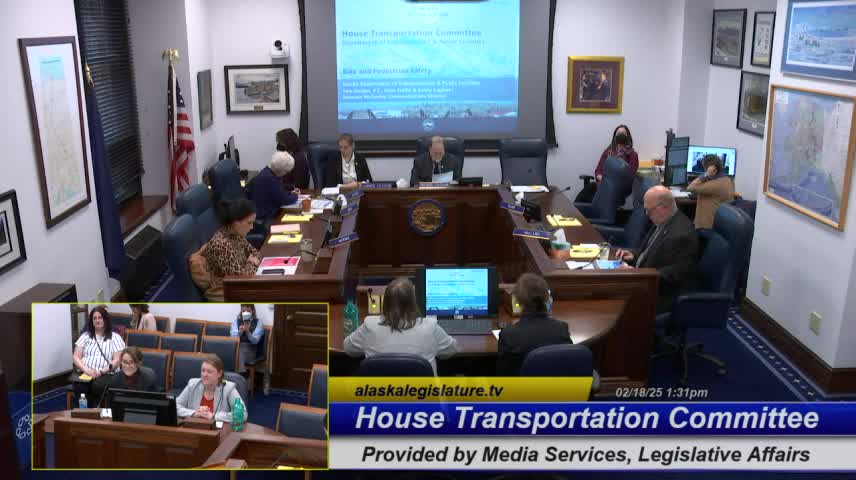
The Department of Transportation and Public Facilities told the House Transportation Committee on Feb. 18 that Alaska’s pedestrians and bicyclists are overrepresented in traffic fatalities and outlined a suite of data‑driven countermeasures that prioritize Anchorage as a focus area.
Anchorage — The Department of Transportation and Public Facilities told the House Transportation Committee on Feb. 18 that Alaska’s pedestrians and bicyclists account for a disproportionate share of traffic deaths and that the agency is pursuing a data-driven “safe systems” approach that prioritizes Anchorage as a focus area.
At the hearing, Shannon McCarthy, communications director for the Department of Transportation and Public Facilities, said, “Pedestrians are overrepresented in our fatalities in Alaska.” Pam Golden, the department’s state traffic and safety engineer, added that the department’s data come from the Fatality Analysis Reporting System and that, because Alaska’s population is small, year-to-year totals can vary.
Committee members were shown five-year totals the department compiled: 77 vulnerable-user fatalities (7 bicyclists and 70 pedestrians). Committee members pressed DOT for more granular breakdowns by year and location after the department noted that Anchorage accounted for a large share of pedestrian fatalities in 2024, including a cluster of 15 deaths in September of that year.
The committee heard that bicyclist crashes average about 95 per year statewide and that roughly three-quarters occur in the Municipality of Anchorage; about 88% of those bicyclist crashes happen at intersections or driveways. DOT presented a geographic split of pedestrian crashes that shows Anchorage at about 67.5% of statewide pedestrian crashes, Mat-Su Borough at about 7%, Fairbanks and Kenai each at about 6%, and Juneau at about 3%.
Why it matters
Committee members repeatedly stressed that the spike in Anchorage pedestrian deaths last year elevated public concern and increased political pressure for action. Lawmakers asked whether legal changes (for example, local jaywalking ordinances), enforcement, maintenance such as brush clearing, or design changes would be most effective — and whether the state should prioritize rapid, low-cost fixes or larger capital projects.
What DOT is doing
Pam Golden described a multi-pronged, evidence-led strategy anchored in the department’s Strategic Highway Safety Plan and a Vision Zero task force convened with the Anchorage Metropolitan Area Transportation Solutions (AMATS) and local law enforcement. Key elements the department described include:
- High-injury network mapping and targeted countermeasures at repeat corridors and intersections identified from crash data; - Road safety audits that bring independent multidisciplinary teams to review problem corridors and produce short-, mid- and long-term recommendations; - Proven roadway countermeasures such as roundabouts (the department said Alaska now has more than 50 roundabouts), road diets, improved crosswalk visibility and pedestrian hybrid or rectangular rapid-flash beacons, and leading pedestrian intervals; - Two variable speed-limit pilot projects: one on the Seward Highway (Girdwood to Potter Marsh) and one in the Fairbanks area (Eielson AFB to the GARS intersection); - A “Partners in Safety” outreach program and safety reporter app to capture community reports of unsafe locations in real time, supplementing crash data with lived experience; - Expanded use of audible/accessible pedestrian signals and consideration of snow‑storage and winter maintenance practices to improve pedestrian and bicycle accessibility.
DOT also described local pilot work in Anchorage that installed temporary protected bike lanes on Pine Street and a downtown corridor (Sixth Avenue). Shannon McCarthy said the pilot produced a much larger public response after the second phase — roughly eight times more survey responses after Phase 2 than before — and that weekday use of the protected facility was about 100–130 users. McCarthy said the pilot did not show an increase in crashes while the temporary lanes were in place and that a notable speeding subgroup (about 2% of drivers in a 30‑mph zone) decreased where the temporary protection was installed.
Lawmakers’ requests and follow-ups
Several lawmakers asked for more detail and for follow-up materials. Requests recorded in the hearing included:
- A year‑by‑year breakdown of pedestrian crashes and the ability to overlay crash locations with known homeless‑camp locations in Anchorage (request from co‑chair Kerrick and Representative Stutes); - A follow-up report on crash counts before, during and after the downtown protected‑bike‑lane pilot, including winter months after the temporary elements were removed (request from Representative McCabe); - The department’s Highway Safety Improvement Program (HSIP) plan and details on how safety funding flows between programs and transfers that have occurred over the last several fiscal years (request from Representative Mina and co‑chair Kerrick); - Cost details for specific countermeasures, including an estimate previously given for a university-area pedestrian beacon project (DOT estimated that project at roughly $500,000) and a ballpark figure for audible pedestrian signal hardware (DOT estimated roughly $1,000 per pole but said it would confirm costs and provide a written follow-up).
What lawmakers emphasized
Committee members repeatedly emphasized enforcement and maintenance concerns: speeding, distracted driving, and the difficulty of proving distraction in crash reports; brush and sight‑distance clearing after citizen reports or trooper requests; and winter snow clearing and snow storage that can degrade pedestrian accessibility. Representative McCabe urged faster responses on local speed‑limit change requests, saying some communities have waited years for studies.
Limits and next steps
DOT officials told the committee that some actions need cooperation from other agencies: changes to state or municipal code (such as jaywalking laws or changes in fines) involve partners in public safety, and speed‑limit adjustments may require engineering studies or Federal Highway Administration review for certain corridors. DOT officials committed to providing the requested HSIP materials, pilot study follow-ups, and cost confirmations to the committee and to continue statewide road safety audits.
The department also announced an upcoming Partners in Safety event in Juneau (University of Alaska Southeast Recreation Center, 4:30–6:30 p.m.) and said it intends to visit borough seats and major hub communities to gather community‑reported safety concerns.
Ending
Committee co‑chairs and members closed the discussion by thanking DOT staff for the presentation and requesting written follow-ups. No formal committee votes were taken on February 18; the committee scheduled its next meeting for Feb. 20 with additional DOT presentations on highway safety.