Get Full Government Meeting Transcripts, Videos, & Alerts Forever!
Get email alerts on the Permanent Fund Dividend topic
No spam. Unsubscribe anytime.
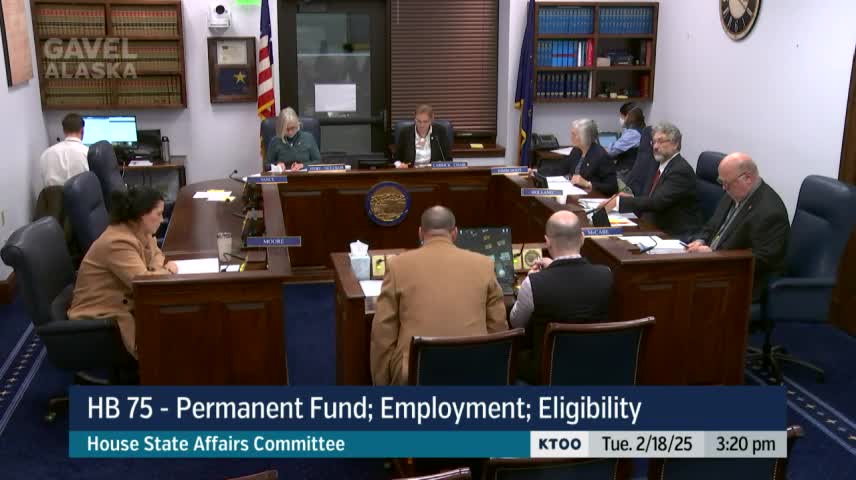
House committee hears bill to modernize PFD rules for Merchant Marine trainees, tighten applicant privacy
Summary
Representative Jeremy Bynum introduced HB 75 to treat Merchant Marine Academy attendance like college for Permanent Fund Dividend purposes, expand allowable student absences and require fingerprint background checks for PFD employees who handle sensitive data.
Representative Jeremy Bynum introduced House Bill 75 on Tuesday, proposing changes to Alaska’s Permanent Fund Dividend (PFD) rules to accommodate maritime training, protect applicant privacy and require stronger background checks for staff handling sensitive data.
The bill would treat time spent at the United States Merchant Marine Academy the same as attending college for PFD purposes, add school breaks and holidays (excluding summer break) to allowable student absences, permit vocational and Coast Guard‑approved training programs to qualify, require FBI fingerprint‑based national criminal history checks for current and prospective PFD division employees who handle sensitive personal data, make PFD applicant names confidential, and allow applicants to opt in to receive electronic notices about levies or garnishments. The bill includes an effective date of Jan. 1, 2026, and carries a zero fiscal note in the packet presented to the committee.
Why it matters: The Permanent Fund Dividend is a widely used cash benefit for many Alaskans. Backers say HB 75 removes administrative barriers that can disqualify residents who pursue out‑of‑state maritime or vocational training or who face short, unavoidable absences for medical reasons. Supporters also say tighter confidentiality and fingerprint checks will reduce the risk of identity theft and fraud tied to PFD records.
Representative Jeremy Bynum, House District 1, told the committee, “The permanent fund dividend is a cornerstone of the economic stability of many residents, but outdated regulations create unnecessary burdens for Alaskans pursuing education, maritime careers, and medical care.” Trevor Shaw, district chief for Representative Bynum, described the bill as a near‑identical companion to Senate Bill 77 and traced many provisions to prior legislation (SB 85) introduced at the governor’s request in the 33rd Legislature.
Shaw summarized key statutory changes described in the bill packet: an amendment to what he identified as “statute 12.62.400(c)” to permit FBI fingerprint checks for employees in positions administering the PFD program; revisions to “statute 43.23.008(a)” to add school breaks and holidays (not summer) and to extend coverage to vocational and Coast Guard‑credentialed Merchant Marine training; conforming edits to the duties of the Department of Revenue (identified in the packet as “statute 43.23.055”); a change to make applicant names confidential under “statute 43.23.110(a)”; and an opt‑in electronic levy notice provision amending “statute 43.23.140(d).” The office provided a 01/01/2026 effective date.
Committee members pressed for detail. Representative McCabe asked whether the Merchant Marine language began as a constituent request; Bynum and Shaw said the change was intended to align Merchant Marine and Coast Guard‑approved vocational training with other uniform‑service training already covered by statute. Representative McCabe and others suggested possible friendly amendments to add airline pilots and other groups who routinely travel for work or training; Bynum said he would consider language if provided.
Vice Chair Representative Story and others asked about the fingerprinting provision and whether there had been documented incidents prompting it. Shaw said the provision was driven in part by the Department of Revenue’s prior requests and the fact that PFD division employees can access highly sensitive information — including Social Security numbers and bank account data — and that current law requires explicit statutory authorization for FBI‑conducted national checks for some state employees. Shaw said no specific misconduct was cited to the committee and that the measure was intended as a preventive step.
Members also asked about definitions: Representative Hemshoo asked whether “break” or “holiday” is defined in statute; committee counsel replied that the bill ties eligibility to the academic year as defined by each institution and intentionally excludes summer breaks. Members asked for data on the number of Merchant Marines from Alaska and on the PFD division’s vacancy rate; sponsors said they would follow up with numbers.
Shaw noted the bill packet lists letters of support from the Alaska Chamber of Commerce, Tote Maritime Alaska, and Matson Shipping (the latter provided in support of the senate companion bill). Committee staff confirmed the bill carries a zero fiscal note as presented. The committee did not take action on HB 75; Representative Bynum said the bill would be brought back for a future hearing.
What's next: The committee adjourned HB 75 debate to a later date and requested follow‑up information on vacancy rates in the PFD division, counts of Alaska Merchant Marines, and any suggested amendment language (for example, to include airline pilots or other uniform services).