Get Full Government Meeting Transcripts, Videos, & Alerts Forever!
Get email alerts on the Alaska Lng Project topic
No spam. Unsubscribe anytime.
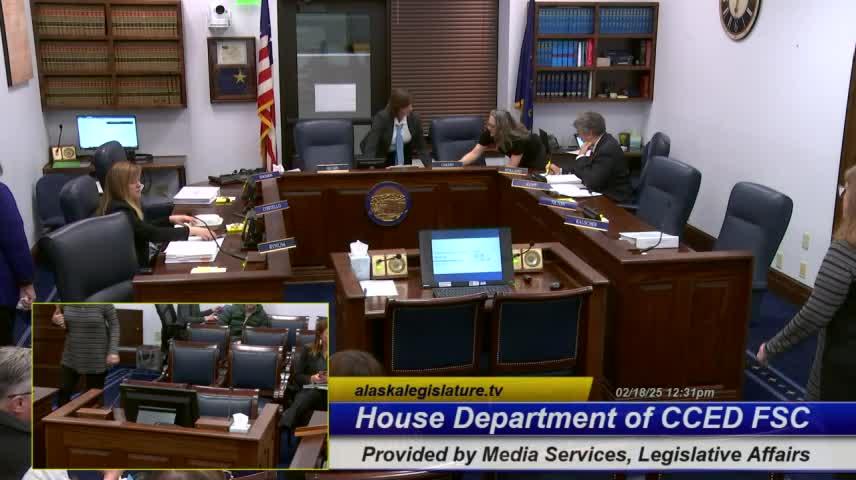
House finance subcommittee hears AGDC briefing on Alaska LNG phase 1, budget requests
Summary
Officials from the Alaska Gasline Development Corporation outlined a Phase 1 pipeline plan, a FY26 operating request of $2,487,000 and a $4.2 million capital request to retain technical and legal support while negotiating with a lead developer. Legislators pressed AGDC on timing, contracts, letters of intent and the proposed $50 million backstop.
The House Finance Department of Commerce, Community and Economic Development (DCCED) subcommittee on Feb. 18 heard a presentation from the Alaska Gasline Development Corporation (AGDC) on the Alaska LNG project and AGDC’s FY26 budget requests, including a $2,487,000 operating request and a $4.2 million general‑fund capital request to retain technical and legal expertise as the state’s minority owner.
AGDC President Frank Richards, speaking by telephone, and Matt Kissinger, AGDC’s venture development manager, described what AGDC presented as a Phase 1 build: a pre‑build 42‑inch mainline pipeline from the North Slope to the north side of Cook Inlet or the west side tie‑in to existing systems, with liquefaction and final export facilities to come in subsequent phases. "The phase 1 is to lead from the North Slope to the North Side of the Cook Inlet," Richards said.
The subcommittee’s chair, Representative Galvin, framed the hearing as a budget review. AGDC’s operating request mirrors the prior year’s authorization and, according to AGDC, primarily covers four project control positions (three current staff and one planned hire) plus contracted services and IT. Richards described AGDC’s staffing model as intentionally lean: "the goal is to keep the staff ... to a small level and utilize the expertise and services through contracts to the maximum extent," he said.
AGDC presented a $44 billion project cost estimate for the full Alaska LNG project and summarized a Wood Mackenzie analysis commissioned under 2024 legislative intent language. AGDC said Wood Mackenzie’s base model found Phase 1 pipeline gas could meet or undercut the projected price of imported LNG (AGDC cited an imported LNG range of roughly $10.21 to $12.72 per million British thermal units in the consultant’s scenarios). AGDC also cited Wood Mackenzie estimates that pipeline construction would generate significantly more jobs and economic activity than an import option, and reported a lifetime household savings estimate of about $5.7 billion and a total gross value added to the state of roughly $10.3 billion from the pipeline model.
Legislators pressed AGDC on key uncertainties: who will underwrite the project, what long‑term gas purchase commitments are necessary to reach final investment decision (FID), the timing for construction and commercial operations, and whether the state faces fiscal risk. Matt Kissinger told the committee that an FID would require long‑term commitments "on the delivery side, but also on the take side," and he pointed the committee to Wood Mackenzie’s model results for different demand scenarios.
On developers and financing, AGDC said it has a binding exclusivity agreement and a negotiated term sheet with a lead developer it called Glenfarn, which AGDC described as an energy infrastructure developer that would prioritize capital for Phase 1 while working toward full project development. AGDC said the term sheet is not public. "Based on the commitments that Glenfarn were willing to make ... we extended and expanded on exclusivity," Kissinger said.
AGDC also told the subcommittee it holds confidential letters of intent (LOIs) with multiple large, creditworthy Asian utilities but did not identify the buyers because terms were confidential. Richards said those LOIs, together with interest from Japan, Korea and Taiwan, help underpin market interest but that definitive long‑term agreements would follow front‑end engineering and design (FEED) and updated cost estimates.
On budgetary risk, AGDC confirmed that discussions over a potential up to $50 million backstop with ADA (as referenced in the hearing) remain under negotiation and are not a legal precondition of the exclusivity or term sheet. Richards said AGDC had applied to ADA for a backstop and that the agency was negotiating its terms; he also said he was unaware of any "breakup fee" in the application. Representative Mears and others asked whether the $50 million backstop remains an outstanding ask; AGDC said the governor’s amended budget would remove a previously proposed $50 million line and that AGDC was not asking this subcommittee for additional capital beyond the operating and $4.2 million capital requests described at the hearing.
The presentation included several program and contracting clarifications. AGDC described using contracted experts for commercial venture development, technical program management, environmental/regulatory work, IT, geographical information systems and legal representation, while using Department of Law only "as necessary as required by the statute." Richards said the capital request is intended to preserve the state’s ability to retain technical and legal representation as a 25% minority owner in the project vehicle.
Committee members asked for follow‑up materials. AGDC agreed to provide more detailed contract lists and to attempt to quantify the minimum offtake or purchase commitments needed to support an FID. The committee closed without taking formal action; no votes were recorded.
Why it matters: AGDC’s budget request funds the corporation’s role as a state minority owner and steward of the state’s commercial interest in a project AGDC and its consultant model say could produce large economic benefits if it advances. Legislators questioned whether market conditions, competing import options, and the rise of renewables could affect long‑term demand and the state’s timing and exposure.
The House Finance DCCED subcommittee adjourned at about 1:26 p.m.; the committee scheduled an ADA presentation for the following week.