Get Full Government Meeting Transcripts, Videos, & Alerts Forever!
Get email alerts on the Rural Airports Maintenance topic
No spam. Unsubscribe anytime.
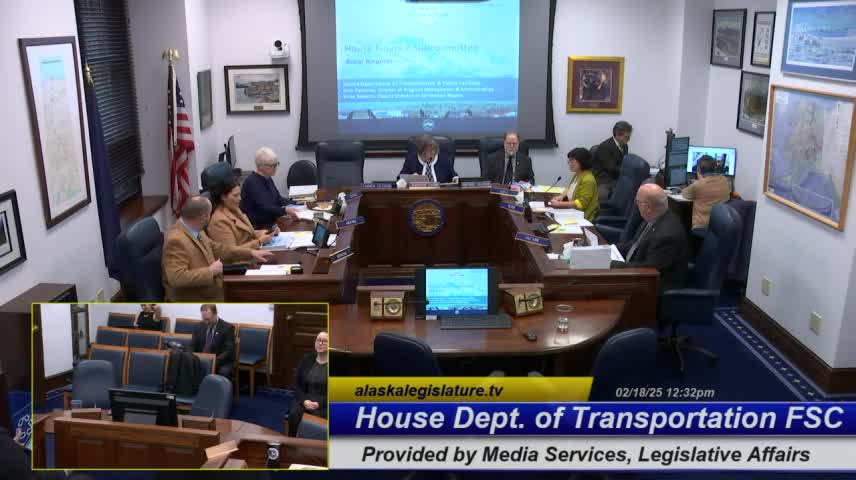
House subcommittee hears DOT briefing on rural airport maintenance, budget requests, PFAS testing and drone integration
Summary
On Feb. 18 the Alaska House Finance subcommittee heard a Department of Transportation presentation on maintenance contracts, budget requests for rural airports, ongoing PFAS testing at Part 139 airports, abandoned-building removal and federal grants to integrate unmanned aircraft.
House Finance Department of Transportation and Public Facilities Subcommittee Chair Representative Hannon convened the subcommittee at 12:32 p.m. Feb. 18 to review Alaska Department of Transportation and Public Facilities (DOT&PF) operations for rural airports, including maintenance contracting, specific budget requests for FY2026, environmental testing and unmanned aircraft integration.
The briefing matters because Alaska relies heavily on aviation for year‑round access to many communities, DOT officials told the subcommittee: “We have 235 rural airports. 82 of our communities rely on rural airports and aviation for access year round,” said Dom Pinone, director of program management and administration for DOT’s South Coast Region. The department also told the committee it operates the rural aviation system at a net operating subsidy that state funding largely supports.
DOT officials outlined the system’s finances and FY2026 requests. The agency told the committee it expects $8,900,000 in rural airport receipts, $4,900,000 in aviation fuel tax revenue and $281,000 in interagency rural airport receipts in the FY2026 aviation-specific budget. DOT reported an operating cost for the rural aviation system of $48,600,000, with leasing receipts covering $6,700,000 and a remaining subsidy and other revenues of $41,200,000.
Pinone listed several specific FY2026 requests for the rural airport program: $72,000 for employee lodging at Akutan Airport, $50,000 for a letters-of-correction database to meet FAA requirements, $100,000 from rural airport receipts for capital improvement and maintenance program inspection software, $111,600 for Kotzebue airport employee housing and travel, $374,000 for rural airport maintenance contractor increases in the Northern Region, $120,000 for after‑hours call‑out support, and a one‑time $160,000 increment to remove abandoned buildings on lease lots.
The committee discussed the Akutan lodging request. Vicki Roberts, deputy regional director for DOT’s South Coast Region, said DOT continues to staff the Akutan airport and that employees rotate housing on the island, roughly ten days on and seven days off, and that the lodging request would cover renting a local lodge room on a rotational basis. Representative Stutes told DOT she had raised concerns about prolonged building disrepair in Kodiak and called the condition “nothing less than disgusting.” Andy Mills, special assistant at DOT, said at least one site in Kodiak also involved a law‑enforcement action and potential hazardous materials remediation, noting “there were other circumstances involved than just, repairing or getting that building up to a standard.”
DOT described its approach to abandoned or derelict lease‑lot buildings as intended to return properties to marketable condition so the state can re‑lease them at fair market rates. The department said lease receipts are carried forward and that airport leasing teams apply market rates when space becomes available, but acknowledged in some cases there is no party able to reimburse demolition costs when a tenant has ceased operations.
On maintenance contracting, DOT said in fiscal 2024 local contractors performed maintenance at dozens of rural airports. The department reported 29 of 235 airports had local maintenance contracts in that year, with an average annual contract value of about $35,000 and a median of about $32,000. DOT staff said many contracts attract single bidders and that rural maintenance contracts often supplement subsistence or seasonal income for local residents.
The department told the committee it has invested in lighting improvements in FY2025 ($626,000) for emergency standby lighting sets, each currently costing about $86,000; DOT staff said those costs have fluctuated over time and that three sets were ordered for Norton Sound communities.
Environmental and safety topics drew committee attention. DOT said it has tested all airports that currently hold FAA Part 139 commercial‑service certification for PFAS contamination tied to aqueous film‑forming foam (AFFF) and that mitigation planning and some operational costs are underway. Pinone said testing began in 2018 and that the statewide aviation component will move into a first mitigation phase in summer. DOT said current mitigation funding comes from a mix of federal funds, the Department of Administration risk management, and DEC spill‑response funding; the department is not requesting a separate operating appropriation for PFAS mitigation at this time.
Members also asked about integrating unmanned aircraft systems. DOT said it received two federal grants to study airspace capacity, modernization and unmanned aircraft integration. The grants are administered by DOT’s statewide aviation component and its unmanned programs; Ryan Marlow was identified as the program lead. DOT staff said commercial large‑scale operations remain constrained by FAA approvals for beyond‑visual‑line‑of‑sight flights but that research partners, including a university unmanned aircraft program discussed in the hearing, are piloting concepts and conversion tests.
Committee members requested follow‑up: DOT agreed to provide a lighting‑status report and additional information about leasing remediation in specific airports, and staff offered to arrange testimony from the statewide aviation and unmanned‑systems leads.
With no formal motions or votes recorded on the topic during the Feb. 18 session, the subcommittee closed at 1:10 p.m. and indicated a future closeout meeting would be scheduled to set amendment deadlines for FY2026 budget items.
Ending: Committee members and DOT staff said they will continue follow‑up outside the hearing on specific remediation and grant‑activity details, and the subcommittee will schedule a closeout meeting before finalizing FY2026 recommendations.