Get Full Government Meeting Transcripts, Videos, & Alerts Forever!
Get email alerts on the Alcohol Delivery Regulation topic
No spam. Unsubscribe anytime.
Committee considers third‑party alcohol delivery license after mother links deliveries to daughter’s death
Summary
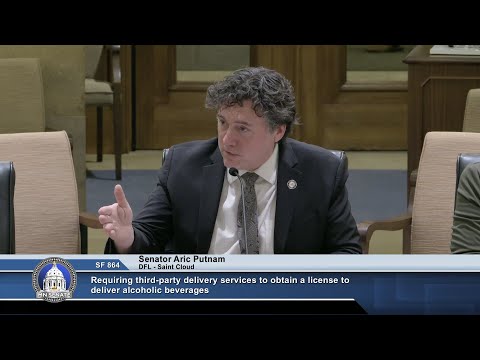
The Minnesota Senate Commerce and Consumer Protection Committee heard testimony Feb. 18 on Senate File 864, a bill that would create a third‑party delivery license for off‑sale liquor and require age verification, training and liability insurance for third‑party alcohol delivery services.
The Minnesota Senate Commerce and Consumer Protection Committee heard testimony Feb. 18 on Senate File 864, a bill that would create a third‑party delivery license for off‑sale liquor and require age verification, training and liability insurance for third‑party alcohol delivery services.
Senator Putnam, the bill’s author, told the committee, “This bill is complex, both practically and morally.” He said the measure aims to bring consistency and legal clarity to a delivery marketplace now dominated by platforms such as Instacart, DoorDash and Uber Eats, which the attorney general’s office has signaled are acting like retailers because receipts and charges are processed through the delivery platforms.
Wendy Manuel of Northfield, Minn., testified about her daughter Jacqueline’s death. Manuel said, “My daughter, Jacqueline, died in September 2022, and she died from alcohol poisoning and intoxication,” and described finding dozens of empty bottles in her daughter’s apartment and reviewing delivery records on the Instacart app. Manuel said some orders in the final months contained the equivalent of dozens of alcoholic servings in a single day and that she had left instructions for delivery workers to bring items into the apartment because her daughter was unable to answer the door.
The bill would require a third‑party delivery license for companies that deliver alcohol, set a minimum age of 21 for employees or contractors who deliver intoxicating beverages, require verification of the recipient’s age at delivery, require training to help delivery personnel recognize signs of impairment and require liability insurance for licensees. Committee members discussed whether the proposed license fee would be $500 annually and whether the Department of Public Safety or another agency would administer the license and enforcement.
Committee members asked how the proposal would interact with existing private platform training and policies. Senator Putnam and witnesses said some platforms have training or policies — for example, DoorDash’s policy compensates drivers who decline to complete a delivery because they judge a customer intoxicated — but approaches vary across companies. Putnam said the bill aims to create consistency across platforms and to attach legal consequences for failures to follow training or refusal protocols.
The committee also discussed edge cases raised by members, including interstate shipments and deliveries by common carriers or parcel services. Committee members said those issues would need further work with stakeholders.
Senate File 864 was amended in committee: Senator Wicklund offered an A1 author’s amendment, which was adopted by voice vote. After testimony and questions the committee laid Senate File 864 as amended over for further consideration.
Votes and formal actions recorded in committee included the adoption of the A1 author’s amendment (voice vote; no roll‑call recorded) and the motion to lay the bill over (laid over). The committee did not take a final floor action on the bill during this hearing.
The committee chair said staff and lawmakers would continue discussions with industry stakeholders to refine training requirements, insurance provisions and agency administration before the bill advances.