Get Full Government Meeting Transcripts, Videos, & Alerts Forever!
Get email alerts on the State Budget topic
No spam. Unsubscribe anytime.
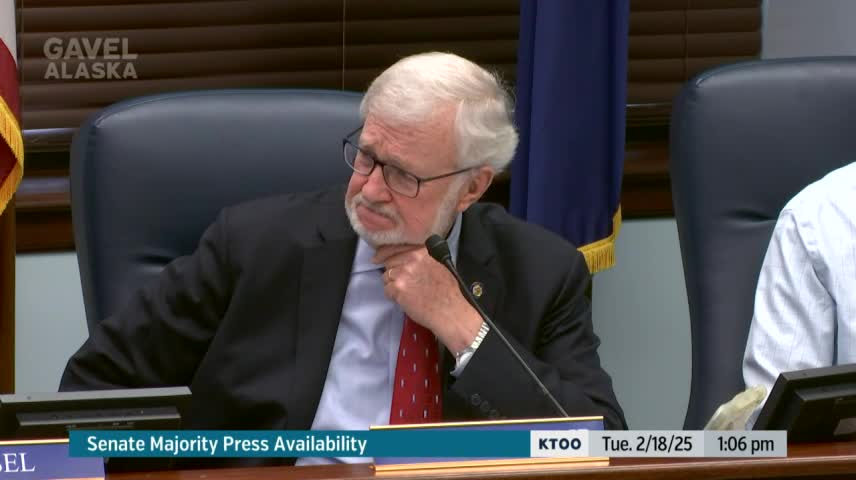
Senators warn of multi-year budget shortfall; pension bill and S-corp changes proposed
Summary
Senators at a press briefing outlined midterm and multi-year deficits, discussed a public-employee pension bill (HB78) and indicated potential new revenue measures including changes to S-corporation treatment for oil companies and considerations on the Permanent Fund Dividend formula.
Juneau — Senate leaders at a March press briefing described a looming multi-year budget shortfall that they said will force lawmakers to consider new revenue measures and changes to spending priorities.
Senator Hoffman, operating chair of the Senate Finance Committee, said the state faces a deficit for the current fiscal year that ends June 30 of about $139,000,000 and projected a fiscal‑year 2026 shortfall of roughly $347,300,000 under the session’s stated assumptions. “So the combination of FY25 and FY26 that we have to address totals $536,300,000,” Hoffman said.
Hoffman listed key assumptions behind the projections: a base student allocation (BSA) estimate of $680, a Permanent Fund Dividend figure set at $75.25, a governor’s capital budget at $300,000,000, $29,000,000 for new contracts and roughly $27,700,000 for fire suppression. He warned that under similar assumptions deficits grow in later years, with FY27 and FY28 projections rising further.
On pensions, Senator Giesel said House Bill 78, the pension proposal for public employees, is under consideration in the House Finance Committee and was being heard again. He said the bill is intended to provide “a modest pension, a new pension for our public employees” to improve retirement security.
Lawmakers flagged a range of potential revenue options they said were under caucus discussion but said an income tax or statewide sales tax was not being considered. Senator Hoffman said proposals under early discussion include changes targeting S corporations and other measures rather than a general income or sales tax.
Senator Hazel and other senators flagged one concrete bill on the calendar: Senator Yount’s S‑corporation bill, described as addressing a loophole that allows some oil companies organized as S corporations to avoid the state’s C‑corporation tax. The Senate Resources Committee was scheduled to hear that measure.
Senator Stevens and others noted prior vetoes and political sensitivity around tax measures: HB49, a tobacco tax proposal, was vetoed previously and may be resubmitted, but the governor has signaled opposition to tax increases. On the Permanent Fund Dividend, Hoffman said he supports keeping a formula level near $75.25 and acknowledged debate over whether drawing more from savings is appropriate.
Other ideas mentioned included potential adjustments to unemployment insurance benefits, raised by Senator Locoski as a possible tool to reduce out‑migration and to help seasonal workers; the senator said staff were asked to research the issue.
Senators said they were aiming to craft revenue and spending solutions that could garner the votes required for an operating budget and warned they did not want to spend the constitutional budget reserve on recurring expenses. “Those are for rainy day funds,” Hoffman said, adding he did not favor using the reserve for ongoing costs.
No formal votes were taken at the press briefing; senators described committee schedules and the status of bills to be heard in coming days.