Alaska Earthquake Center outlines early-warning, tsunami and landslide monitoring work in Juneau talk
Loading...
Summary
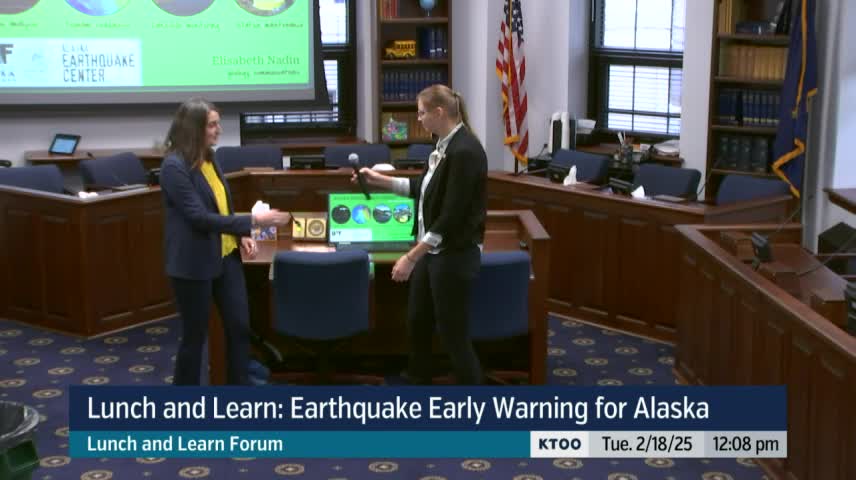
Dr. Elizabeth Nadine of the Alaska Earthquake Center briefed Alaska legislators on the center’s seismic network, earthquake early-warning potential for Alaska, tsunami inundation mapping for coastal communities and a landslide-detection program that has detected recent collapses near Whittier.
Dr. Elizabeth Nadine, a seismologist with the Alaska Earthquake Center at the University of Alaska Fairbanks, told a legislative “lunch and learn” in Juneau that Alaska already has the sensors and data needed to build an earthquake early-warning system and that the center is applying its network to tsunami mapping and landslide detection.
"So we're not at the stage where we can predict earthquakes. We are at the stage where we can use incoming information from an earthquake that has happened to alert people that significant shaking is coming," Nadine said, describing how P waves arrive first and can be used to estimate location and magnitude before stronger S waves produce damaging shaking.
The presentation summarized several ongoing programs at the Alaska Earthquake Center. Nadine said the center maintains roughly 250 seismic stations across Alaska, processes tens of thousands of events a year for hazard mapping, and produces rapid "ShakeMaps" after significant quakes to guide inspections and response. She said the center’s 2024 catalog processed about 40,000 earthquakes and that in several recent years Alaska averaged far more events because of aftershocks from large 2018 earthquakes. Nadine noted that last year about 50 earthquakes above magnitude 5 occurred in Alaska and that 80 events were reported as felt by residents.
Why it matters: Alaska’s seismic risk is concentrated along the southern subduction zone and in some interior faults, Nadine said. Large subduction-zone ruptures can produce prolonged shaking and tsunamis. Early-warning alerts distributed to phones, TV and infrastructure operators could provide seconds to tens of seconds of lead time in population centers; Nadine’s scenario modelling showed Anchorage could receive roughly 30–40 seconds of warning for a large south-coast rupture, and offshore subduction events could afford up to about a minute of lead time for some locations.
Nadine described practical uses for those seconds: automated actions such as pausing transportation, opening emergency bay doors, securing equipment at ports and airports, shutting off gas lines, and giving first responders a moment to secure operations. She noted existing systems on the U.S. West Coast use the USGS ShakeAlert service and said a comparable capability could be implemented for Alaska using the state’s seismic network.
Nadine also outlined the center’s tsunami work: the center models worst-case tsunami scenarios and produces inundation maps and evacuation-route brochures in partnership with local communities, NOAA’s National Tsunami Hazard Mitigation Program and the State Division of Homeland Security and Emergency Management. She showed an example map for Homer with designated evacuation lines and assembly areas and said communities set their own evacuation boundaries based on those models.
On landslides, Nadine described a monitoring program in Prince William Sound near Berry Arm where glacier retreat has left a large unstable slope. Using seismic signatures that differ from earthquakes, the center’s sweep algorithm monitors a roughly 200-mile radius and has detected known slides in near real time; detections are verified by satellite imagery. Nadine said one recent cliff collapse last September involved about 2,300,000 cubic meters of rock and produced a small measurable tsunami. She contrasted that with a much larger Greenland rockfall (Taunfjord) of about 70,000,000 cubic meters.
Nadine addressed funding and operations in the question period. She said about 86% of the earthquake center’s funding comes from federal sources and that the center is watching federal budget and agency changes that could affect USGS and FEMA partnerships. On station reliability, she said many stations in population centers are on reliable power and internet while remote outposts rely on batteries and solar and require field maintenance in summer.
The presentation ended with Nadine noting the seismic network’s broader uses: beyond earthquakes, seismic sensors can detect infrasound (used for volcanic monitoring and explosion detection), weather data for wildfire forecasting and other environmental signals, including seasonal Arctic snow changes.
The talk included a question-and-answer period with legislators and audience members about Denali and Brooks Range seismicity, early-warning lead times and the center’s partnerships with state and federal agencies. No formal votes or actions were recorded at the session.