Get Full Government Meeting Transcripts, Videos, & Alerts Forever!
Get email alerts on the Education Funding topic
No spam. Unsubscribe anytime.
Senators say Alaska must boost school funding as Municipal League highlights deferred maintenance
Summary
Senators at a March press briefing said Alaska underfunds K–12 education, citing a presentation from the Institute for Social and Economic Research and upcoming testimony from the Alaska Municipal League on deferred maintenance and school construction needs.
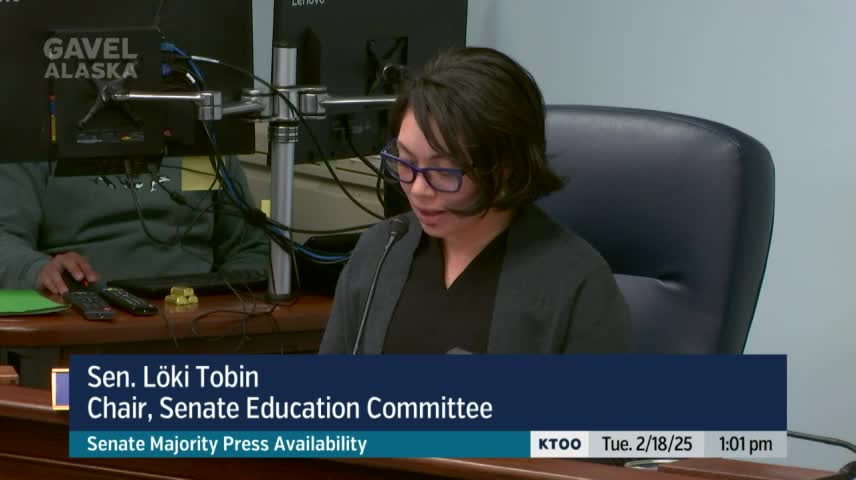
Juneau — Senator Trolbin, speaking at a Senate majority press briefing on day 29 of the 2025 legislative session, said research presented this week shows Alaska’s public schools are substantially underfunded and that municipal officials will press the Legislature for help.
“Alaska continues to underfund and under invest in its public schools,” said Senator Trolbin, referring to a presentation by Dr. DeFeo and Dr. Berman from the Institute for Social and Economic Research. Trolbin said the research shows Alaska’s public school spending is “about 15% the national average” and that teacher salaries are roughly “$16,000 below the national average.”
The senator said those shortfalls have shifted much of the cost of public education onto local communities and federal funding streams, increasing instability for school districts. “Across the state, our municipalities and boroughs support about 76% of our public school facilities and they are just crumbling under the weight of deferred maintenance,” she said.
Trolbin invited the public to watch testimony: the Alaska Municipal League is scheduled to present concerns about local contributions to education at 8 a.m. tomorrow, she said. The senator said one clear theme she expects from municipal leaders is a request for resources to address deferred maintenance and school construction, items she said were absent from the governor’s budget.
The senator also said the Senate education committee will continue scrutinizing the governor’s approach to education funding, pointing to SB 82 as a vehicle the committee has noticed for further hearings. “We are looking for the correct vehicle and the opportunity to really find a compromise and ensure that the approach that we take is going to be able to not only move through both bodies, but also be signed by the governor,” she said.
Senators at the briefing tied the school funding problem to broader fiscal stress facing the state, including lower oil revenue and projected budget deficits discussed later in the conference. Trolbin and others urged follow-up work in the weeks ahead to craft a funding approach that addresses both operational costs such as teacher pay and capital needs including building repairs and safety upgrades.
Additional details raised at the briefing included the Institute for Social and Economic Research’s methodology and key findings; Trolbin encouraged listeners to review that presentation for full context.
The Municipal League’s testimony and the Senate education committee’s follow-up on SB 82 will be public and recorded in committee minutes and hearing schedules, the senators said.