Get Full Government Meeting Transcripts, Videos, & Alerts Forever!
Get email alerts on the Attorney General Budget topic
No spam. Unsubscribe anytime.
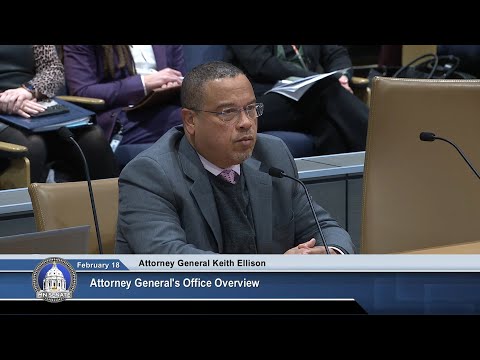
Attorney General Ellison highlights enforcement wins and requests funding for staff, including Medicaid fraud unit expansion
Summary
Attorney General Keith Ellison described recent settlements and consumer protection work, and asked the Senate committee for a $7.9 million ongoing increase and 26 FTEs for 2026–27, plus a one‑time $940,000. He also requested nine new positions for the Medicaid Fraud Control Unit, 75% federally funded.
Attorney General Keith Ellison told the Senate Committee on State and Local Government that his office’s recent legal work has returned money to the state and to Minnesota households and that additional staff and pay parity are needed to sustain enforcement.
“My office has contributed $2,100,000,000 to the bottom line of both state of Minnesota and Minnesota households,” Ellison said, citing settlements, rate interventions and consumer relief across multiple enforcement areas. He said the office’s general fund budget is about $40 million per fiscal year and that roughly 82% of that amount funds compensation.
Ellison outlined a two‑part budget request for fiscal 2026–27: a one‑time request of $940,000 and an ongoing increase of $7.9 million per year. The ongoing request would fund salary parity, address retention, and support 26 additional full‑time equivalent positions. He said the office hired 26 legal staff through 2023 investments and that even with those investments, inflation‑adjusted base funding remains below historic levels.
Ellison described enforcement outcomes the office points to as evidence of program impact: more than $565 million in opioid‑related settlements (with about $183 million received so far), more than $60 million from settlements with Juul and Altria over e‑cigarette marketing, more than $81 million won for the state’s tobacco fund, and $1.5 billion in consumer energy savings attributed to Residential Utilities Division interventions. He also said the office returned more than $85 million in restitution and debt relief tied to student loan scams and over $51 million in consumer‑direct relief through mediations and complaint handling.
The attorney general separately highlighted a request for nine new positions for the Medicaid Fraud Control Unit — one attorney and eight investigators — and said the federal Office of Inspector General staffing algorithm indicates the unit is understaffed relative to the size of Minnesota’s Medicaid program. Ellison said about 75% of the cost of those nine positions would be borne by federal reimbursement, leaving the state to fund the remaining 25%.
During Q&A, senators asked about the AG’s ongoing antitrust work. Ellison described current litigation and enforcement priorities, naming cases by industry and some defendants from his remarks: he cited lawsuits involving RealPage, AgriStats, Meta, major insulin manufacturers and John Deere, framing those actions as efforts to protect competition and consumers. He also described the office’s litigation history and noted that consumer protection activity often requires sustained staffing and resources.
Ellison told the committee the office answers tens of thousands of consumer calls annually — he said the consumer function receives between 65,000 and 85,000 calls per year — and that additional resources support both direct consumer assistance and complex civil and criminal investigations.
Ending: Ellison asked the committee to consider the office’s 2026–27 budget requests to maintain ongoing enforcement, preserve institutional knowledge and increase the office’s investigative capacity, especially for Medicaid fraud.