Get Full Government Meeting Transcripts, Videos, & Alerts Forever!
Get email alerts on the Office Of Inspector General topic
No spam. Unsubscribe anytime.
House committee advances bill to create legislative Office of Inspector General after hours of amendment votes
Summary
Lawmakers debated House File 1, which would create an Office of Inspector General under the Legislative Audit Commission to investigate fraud, waste and abuse in state-funded programs; the committee approved several technical changes and referred the bill to the Human Services and Finance Policy committees with further revisions expected.
A Minnesota House committee advanced House File 1 on a voice vote after more than two hours of debate and a string of amendments, endorsing a plan to create an Office of Inspector General (OIG) placed under the Legislative Audit Commission.
The bill, introduced and presented in committee by Representative Anderson, would establish a nonpartisan OIG within the Legislative Audit Commission to investigate alleged fraud, waste and abuse in state programs and in recipients of state funds. Representative Anderson said the placement under the Legislative Audit Commission was intended to preserve independence and nonpartisanship: "that body...is very nonpartisan...and it's independent," she said, arguing that the OIG should be able to act "without threats from anyone or any angle." She also described the measure as a response to a recent wave of grant- and program-related fraud prosecutions and said lawmakers expect additional cases to emerge.
Why it matters: supporters said the proposal would centralize investigative expertise and improve detection of multi-agency fraud, while opponents warned the draft contains broad authorities over rulemaking, data access and staff classification that could raise separation-of-powers and privacy concerns.
Key votes and amendments
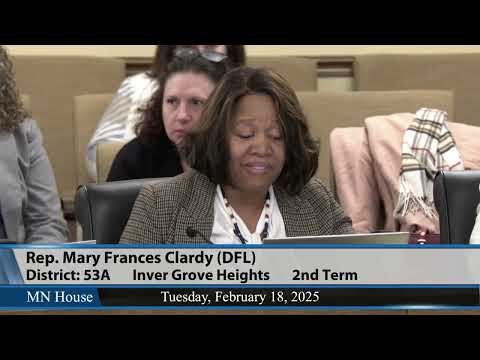
- The committee moved a DE amendment first and adopted it; the bill was then considered in the amended form. The A1 amendment was also adopted. - Representative Clardy’s A2 amendment — which would have removed a rulemaking exemption and subjected the OIG to formal rulemaking (public notice and comment) — was debated and voted down. House nonpartisan staff explained that legislative entities typically do not follow the formal administrative rulemaking process and that a similar rulemaking authority had been removed elsewhere in the draft. Representative Clardy argued for public notice; Representative Quam and others said some enforcement procedures may need to remain nonpublic to avoid tipping off bad actors. - Several attempts to broaden the bill’s stated investigative scope (A3 and A4), adding explicit references to tax preferences, business subsidies and labor-law enforcement, were debated and not adopted. - Representative Howard’s A5 was divided: lines 1.1–1.8 (requiring IG staff to be subject to conflict-of-interest laws and to file statements of economic interest) were adopted; the remainder of A5 addressing data-record tracking was withdrawn after discussion about access to nonpublic data. - Representative Freiberg’s A6 was adopted (engrossed) after negotiation and the author agreed some large grants-related language would be removed or reworked in subsequent drafts.
Staffing, classification and grants management
MAPE (Minnesota Association of Professional Employees) testified that the bill as written would move OIG staff into unclassified service and remove merit-based hiring and collective-bargaining protections for employees now embedded in agencies. "The language here in this bill stripping the OIG employees of their classified service designation and union protections is antithetical to the creation of a qualified independent office of inspector general," said Devin Bruce, director of legislative and political affairs for MAPE.
Representative Anderson and witnesses said the office would have embedded staff in agencies for operational knowledge, but the bill’s grants-related provisions are a work in progress. The committee heard that the Office of Grants Management had four employees before a 2023 expansion to a statutory cap of 12 and currently had nine staff. Representative Anderson said much of the grants-management language would be removed and reworked with input from the Department of Administration and the Legislative Auditor.
Data access and privacy
Members repeatedly questioned broad data-access language in the draft. Representative Howard pointed to provisions that would require agencies and recipients of state funds to provide "full and unrestricted access to all government data regardless of classification," and warned that this could include nonpublic or personally identifying records maintained by private recipients of state funds. Representative Anderson answered that the OIG would need access when there is an investigative reason, but she said legislators themselves should not have direct access to nonpublic data.
Rulemaking and separation of powers
The committee debated whether the OIG should be subject to chapter 14 rulemaking. House nonpartisan staff explained the formal rulemaking process (notice, comment, hearings and statements of need and reasonableness) and said legislative entities generally do not go through the administrative rulemaking process. Supporters of public rulemaking argued for transparency; opponents said operational details used to detect fraud are sometimes appropriately limited to the oversight body to avoid alerting bad actors.
Other testimony and concerns
- Judy Randall, the Legislative Auditor, described how the Office of the Legislative Auditor (OLA) is staffed with a mix of unclassified appointed positions and classified staff; she did not offer an opinion about the OIG classification but explained OLA practice for committee members. - MAPE and other speakers raised concerns about consolidating or eliminating agency-level OIGs (for example at DHS), and how the new office would coordinate with the Attorney General’s Medicaid fraud unit and federal Medicaid rules.
Outcome and next steps
After adopting several amendments and rejecting others, the committee approved a motion to refer House File 1 to the Human Services and Finance Policy committees. Representative Anderson told members the bill will be further revised, that the author and staff will continue discussions with the Department of Administration and the Senate sponsor, and that a new DE is expected at a later committee stop.
Ending note: the author and committee members said they expect further changes; members requested continued briefings from the Legislative Auditor, the Department of Administration and the Attorney General on coordination, staffing and data-access safeguards.