Get Full Government Meeting Transcripts, Videos, & Alerts Forever!
Get email alerts on the Minnesota State Capital Heapr topic
No spam. Unsubscribe anytime.
Minnesota State requests $200 million HEAPR and operating funds to repair, replace and demolish aging campus space
Summary
Minnesota State officials told the Capital Investment Committee the system’s greatest need is HEAPR renewal funding ($200M) and additional operating support for demolition and repair; the system emphasized it is overbuilt for current enrollment and seeks targeted renewal, replacement and demolition financing.
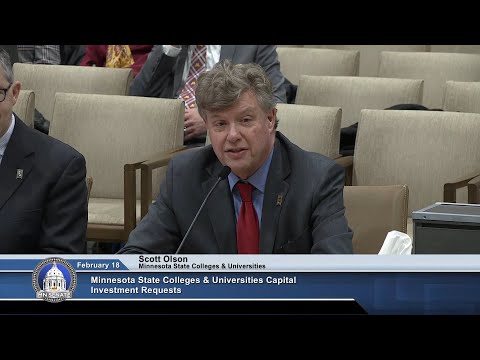
Minnesota State officials told the Senate Capital Investment Committee on Feb. 18 that the system’s top capital priority is a $200 million HEAPR request to renew aging campus facilities and that they are also seeking operating budget dollars for demolition and repair-and-replacement activities.
Chancellor Scott Olsen and Associate Vice Chancellor Brian Swanson described the system as the fourth‑largest higher‑education network in the U.S., with 33 colleges and universities on 54 campuses and roughly 28.5 million square feet across 843 structures. Olsen said Minnesota State has 364 buildings over 50 years old and that 40% of buildings represent 60% of system square footage. Swanson said deferred‑renewal backlogs are growing as capital funding and operating resources have not kept pace with inflation and maintenance needs.
Minnesota State’s 2025 request centers on HEAPR as the most flexible capital funding to renew building envelopes, plumbing, HVAC, accessibility and code needs. The system also is seeking operating‑budget proposals: $25 million non‑recurring for demolition (to reduce excess square footage) and $50 million non‑recurring for repair and replacement (an operating complement to HEAPR). Swanson said the system is pursuing a “no net new growth” strategy and has identified 1.3 million square feet of space that could be demolished if adequate funds are available.
The system presented 65 HEAPR projects across campuses and 14 larger renovation or replacement projects, five of which already have design funding and will seek construction funding next. Olsen and Swanson emphasized that operating funds and tuition cannot sustainably substitute for capital renewal without curtailing programs. Committee members asked about prioritization and return‑on‑investment metrics; senators suggested the system target projects that produce the largest economic or workforce impacts for the state, including health‑care programs and hands‑on technical training.
No formal actions or votes were taken during the hearing portion of the presentation.