Get Full Government Meeting Transcripts, Videos, & Alerts Forever!
Get email alerts on the Oversight Oig topic
No spam. Unsubscribe anytime.
Committee advances bill to create legislative Office of Inspector General after amendment fight
Summary
The State Government and Policy Committee advanced House File 1, which would create an Office of Inspector General (OIG) under the Legislative Audit Commission, after votes on multiple amendments and discussion about rulemaking, data access, grants oversight and staff classification.
ST. PAUL, Minn. — The State Government and Policy Committee on Feb. 18 advanced House File 1, a measure that would create an Office of Inspector General (OIG) located under the Legislative Audit Commission to investigate fraud, waste and abuse tied to state funds.
The billauthor, identified in committee as Representative Anderson, described the proposal as the statefraud bill and said it would place an independent investigative office "within, under the Legislative Audit Commission." The committee approved the bill as amended and referred it to the Human Services and Finance Policy committee.
Supporters and the bill author said the Legislative Audit Commission (LAC) provides a bipartisan, bicameral and nonpartisan oversight structure and argued the office should be placed there to preserve independence. Representative Anderson said the Legislaturehas already seen large-scale fraud and that a new office could improve oversight. "House file 1 is, essentially we call it the fraud bill. It creates the Office of Inspector General, within, under the Legislative Audit Commission," the author told the committee.
Opponents and some members pressed several recurring concerns: whether the OIG should be exempt from the formal rulemaking process, how broad the officewould be, whether it would duplicate existing agency OIGs, how staff would be classified, and the scope of data access the OIG would have. Nonpartisan staff explained that entities in the legislative branch do not typically follow Chapter 14 rulemaking procedures, and cited practice at the Office of Legislative Auditor as precedent.
On the narrow rulemaking issue, nonpartisan counsel summarized the formal rulemaking process and told members: "with the formal rule making process, there's public notice, there's opportunity for public comment, there's often a public hearing... and the agency has to often submit a statement of need and reasonableness." Members who favored keeping an exemption said some investigative procedures cannot be fully public for operational reasons; Representative Quam argued that withholding limited investigative playbooks from potential wrongdoers is common practice.
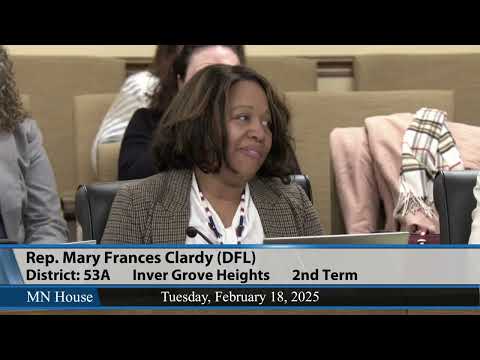
The committee considered a series of author and member amendments and votes: - The bill was taken up with an A1 amendment and a DE; the committee adopted the DE and the A1 and the bill was placed in amended form. (Voice vote; recorded as adopted in committee minutes.) - Representative Clardy's amendment to remove an exemption for rulemaking (A2) was debated and failed to pass. - Subsequent amendments broadening the OIG's statutory reach (to include tax preferences, business subsidies and worker misclassification) (A3, A4) were offered and not adopted. - An accountability amendment requiring OIG staff to follow conflict-of-interest laws and submit statements of economic interest (A5) was divided by the author; lines 1.1through 1.8 of A5 (conflict-of-interest and related technical cleanup) were adopted; the second part addressing a data-access reporting requirement was withdrawn at the author's request. - An amendment (A6) that removed large portions of grant-management transfer language was adopted after the bill author said most of those grant provisions would be removed in the next DE.
Public witnesses and agency staff testified. Stacy Christiansen, Deputy Commissioner, Department of Administration, told the committee the department appreciates the conversations but still had two outstanding concerns: "There is a difference between an unannounced verification visit and an unannounced monitoring visit," she said, and urged clarification because unannounced monitoring visits could strain agency resources. Devin Bruce, director of legislative and political affairs for the Minnesota Association of Professional Employees (MAPE), warned that some provisions would declassify employees and remove civil service and collective-bargaining protections: "The language here in this bill stripping the OIG employees of their classified service designation and union protections is antithetical to the creation of a qualified independent office of inspector general," he said. Judy Randall, the Legislative Auditor, explained the current classification mix at the Office of Legislative Auditor as background for committee deliberations.
Committee members also pressed the bill author about separation of powers, whether the OIG would duplicate existing agency investigative offices (including the DHS and the attorney generalMedicaid fraud unit), and whether the Legislative Audit Commission would have enough time and capacity to make the OIG complementary rather than duplicative.
Representative Anderson said the bill is a work in progress and repeatedly told members she expected to revise grant-related language after further meetings with the administration and the Senate. The committee ultimately voted to refer the amended bill to Human Services and Finance Policy. "Representative PH Anderson renews his motion to refer House File 1 to Human Services and Finance Policy. All in favor? Aye. Opposed? No," the chair announced.
The referral advances the measure to its next stop, where members said they will continue negotiations over rulemaking language, data access safeguards and the scope of grant-management authority.
Members and several testifiers asked the author to continue discussions, to limit duplication with federal and agency-level fraud units, and to clarify how staff would be appointed and classified. The bill will return to later committees for additional drafting and votes.
The committee hearing also included multiple procedural disagreements about which amendment had been voted on and whether the committee should lay the bill over for more drafting; those motions were debated and decided by voice vote.
Ending: The committeereferred House File 1 as amended to Human Services and Finance Policy. Lawmakers said they expect further changes in subsequent committee stops and in coordination with the Legislative Audit Commission and the Department of Administration.