Get Full Government Meeting Transcripts, Videos, & Alerts Forever!
Get email alerts on the Eidbi Licensure topic
No spam. Unsubscribe anytime.
DHS recommends licensure for EIDBI services, seeks provisional license and stronger oversight
Summary
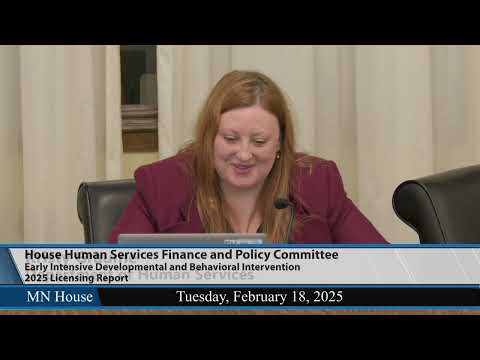
The Minnesota Department of Human Services recommended licensing Early Intensive Developmental and Behavioral Intervention, or EIDBI, during a presentation to the House Human Services Finance and Policy Committee. Christy Grom, Director of State Government Relations at DHS, told the committee that licensure would “provide a minimum standard, that really helps us to have a firm foundation to oversee basic health and safety and improve quality of service.”
The Minnesota Department of Human Services recommended licensing Early Intensive Developmental and Behavioral Intervention, or EIDBI, during a presentation to the House Human Services Finance and Policy Committee. Christy Grom, Director of State Government Relations at DHS, told the committee that licensure would “provide a minimum standard, that really helps us to have a firm foundation to oversee basic health and safety and improve quality of service.”
Grom said the department’s multi‑phase licensure evaluation — which included community engagement, comparative analysis with other states and a review of service models — led DHS to recommend licensure as a way to address operational inconsistencies, supervision shortfalls and safety concerns in a rapidly expanding provider market. EIDBI is a state plan medical assistance service authorized under the Medicaid EPSDT (Early and Periodic Screening, Diagnostic and Treatment) benefit, and it is delivered in homes, clinics and schools using a set of approved therapeutic modalities.
Why it matters: Committee members were told the number of enrolled individual EIDBI providers rose sharply since the pandemic while children receiving services increased by about 30 percent. DHS said rapid provider growth has not been matched by an equivalent growth in advanced supervising providers, creating supervision strain and potential safety risks. Grom noted some licensed supervising professionals were affiliated with as many as 20 provider agencies, and DHS flagged the proportion of out‑of‑state provider addresses and heavier telehealth use as areas needing guardrails.
Recommendations and immediate changes: DHS described a two‑step approach. The department asked the legislature for authority and funding to implement a provisional licensure this session while it develops full licensing standards. Under the proposal:
- Providers would apply for provisional licensure (Grom said applications would be required by January, with DHS beginning provisional application development in July if the Legislature funds the proposal). - DHS would be authorized to identify controlling individuals, disqualify ineligible persons, and conduct background studies prior to enrollment rather than allowing background checks to run concurrently with service delivery. - DHS would be the investigative agency for alleged maltreatment in EIDBI settings, working with but not replacing local law enforcement, the department said. - EIDBI provider agencies would be reclassified to a higher risk category for enrollment oversight, moving from periodic checks every five years to more frequent reviews (DHS cited three‑year revalidation as an example).
Grom described the provisional license as a short‑term safety step while DHS works with clinicians, families and providers to design detailed, location‑sensitive health and safety standards and to set limits on supervising workloads and training requirements. She said the department had completed on‑site reviews of roughly 160 agencies and referred a small number of matters to appropriate authorities; DHS also reported about 29 open investigations related to EIDBI during the presentation.
Questions from legislators: Committee members raised concerns about timeline, enforcement and local control. Representative Gilman pressed DHS on rapid spending growth noted in claims data and on the number of open investigations; Grom said DHS had not seen pervasive findings in initial site visits but is continuing investigations and monitoring billing patterns using fraud‑detection systems. Representative Jacob asked whether state investigative authority would subsume local control; Grom responded that DHS would continue to collaborate with local law enforcement and county partners but that state authority would allow earlier intervention in maltreatment matters that DHS otherwise could not investigate.
Several members asked for additional data and follow‑up from DHS. Representative Murphy drew attention to a figure cited by committee staff that individual providers rose from about 1,200 to 12,000 from 2020–24 (a committee member reported that figure during questioning), while recipients rose by roughly 30 percent; DHS said it would verify and return with active‑vs‑inactive provider counts and a clearer breakdown of what is counted as an “individual provider.” Members also asked DHS to provide more detail on: how many providers on DHS rolls are inactive; the speed and legal authority for DHS to act on violations; how telehealth and out‑of‑state supervision should be limited; and how services should be coordinated with schools.
Budget and timeline: Grom summarized related items in the governor’s budget for 2025. The proposal funds provisional licensure implementation steps, system upgrades and additional DHS staff to review applications and conduct on‑site investigations. DHS presented what it called an aggressive timeline: provisional licensure application work to begin in July if authorized; additional rule, standard and statute recommendations returned to the Legislature in 2027; and potential full implementation in 2028 if approved.
Limitations and department caveats: DHS emphasized licensure is not a panacea. Grom said it establishes minimum standards to support health and safety oversight but will not resolve non‑licensure barriers such as school access or broader workforce shortages. She and other DHS speakers said some proposed changes — for example, requiring providers to be agency employees rather than independent contractors — are meant to clarify legislative intent from earlier statutes rather than to upend existing, licit provider arrangements.
Next steps: Committee members requested follow‑ups on several technical items (active provider counts, the mechanics and timing of background checks, details of DHS investigative authority and the interplay with county responsibilities). DHS also offered to continue working with legislators and community partners to design training, clarify supervision caps for Qualified Supervising Professionals and fine‑tune risk categorization and investigation authorities.
Closing note: The presentation prompted extensive committee discussion about balancing access, workforce needs and taxpayer protections. DHS urged a collaborative drafting process for licensure language and regulatory design rather than immediate, unilateral rulemaking. Commissioner Shereen Gandhi and DHS staff who later appeared for additional budget questions reiterated the department’s interest in stronger program integrity tools across DHS programs and said additional statutory authority and funding requests would be part of the budget package.