Get Full Government Meeting Transcripts, Videos, & Alerts Forever!
Get email alerts on the Transportation Capital topic
No spam. Unsubscribe anytime.
MnDOT seeks funds for rail-crossing signals and port infrastructure as federal grant uncertainty looms
Summary
MnDOT told the Capital Investment Committee it seeks GO bonding for railroad crossing warning devices and port development assistance, and officials warned several federal programs (NEVI, Protect, carbon reduction) face possible freezes that could affect planned projects and matching funds.
Officials from the Minnesota Department of Transportation told the House Capital Investment Committee on Feb. 18 that the governor's capital recommendations include funding for railroad crossing warning devices and port development assistance, and they described ongoing uncertainty about several federal programs that supply match dollars for state projects.
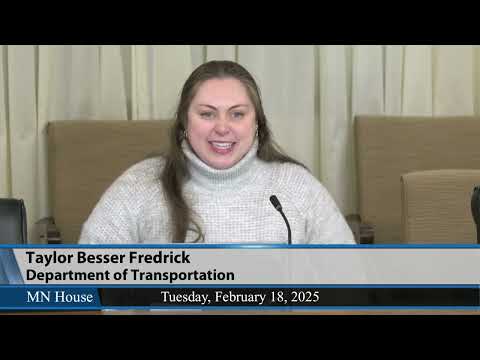
"We have $1,800,000 in GO bonds included in the governor's recommendation" for railroad crossing warning devices, Taylor Besser Frederick, Assistant Budget Director with MnDOT, said, adding the agency has roughly 750 signal systems past their life cycle and that "total cost to replace those is over $300,000,000." She said the requested funds would continue ongoing replacement to keep signals in their life cycle.
MnDOT also is seeking $2,800,000 for a port development assistance program for public ports, Frederick said; Eric Rudine, MnDOT Government Affairs, listed the five eligible Minnesota public ports as St. Paul, Duluth, Red Wing, Wabasha and Winona.
Committee members pressed MnDOT about responsibilities between road authorities and railroads. Rudine said road authorities typically install the systems and the railroad operates and maintains them; the state request is intended to pay for replacement and life-cycle upkeep.
Members also pressed MnDOT about several federal programs after questions about a broader pause of federal funds. Rudine said Minnesota has received the most guidance on the National Electric Vehicle Infrastructure formula (NEVI) program and that the Protect (resiliency) and carbon reduction programs have been targeted for review. "As of today...the NEVI formula funds have continued to flow, that have been obligated. It's really funds that have not yet been obligated," he said, and later added that MnDOT anticipates about $4,000,000 in NEVI funds it now does not expect to receive.
Mary Ann Conboy, capital budget coordinator at Minnesota Management and Budget, briefed the committee on state debt guidelines and guideline 3, which measures the pace at which the state pays down general obligation debt. She told members guideline 3 limits how much new GO bonding the state can take on in the near term, and that trunk highway bonds are constitutionally authorized GO bonds that interact with those capacity calculations.
Members asked about specific projects that rely on federal grants — including the Robert Street Viaduct, the Blatnik Bridge in Duluth and planned Minneapolis projects — and MnDOT said it is monitoring federal developments and working with congressional offices. Several members asked the department to study whether a rapid-response fund could address retrofit needs (for example, bridge fencing for suicide prevention) rather than waiting for full replacement projects.
MnDOT did not present a motion or seek a committee vote during the hearing; staff stood for questions and follow-up requests.