Get Full Government Meeting Transcripts, Videos, & Alerts Forever!
Get email alerts on the Data Practices topic
No spam. Unsubscribe anytime.
Rules committee advances floor placement of bill changing Data Practices Act handling for attorney general amid fiscal-note objections
Summary
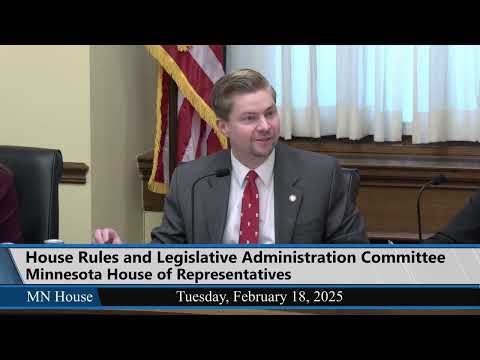
The Rules and Legislative Administration Committee voted to place on Thursday, Feb. 20, 2025, on the House calendar a bill that clarifies classifications under the Minnesota Government Data Practices Act as they apply to the Attorney General's Office, amid objections from minority members who said the panel rushed the process without a fiscal note or referral to State Government Finance.
The Rules and Legislative Administration Committee voted to place on Thursday, Feb. 20, 2025, on the House calendar a bill that clarifies classifications under the Minnesota Government Data Practices Act as they apply to the Attorney General's Office, amid objections from minority members who said the panel rushed the process without a fiscal note or referral to State Government Finance.
The bill’s placement on the floor drew criticism from Minority Lead Representative Long, who said committee members had requested a fiscal note to determine whether the Attorney General’s Office would need additional staffing to handle any change in workload. "We didn't have the fiscal note," Long said, and added that members from his side, including offers from Representatives Liebling and Feist, had proposed working together for a bipartisan solution before the bill went to the floor.
Committee Chair Representative Nash defended the decision to move the bill onto the calendar, saying the measure corrected a misinterpretation of the Data Practices Act and cited a judicial dissent as part of the rationale. "We didn't feel like it was necessary to come before State Government Finance, so we did not call for it," Nash said. Nash also referenced the approach advocated by former speaker Paul Thiessen in a court dissent as supporting the committee's view about the statute’s meaning.
Janice, a committee staff member, told the panel she had discussed the measure with officials in the Attorney General's Office. "They did express their belief generally about data practices requests being something that they would like resources to deal with and that's something that we will discuss as things go along," Janice said, adding that the bill as drafted did not change the number of data-practices requests the office would receive.
Representative Long pushed back that the fiscal note is precisely the mechanism to determine whether workload or staffing would increase. He also said he believed the bill would not receive the 68 votes required on the House floor in its current form and that time would be better spent negotiating changes to reach bipartisan agreement.
After discussion, Long requested a roll call. The committee recorded seven ayes and six nays and passed the calendar for Thursday, Feb. 20, 2025. The committee had earlier approved minutes from its Feb. 6 meeting by voice vote.
The committee did not take final action on the underlying bill; it only advanced placement on the floor calendar. Committee members who raised concerns said they were seeking a fiscal analysis and more bipartisan negotiations before floor consideration.