Get Full Government Meeting Transcripts, Videos, & Alerts Forever!
Get email alerts on the Renewable Energy Hydropower topic
No spam. Unsubscribe anytime.
House committee advances bill to let large hydro count toward Minnesota renewable credits
Summary
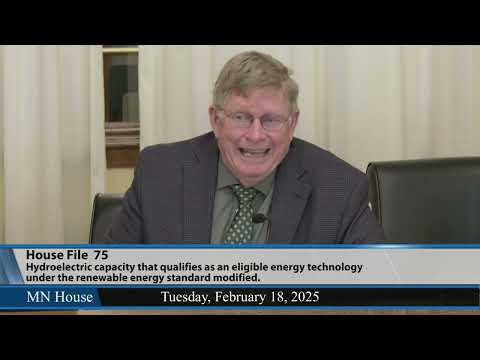
A Minnesota House committee voted to send House File 75 to the General Register after debate over whether hydroelectric projects larger than 100 megawatts should qualify for renewable-energy credits and how environmental review should be handled.
The Minnesota House committee voted to send House File 75 to the General Register after debating whether hydroelectric projects larger than 100 megawatts should be allowed to count toward the state's renewable-energy standards.
Representative Anderson, the bill's sponsor, told the committee the measure simply removes statutory language that bars larger hydro projects from qualifying for renewable-energy credits and “allows the discussion to take place” about whether larger hydropower could serve as carbon-free baseload generation for the state. He said the proposal does not authorize any specific projects but would permit projects above the 100-megawatt threshold to be considered for credits.
Supporters said lifting the limit could help grid reliability. Joe Hoppe of Otter Tail Power Company described his utility's small hydro fleet and noted it produces a modest share of the company's generation: “We operate 5 small hydro plants ... they generate a total of a little over 3 and a half megawatts,” Hoppe said, adding Otter Tail has no current plans to build large hydro. Rachel Stuckey, executive director of the Minnesota Conservative Energy Forum, said, “Hydroelectric power represents a proven, dependable source of carbon free base load generation,” and urged the committee to advance the bill while noting that new or modified projects still would need federal and state licensing and environmental review.
Opponents and some members questioned whether the bill addresses an existing problem. Representative Jones asked what problem the bill was trying to solve if no utilities are planning projects above 100 megawatts and if water capacity exists. Representative Acum urged a referral to the House Environment Committee because of the environmental impacts associated with hydropower, saying, “I strongly encourage a stop in environment.” Anderson replied that the bill does not amend environmental statutes and noted a similar approach had been taken in the Senate, but he said he would speak with the environment committee chair if re-referral were requested.
After debate, Representative Anderson renewed his motion that House File 75 be referred to the General Register. The committee carried the motion by voice vote; the chair declared, “The ayes have it,” and the bill was sent to the General Register.
The measure, as advanced, removes statutory restrictions that prevent projects larger than 100 megawatts from counting toward Minnesota's renewable-energy standards but does not authorize construction or licensing of specific hydroelectric projects. Any future project would remain subject to Federal Energy Regulatory Commission and state licensing and environmental review processes.