Get Full Government Meeting Transcripts, Videos, & Alerts Forever!
Get email alerts on the Opioid Treatment Reentry topic
No spam. Unsubscribe anytime.
Commissioners approve opioid-settlement funding for reentry peer-support position at county health department
Summary
Rockingham County commissioners voted to fund a certified peer support specialist position at the Rockingham County Division of Public Health to support medications for opioid use disorder (MOUD) and reentry services; the three-year request totals about $499,000 with an annual salary figure of $166,625 cited.
Rockingham County commissioners voted to approve a grant award drawn from opioid settlement funds to add a certified peer support specialist to the Rockingham County Division of Public Health to support medications for opioid use disorder (MOUD) and a reentry program for people leaving incarceration.
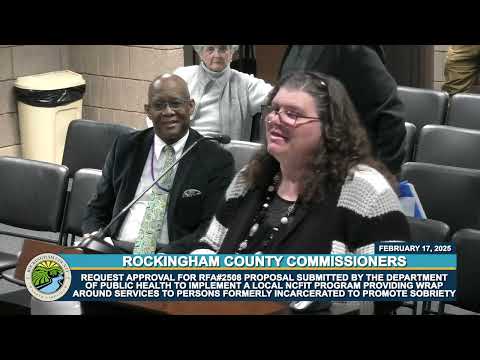
The board approved the proposal after a presentation by Lisa Ellington, who said the health department partnered with the North Carolina Formerly Incarcerated Transition Program (FIT) to implement a reentry model developed by the Transitions Clinic Network. Ellington told commissioners the role — listed in the packet as “community health worker” but recommended to be classified as a certified peer support specialist — would provide individualized and group support, coaching, education and case management for formerly incarcerated people with chronic disease, substance use disorder or mental illness.
Ellington said the position’s annual cost is $166,625 and the request covers up to three years; the packet lists a total allocation request of $499,000. Indicators of success would include numbers of formerly incarcerated clients engaged and referrals to treatment and services; Ellington also said the program intends to reduce recidivism among participants.
Commissioner Barrow framed the program as an effort to “intercept people that are dealing with opioid use disorder as they're coming out of incarceration and trying to link them up with services ... such as primary care and getting them situated with the medication for opioid use disorder.” Barrow moved the motion; Commissioner Hall seconded. The chair called for the ayes and the motion carried.
Commissioners and staff clarified funding context during the discussion: board remarks placed prior opioid-related commitments in the range of about $700,000 to $860,000, while another participant later referenced a larger, multi‑year figure of $2,000,000. Ellington and commissioners said the peer-support position would be tied to opioid settlement funds and would not be continued unless the board directed otherwise.
Ellington described operational steps for the role: pre‑release planning with appointments at the health department, medical assessment and labs, continuation of any MOUD begun while incarcerated, and linkage to wraparound services including housing, food and other referral partners such as Daymark Recovery and other county treatment providers.
The board’s approval continues a county effort to use opioid settlement money for treatment and reentry supports. Ellington said Rockingham County Public Health is positioned to provide “whole patient care” by coordinating primary care, dental care and MOUD referrals.
The board gave final approval to the award by voice vote.